Yen-Yi Lee , Balasubramanian Sriram , Sea-Fue Wang , Megha Maria Stanley , Wan-Ching Lin , Sakthivel Kogularasu , Guo-Ping Chang-Chien , Mary George
{"title":"Eco-innovative electrochemical sensing for precise detection of vanillin and sulfadiazine additives in confectioneries","authors":"Yen-Yi Lee , Balasubramanian Sriram , Sea-Fue Wang , Megha Maria Stanley , Wan-Ching Lin , Sakthivel Kogularasu , Guo-Ping Chang-Chien , Mary George","doi":"10.1016/j.apsadv.2024.100584","DOIUrl":null,"url":null,"abstract":"<div><p>The continuous emergence of food additives and contaminants in edibles, especially confectioneries, demands advanced detection methods to ensure public health and safety. Vanillin (VAL) and sulfadiazine (SD) are of paramount concern due to their extensive application in various products. While VAL is favored for its flavoring attributes, SD, a common antibiotic, can inadvertently contaminate food items. For accurate and swift detection of these compounds, we introduced an innovative electrochemical sensor using cobalt oxide nanostructures. Notably, synthesizing these nanostructures through a green approach using glucose and starch is a significant advancement, offering both environmental benefits and enhanced material properties. The novelty of the material lies in its eco-friendly synthesis route and superior electrocatalytic performance. Preliminary results indicate a promising limit of detection (LOD) VAL= 0.003 µM & SD= 0.0055 µM and a broad linear range 0.02–209 µM emphasizing its potential for real-world food quality monitoring. This work, therefore, provides a crucial intersection of sustainable material synthesis and effective food contaminant detection, heralding a new era in food safety evaluation.</p></div>","PeriodicalId":34303,"journal":{"name":"Applied Surface Science Advances","volume":"20 ","pages":"Article 100584"},"PeriodicalIF":8.7000,"publicationDate":"2024-04-01","publicationTypes":"Journal Article","fieldsOfStudy":null,"isOpenAccess":false,"openAccessPdf":"https://www.sciencedirect.com/science/article/pii/S2666523924000126/pdfft?md5=5d0f5f86e7e078dbd3be9edc519643e4&pid=1-s2.0-S2666523924000126-main.pdf","citationCount":"0","resultStr":null,"platform":"Semanticscholar","paperid":null,"PeriodicalName":"Applied Surface Science Advances","FirstCategoryId":"1085","ListUrlMain":"https://www.sciencedirect.com/science/article/pii/S2666523924000126","RegionNum":0,"RegionCategory":null,"ArticlePicture":[],"TitleCN":null,"AbstractTextCN":null,"PMCID":null,"EPubDate":"2024/2/23 0:00:00","PubModel":"Epub","JCR":"Q1","JCRName":"CHEMISTRY, PHYSICAL","Score":null,"Total":0}
引用次数: 0
Abstract
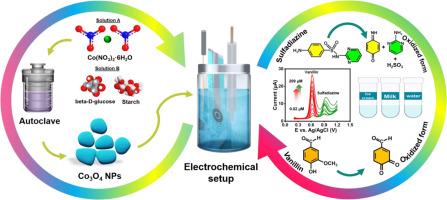
The continuous emergence of food additives and contaminants in edibles, especially confectioneries, demands advanced detection methods to ensure public health and safety. Vanillin (VAL) and sulfadiazine (SD) are of paramount concern due to their extensive application in various products. While VAL is favored for its flavoring attributes, SD, a common antibiotic, can inadvertently contaminate food items. For accurate and swift detection of these compounds, we introduced an innovative electrochemical sensor using cobalt oxide nanostructures. Notably, synthesizing these nanostructures through a green approach using glucose and starch is a significant advancement, offering both environmental benefits and enhanced material properties. The novelty of the material lies in its eco-friendly synthesis route and superior electrocatalytic performance. Preliminary results indicate a promising limit of detection (LOD) VAL= 0.003 µM & SD= 0.0055 µM and a broad linear range 0.02–209 µM emphasizing its potential for real-world food quality monitoring. This work, therefore, provides a crucial intersection of sustainable material synthesis and effective food contaminant detection, heralding a new era in food safety evaluation.



 京公网安备 11010802042870号
京ICP备2023020795号-1
京公网安备 11010802042870号
京ICP备2023020795号-1

 分享
分享
 求助内容:
求助内容: 应助结果提醒方式:
 扫码关注我们
