Kai S. Thomas, Catherine R. G. Jones, Marc O. Williams, Ross E. Vanderwert
{"title":"Associations between disordered eating, internalizing symptoms, and behavioral and neural correlates of response inhibition in preadolescence","authors":"Kai S. Thomas, Catherine R. G. Jones, Marc O. Williams, Ross E. Vanderwert","doi":"10.1002/dev.22477","DOIUrl":null,"url":null,"abstract":"<p>Response inhibition difficulties are reported in individuals with eating disorders (EDs), anxiety, and depression. Although ED symptoms and internalizing symptoms co-occur in preadolescence, there is limited research examining associations between these symptoms and response inhibition in this age group. This study is the first to investigate the associations between behavioral and neural markers of response inhibition, disordered eating (DE), and internalizing symptoms in a community sample of preadolescents. Forty-eight children (<i>M</i> age = 10.95 years, 56.3% male) completed a Go/NoGo task, whereas electroencephalography was recorded. Self-report measures of DE and internalizing symptoms were collected. Higher levels of anxiety and depression were associated with neural markers of suboptimal response inhibition (attenuated P3<sub>NoGo</sub> amplitudes) in preadolescence. In contrast, higher levels of depression were associated with greater response inhibition at a behavioral level. These findings suggest internalizing symptoms in preadolescence are associated with P3-indexed difficulties in evaluation and monitoring, but these are not sufficient to disrupt behavioral performance on a response inhibition task. This pattern may reflect engagement of compensatory processes to support task performance. DE was not significantly associated with response inhibition, suggesting that difficulties in response inhibition may only be reliably observed in more chronic and severe DE and ED presentations.</p>","PeriodicalId":11086,"journal":{"name":"Developmental psychobiology","volume":"66 3","pages":""},"PeriodicalIF":2.2000,"publicationDate":"2024-03-03","publicationTypes":"Journal Article","fieldsOfStudy":null,"isOpenAccess":false,"openAccessPdf":"https://onlinelibrary.wiley.com/doi/epdf/10.1002/dev.22477","citationCount":"0","resultStr":null,"platform":"Semanticscholar","paperid":null,"PeriodicalName":"Developmental psychobiology","FirstCategoryId":"102","ListUrlMain":"https://onlinelibrary.wiley.com/doi/10.1002/dev.22477","RegionNum":4,"RegionCategory":"心理学","ArticlePicture":[],"TitleCN":null,"AbstractTextCN":null,"PMCID":null,"EPubDate":"","PubModel":"","JCR":"Q3","JCRName":"DEVELOPMENTAL BIOLOGY","Score":null,"Total":0}
引用次数: 0
Abstract
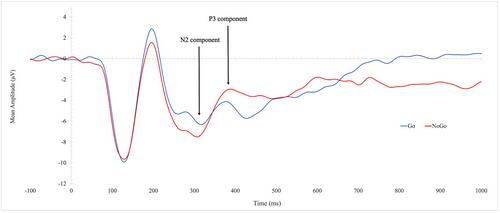
Response inhibition difficulties are reported in individuals with eating disorders (EDs), anxiety, and depression. Although ED symptoms and internalizing symptoms co-occur in preadolescence, there is limited research examining associations between these symptoms and response inhibition in this age group. This study is the first to investigate the associations between behavioral and neural markers of response inhibition, disordered eating (DE), and internalizing symptoms in a community sample of preadolescents. Forty-eight children (M age = 10.95 years, 56.3% male) completed a Go/NoGo task, whereas electroencephalography was recorded. Self-report measures of DE and internalizing symptoms were collected. Higher levels of anxiety and depression were associated with neural markers of suboptimal response inhibition (attenuated P3NoGo amplitudes) in preadolescence. In contrast, higher levels of depression were associated with greater response inhibition at a behavioral level. These findings suggest internalizing symptoms in preadolescence are associated with P3-indexed difficulties in evaluation and monitoring, but these are not sufficient to disrupt behavioral performance on a response inhibition task. This pattern may reflect engagement of compensatory processes to support task performance. DE was not significantly associated with response inhibition, suggesting that difficulties in response inhibition may only be reliably observed in more chronic and severe DE and ED presentations.
期刊介绍:
Developmental Psychobiology is a peer-reviewed journal that publishes original research papers from the disciplines of psychology, biology, neuroscience, and medicine that contribute to an understanding of behavior development. Research that focuses on development in the embryo/fetus, neonate, juvenile, or adult animal and multidisciplinary research that relates behavioral development to anatomy, physiology, biochemistry, genetics, or evolution is appropriate. The journal represents a broad phylogenetic perspective on behavior development by publishing studies of invertebrates, fish, birds, humans, and other animals. The journal publishes experimental and descriptive studies whether carried out in the laboratory or field.
The journal also publishes review articles and theoretical papers that make important conceptual contributions. Special dedicated issues of Developmental Psychobiology , consisting of invited papers on a topic of general interest, may be arranged with the Editor-in-Chief.
Developmental Psychobiology also publishes Letters to the Editor, which discuss issues of general interest or material published in the journal. Letters discussing published material may correct errors, provide clarification, or offer a different point of view. Authors should consult the editors on the preparation of these contributions.



 京公网安备 11010802042870号
京ICP备2023020795号-1
京公网安备 11010802042870号
京ICP备2023020795号-1

 分享
分享
 求助内容:
求助内容: 应助结果提醒方式:
 扫码关注我们
