Silvan Lange, Nils Krüger, Maximilian Warm, Johanna Buechel, Orsolya Genzel-Boroviczény, Martin R. Fischer, Konstantinos Dimitriadis
{"title":"Lost in translation: Unveiling medical students' untold errors of medical history documentation","authors":"Silvan Lange, Nils Krüger, Maximilian Warm, Johanna Buechel, Orsolya Genzel-Boroviczény, Martin R. Fischer, Konstantinos Dimitriadis","doi":"10.1111/tct.13749","DOIUrl":null,"url":null,"abstract":"<div>\n \n \n <section>\n \n <h3> Objective</h3>\n \n <p>The accurate documentation of a medical history interview is an important goal in medical education. As students' documentation of medical history interviews is mostly decentralised on the wards, a systematic assessment of documentation quality is missing. We therefore evaluated the extent of details missed in students' medical history reports in a standardised setting.</p>\n </section>\n \n <section>\n \n <h3> Methods</h3>\n \n <p>In this prospective, observational study, 123 of 380 students (32.4%) participated in an Objective Structured Clinical Examination (OSCE) regarding history taking and documentation. Based on the interviews and nine deductively selected main categories, a categorical system was established using a summarising qualitative content analysis. The items in the transcripts (defined as ground truth) and in students' reports were labelled and assigned to the correct subcategory. The ground truth and students' reports were compared to quantify students' documentation completeness.</p>\n </section>\n \n <section>\n \n <h3> Results</h3>\n \n <p>Next to the nine deductively selected main categories, 61 subcategories were defined. A total of 8943 items were labelled in the 123 interview transcripts (ground truth), compared with 5870 items labelled in students' reports (65.6% completeness of students' reports compared with ground truth). The main category <i>personal details</i> overlapped with 94.2% between students' report and ground truth in contrast to the main category with the highest discrepancy, <i>allergy</i>, with 41.1% overlap. Pertinent negative items and non-numerical quantifications were often missed.</p>\n </section>\n \n <section>\n \n <h3> Conclusions</h3>\n \n <p>Medical students show incomplete documentation of medical history interviews. Therefore, accurate documentation should be taught as an important goal in medical education.</p>\n </section>\n </div>","PeriodicalId":47324,"journal":{"name":"Clinical Teacher","volume":"21 4","pages":""},"PeriodicalIF":1.2000,"publicationDate":"2024-03-03","publicationTypes":"Journal Article","fieldsOfStudy":null,"isOpenAccess":false,"openAccessPdf":"https://onlinelibrary.wiley.com/doi/epdf/10.1111/tct.13749","citationCount":"0","resultStr":null,"platform":"Semanticscholar","paperid":null,"PeriodicalName":"Clinical Teacher","FirstCategoryId":"1085","ListUrlMain":"https://asmepublications.onlinelibrary.wiley.com/doi/10.1111/tct.13749","RegionNum":0,"RegionCategory":null,"ArticlePicture":[],"TitleCN":null,"AbstractTextCN":null,"PMCID":null,"EPubDate":"","PubModel":"","JCR":"Q4","JCRName":"MEDICINE, RESEARCH & EXPERIMENTAL","Score":null,"Total":0}
引用次数: 0
Abstract
Objective
The accurate documentation of a medical history interview is an important goal in medical education. As students' documentation of medical history interviews is mostly decentralised on the wards, a systematic assessment of documentation quality is missing. We therefore evaluated the extent of details missed in students' medical history reports in a standardised setting.
Methods
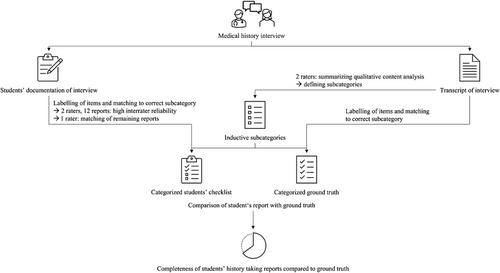
In this prospective, observational study, 123 of 380 students (32.4%) participated in an Objective Structured Clinical Examination (OSCE) regarding history taking and documentation. Based on the interviews and nine deductively selected main categories, a categorical system was established using a summarising qualitative content analysis. The items in the transcripts (defined as ground truth) and in students' reports were labelled and assigned to the correct subcategory. The ground truth and students' reports were compared to quantify students' documentation completeness.
Results
Next to the nine deductively selected main categories, 61 subcategories were defined. A total of 8943 items were labelled in the 123 interview transcripts (ground truth), compared with 5870 items labelled in students' reports (65.6% completeness of students' reports compared with ground truth). The main category personal details overlapped with 94.2% between students' report and ground truth in contrast to the main category with the highest discrepancy, allergy, with 41.1% overlap. Pertinent negative items and non-numerical quantifications were often missed.
Conclusions
Medical students show incomplete documentation of medical history interviews. Therefore, accurate documentation should be taught as an important goal in medical education.
期刊介绍:
The Clinical Teacher has been designed with the active, practising clinician in mind. It aims to provide a digest of current research, practice and thinking in medical education presented in a readable, stimulating and practical style. The journal includes sections for reviews of the literature relating to clinical teaching bringing authoritative views on the latest thinking about modern teaching. There are also sections on specific teaching approaches, a digest of the latest research published in Medical Education and other teaching journals, reports of initiatives and advances in thinking and practical teaching from around the world, and expert community and discussion on challenging and controversial issues in today"s clinical education.





 京公网安备 11010802042870号
京ICP备2023020795号-1
京公网安备 11010802042870号
京ICP备2023020795号-1

 分享
分享
 求助内容:
求助内容: 应助结果提醒方式:
 扫码关注我们
