Shengqin Zang , Xiaorui Yang , Jiangfeng Ye , Xianhong Mo , Guangbin Zhou , Yi Fang
{"title":"Quantitative phosphoproteomics explain cryopreservation-induced reductions in ram sperm motility","authors":"Shengqin Zang , Xiaorui Yang , Jiangfeng Ye , Xianhong Mo , Guangbin Zhou , Yi Fang","doi":"10.1016/j.jprot.2024.105153","DOIUrl":null,"url":null,"abstract":"<div><p>Sperm cryopreservation decreases motility, probably due to changes in protein phosphorylation. Our objective was to use quantitative phosphoproteomics for systematic comparative analyses of fresh versus frozen-thawed sperm to identify factors causing cryo-injury. Ejaculates were collected (artificial vagina) from six Dorper rams, pooled, extended, and frozen over liquid nitrogen. Overall, 915, 3382, and 6875 phosphorylated proteins, phosphorylated peptides, and phosphorylation sites, respectively, were identified. At least two modified sites were present in 57.94% of the 6875 phosphosites identified, of which AKAP4 protein contained up to 331 modified sites. There were 732 phosphorylated peptides significantly up-regulated and 909 significantly down-regulated in frozen-thawed versus fresh sperm. Moreover, the conserved motif [RxxS] was significantly down-regulated in frozen-thawed sperm. Phosphorylation of sperm-specific proteins, e.g., AKAP3/4, CABYR, FSIP2, GSK3A/B, GPI, and ODF1/2 make them potential biomarkers to assess the quality of frozen-thawed ram sperm. Furthermore, these differentially phosphorylated proteins and modification sites were implicated in cryopreservation-induced changes in sperm energy production, fiber sheath composition, and various biological processes. We concluded that abnormal protein phosphorylation modifications are key regulators of reduced sperm motility. These novel findings implicated specific protein phosphorylation modifications in sperm cryo-injury.</p></div><div><h3>Significance</h3><p>This study used phosphorylated TMT quantitative proteomics to explore regulation of epigenetic modifications in frozen-thawed ram sperm. This experiment demonstrated that ram sperm freezing affects phosphorylation site modifications of proteins, especially those related to functions such as sperm motility and energy production. Furthermore, it is important to link functions of phosphorylated proteins with changes in sperm quality after freezing and thawing, and to clarify intrinsic reasons for sperm quality changes, which is of great importance for elucidating mechanisms of sperm freezing damage. Based on these protein markers and combined with cryoprotectant design theory, it provides a theoretical basis and data reference to study sperm cryoprotectants.</p></div>","PeriodicalId":16891,"journal":{"name":"Journal of proteomics","volume":"298 ","pages":"Article 105153"},"PeriodicalIF":2.8000,"publicationDate":"2024-04-30","publicationTypes":"Journal Article","fieldsOfStudy":null,"isOpenAccess":false,"openAccessPdf":"","citationCount":"0","resultStr":null,"platform":"Semanticscholar","paperid":null,"PeriodicalName":"Journal of proteomics","FirstCategoryId":"99","ListUrlMain":"https://www.sciencedirect.com/science/article/pii/S187439192400085X","RegionNum":2,"RegionCategory":"生物学","ArticlePicture":[],"TitleCN":null,"AbstractTextCN":null,"PMCID":null,"EPubDate":"2024/3/2 0:00:00","PubModel":"Epub","JCR":"Q2","JCRName":"BIOCHEMICAL RESEARCH METHODS","Score":null,"Total":0}
引用次数: 0
Abstract
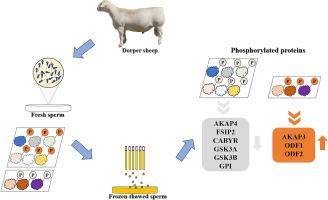
Sperm cryopreservation decreases motility, probably due to changes in protein phosphorylation. Our objective was to use quantitative phosphoproteomics for systematic comparative analyses of fresh versus frozen-thawed sperm to identify factors causing cryo-injury. Ejaculates were collected (artificial vagina) from six Dorper rams, pooled, extended, and frozen over liquid nitrogen. Overall, 915, 3382, and 6875 phosphorylated proteins, phosphorylated peptides, and phosphorylation sites, respectively, were identified. At least two modified sites were present in 57.94% of the 6875 phosphosites identified, of which AKAP4 protein contained up to 331 modified sites. There were 732 phosphorylated peptides significantly up-regulated and 909 significantly down-regulated in frozen-thawed versus fresh sperm. Moreover, the conserved motif [RxxS] was significantly down-regulated in frozen-thawed sperm. Phosphorylation of sperm-specific proteins, e.g., AKAP3/4, CABYR, FSIP2, GSK3A/B, GPI, and ODF1/2 make them potential biomarkers to assess the quality of frozen-thawed ram sperm. Furthermore, these differentially phosphorylated proteins and modification sites were implicated in cryopreservation-induced changes in sperm energy production, fiber sheath composition, and various biological processes. We concluded that abnormal protein phosphorylation modifications are key regulators of reduced sperm motility. These novel findings implicated specific protein phosphorylation modifications in sperm cryo-injury.
Significance
This study used phosphorylated TMT quantitative proteomics to explore regulation of epigenetic modifications in frozen-thawed ram sperm. This experiment demonstrated that ram sperm freezing affects phosphorylation site modifications of proteins, especially those related to functions such as sperm motility and energy production. Furthermore, it is important to link functions of phosphorylated proteins with changes in sperm quality after freezing and thawing, and to clarify intrinsic reasons for sperm quality changes, which is of great importance for elucidating mechanisms of sperm freezing damage. Based on these protein markers and combined with cryoprotectant design theory, it provides a theoretical basis and data reference to study sperm cryoprotectants.
期刊介绍:
Journal of Proteomics is aimed at protein scientists and analytical chemists in the field of proteomics, biomarker discovery, protein analytics, plant proteomics, microbial and animal proteomics, human studies, tissue imaging by mass spectrometry, non-conventional and non-model organism proteomics, and protein bioinformatics. The journal welcomes papers in new and upcoming areas such as metabolomics, genomics, systems biology, toxicogenomics, pharmacoproteomics.
Journal of Proteomics unifies both fundamental scientists and clinicians, and includes translational research. Suggestions for reviews, webinars and thematic issues are welcome.



 京公网安备 11010802042870号
京ICP备2023020795号-1
京公网安备 11010802042870号
京ICP备2023020795号-1

 分享
分享
 求助内容:
求助内容: 应助结果提醒方式:
 扫码关注我们
