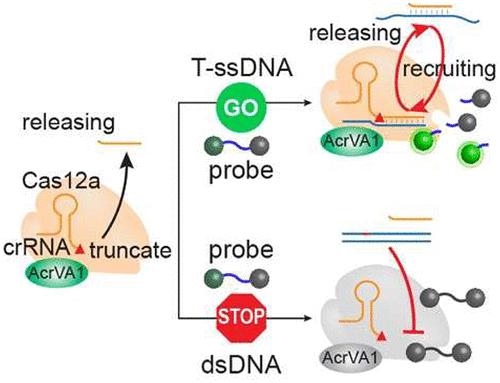
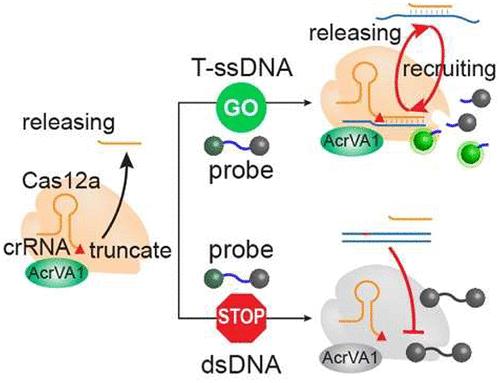
{"title":"Novel Anti-CRISPR-Assisted CRISPR Biosensor for Exclusive Detection of Single-Stranded DNA (ssDNA)","authors":"Qiaoqiao Ci, Yawen He and Juhong Chen*, ","doi":"10.1021/acssensors.4c00201","DOIUrl":null,"url":null,"abstract":"<p >Nucleic acid analysis plays an important role in disease diagnosis and treatment. The discovery of CRISPR technology has provided novel and versatile approaches to the detection of nucleic acids. However, the most widely used CRISPR-Cas12a detection platforms lack the capability to distinguish single-stranded DNA (ssDNA) from double-stranded DNA (dsDNA). To overcome this limitation, we first employed an anti-CRISPR protein (AcrVA1) to develop a novel CRISPR biosensor to detect ssDNA exclusively. In this sensing strategy, AcrVA1 cut CRISPR guide RNA (crRNA) to inhibit the cleavage activity of the CRISPR-Cas12a system. Only ssDNA has the ability to recruit the cleaved crRNA fragment to recover the detection ability of the CRISPR-Cas12 biosensor, but dsDNA cannot accomplish this. By measuring the recovered cleavage activity of the CRISPR-Cas12a biosensor, our developed AcrVA1-assisted CRISPR biosensor is capable of distinguishing ssDNA from dsDNA, providing a simple and reliable method for the detection of ssDNA. Furthermore, we demonstrated our developed AcrVA1-assisted CRISPR biosensor to monitor the enzymatic activity of helicase and screen its inhibitors.</p>","PeriodicalId":24,"journal":{"name":"ACS Sensors","volume":"9 3","pages":"1162–1167"},"PeriodicalIF":9.1000,"publicationDate":"2024-03-05","publicationTypes":"Journal Article","fieldsOfStudy":null,"isOpenAccess":false,"openAccessPdf":"https://pubs.acs.org/doi/epdf/10.1021/acssensors.4c00201","citationCount":"0","resultStr":null,"platform":"Semanticscholar","paperid":null,"PeriodicalName":"ACS Sensors","FirstCategoryId":"92","ListUrlMain":"https://pubs.acs.org/doi/10.1021/acssensors.4c00201","RegionNum":1,"RegionCategory":"化学","ArticlePicture":[],"TitleCN":null,"AbstractTextCN":null,"PMCID":null,"EPubDate":"","PubModel":"","JCR":"Q1","JCRName":"CHEMISTRY, ANALYTICAL","Score":null,"Total":0}
引用次数: 0
Abstract
Nucleic acid analysis plays an important role in disease diagnosis and treatment. The discovery of CRISPR technology has provided novel and versatile approaches to the detection of nucleic acids. However, the most widely used CRISPR-Cas12a detection platforms lack the capability to distinguish single-stranded DNA (ssDNA) from double-stranded DNA (dsDNA). To overcome this limitation, we first employed an anti-CRISPR protein (AcrVA1) to develop a novel CRISPR biosensor to detect ssDNA exclusively. In this sensing strategy, AcrVA1 cut CRISPR guide RNA (crRNA) to inhibit the cleavage activity of the CRISPR-Cas12a system. Only ssDNA has the ability to recruit the cleaved crRNA fragment to recover the detection ability of the CRISPR-Cas12 biosensor, but dsDNA cannot accomplish this. By measuring the recovered cleavage activity of the CRISPR-Cas12a biosensor, our developed AcrVA1-assisted CRISPR biosensor is capable of distinguishing ssDNA from dsDNA, providing a simple and reliable method for the detection of ssDNA. Furthermore, we demonstrated our developed AcrVA1-assisted CRISPR biosensor to monitor the enzymatic activity of helicase and screen its inhibitors.
期刊介绍:
ACS Sensors is a peer-reviewed research journal that focuses on the dissemination of new and original knowledge in the field of sensor science, particularly those that selectively sense chemical or biological species or processes. The journal covers a broad range of topics, including but not limited to biosensors, chemical sensors, gas sensors, intracellular sensors, single molecule sensors, cell chips, and microfluidic devices. It aims to publish articles that address conceptual advances in sensing technology applicable to various types of analytes or application papers that report on the use of existing sensing concepts in new ways or for new analytes.



 京公网安备 11010802042870号
京ICP备2023020795号-1
京公网安备 11010802042870号
京ICP备2023020795号-1

 分享
分享
 求助内容:
求助内容: 应助结果提醒方式:
 扫码关注我们
