Linker gadolinium as charge channel and singlet oxygen activation site in graphitic carbon nitride for enhancing photocatalytic decomposition of tetracycline
Jianmin Luo , Wenqin Li , Xinglei Wang , Eric Lichtfouse , Donglan Huang , Xiaoyuan Chen , Yi Zhang , Lejie Zhu , Chuanyi Wang
{"title":"Linker gadolinium as charge channel and singlet oxygen activation site in graphitic carbon nitride for enhancing photocatalytic decomposition of tetracycline","authors":"Jianmin Luo , Wenqin Li , Xinglei Wang , Eric Lichtfouse , Donglan Huang , Xiaoyuan Chen , Yi Zhang , Lejie Zhu , Chuanyi Wang","doi":"10.1016/j.jre.2024.02.008","DOIUrl":null,"url":null,"abstract":"<div><p>Reactive oxygen species are essential in photocatalytic water treatment. In this paper, Gd doped carbon nitride (CN) photocatalysts were prepared by simple thermal polymerization for the photocatalytic degradation of tetracycline under visible light irradiation. The photodegradation rate of 1.0GdCN is as high as 95% in 18 min, and the photocatalytic performance is much higher than that of CN. The improvement of photocatalytic performance is mainly attributed to the fact that Gd ion implantation directly provides active sites for oxygen activation and induces the formation of N vacancies. The results of characterizations show that the introduction of Gd in CN can improve the conversion ability of activated oxygen, carrier separation and energy band structure adjustment. Therefore, 1.0GdCN photocatalyst can be employed for efficient photocatalytic synthesis of tetracycline. Furthermore, three ways of photocatalytic degradation of tetracycline were revealed by high performance liquid chromatography-mass spectrometry. This work provides insights into the doping strategy of CN to improve the production of reactive oxygen species for environmental remediation.</p></div>","PeriodicalId":16940,"journal":{"name":"Journal of Rare Earths","volume":"42 5","pages":"Pages 827-837"},"PeriodicalIF":7.2000,"publicationDate":"2024-02-29","publicationTypes":"Journal Article","fieldsOfStudy":null,"isOpenAccess":false,"openAccessPdf":"","citationCount":"0","resultStr":null,"platform":"Semanticscholar","paperid":null,"PeriodicalName":"Journal of Rare Earths","FirstCategoryId":"92","ListUrlMain":"https://www.sciencedirect.com/science/article/pii/S1002072124000449","RegionNum":1,"RegionCategory":"化学","ArticlePicture":[],"TitleCN":null,"AbstractTextCN":null,"PMCID":null,"EPubDate":"","PubModel":"","JCR":"Q1","JCRName":"CHEMISTRY, APPLIED","Score":null,"Total":0}
引用次数: 0
Abstract
Reactive oxygen species are essential in photocatalytic water treatment. In this paper, Gd doped carbon nitride (CN) photocatalysts were prepared by simple thermal polymerization for the photocatalytic degradation of tetracycline under visible light irradiation. The photodegradation rate of 1.0GdCN is as high as 95% in 18 min, and the photocatalytic performance is much higher than that of CN. The improvement of photocatalytic performance is mainly attributed to the fact that Gd ion implantation directly provides active sites for oxygen activation and induces the formation of N vacancies. The results of characterizations show that the introduction of Gd in CN can improve the conversion ability of activated oxygen, carrier separation and energy band structure adjustment. Therefore, 1.0GdCN photocatalyst can be employed for efficient photocatalytic synthesis of tetracycline. Furthermore, three ways of photocatalytic degradation of tetracycline were revealed by high performance liquid chromatography-mass spectrometry. This work provides insights into the doping strategy of CN to improve the production of reactive oxygen species for environmental remediation.
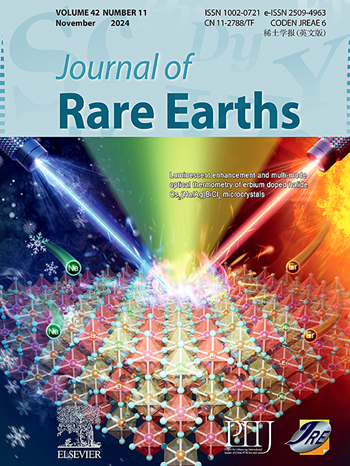
期刊介绍:
The Journal of Rare Earths reports studies on the 17 rare earth elements. It is a unique English-language learned journal that publishes works on various aspects of basic theory and applied science in the field of rare earths (RE). The journal accepts original high-quality original research papers and review articles with inventive content, and complete experimental data. It represents high academic standards and new progress in the RE field. Due to the advantage of abundant RE resources of China, the research on RE develops very actively, and papers on the latest progress in this field emerge every year. It is not only an important resource in which technicians publish and obtain their latest research results on RE, but also an important way of reflecting the updated progress in RE research field.
The Journal of Rare Earths covers all research and application of RE rare earths including spectroscopy, luminescence and phosphors, rare earth catalysis, magnetism and magnetic materials, advanced rare earth materials, RE chemistry & hydrometallurgy, RE metallography & pyrometallurgy, RE new materials, RE solid state physics & solid state chemistry, rare earth applications, RE analysis & test, RE geology & ore dressing, etc.




 京公网安备 11010802042870号
京ICP备2023020795号-1
京公网安备 11010802042870号
京ICP备2023020795号-1

 分享
分享
 求助内容:
求助内容: 应助结果提醒方式:
 扫码关注我们
