{"title":"Plant phylogenetic diversity influences arthropod communities in tropical forest restoration plots","authors":"Faride Ugalde, Rocío Santos-Gally, Rubén Pérez-Ishiwara, Nancy Gálvez-Reyes, Ana Wegier, Karina Boege","doi":"10.1111/btp.13313","DOIUrl":null,"url":null,"abstract":"<p>Consideration of plant phylogenetic diversity in ecological restoration carries substantial potential, as communities with a greater diversity of lineages with older evolutionary histories can increase the diversity of niches and thus are likely to recover larger species networks than communities clustered in specific clades with reduced variation in functional traits. In this study, we experimentally assessed how arthropod communities were affected by the phylogenetic diversity of a set of tropical tree species. We established 12 experimental restoration plots with either high or low plant phylogenetic diversity while maintaining constant the number of plant species. After 1 and 3 years, arthropods with different feeding habits (herbivores, predators, pollinators, and detritivores) were collected and identified as morphospecies or operational taxonomic units using metabarcoding techniques. We provide insights on the influence of plant phylogenetic diversity on arthropod abundance and species diversity, particularly among predator, pollinator, and detritivore common and dominant species, which increased with plant phylogenetic diversity. The trend, however, was the opposite for the diversity of herbivore common and dominant species, which decreased as plant phylogenetic diversity increased. These findings highlight the importance of considering plant species richness when designing restoration strategies, but also their evolutionary histories, as the same number of plant species can produce different outcomes for higher trophic levels, as a function of their phylogenetic relationships.</p><p>Abstract in Spanish is available with online material.</p>","PeriodicalId":8982,"journal":{"name":"Biotropica","volume":"56 3","pages":""},"PeriodicalIF":1.7000,"publicationDate":"2024-03-06","publicationTypes":"Journal Article","fieldsOfStudy":null,"isOpenAccess":false,"openAccessPdf":"https://onlinelibrary.wiley.com/doi/epdf/10.1111/btp.13313","citationCount":"0","resultStr":null,"platform":"Semanticscholar","paperid":null,"PeriodicalName":"Biotropica","FirstCategoryId":"93","ListUrlMain":"https://onlinelibrary.wiley.com/doi/10.1111/btp.13313","RegionNum":3,"RegionCategory":"环境科学与生态学","ArticlePicture":[],"TitleCN":null,"AbstractTextCN":null,"PMCID":null,"EPubDate":"","PubModel":"","JCR":"Q3","JCRName":"ECOLOGY","Score":null,"Total":0}
引用次数: 0
Abstract
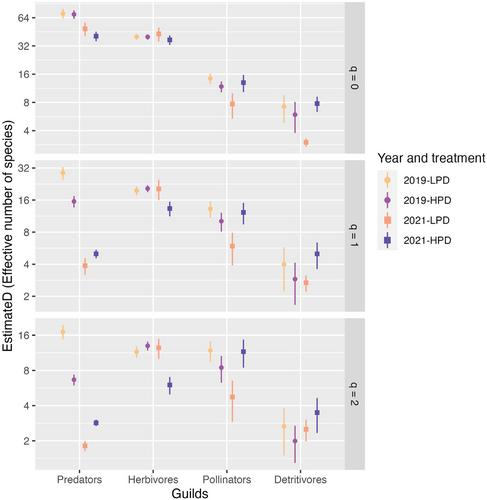
Consideration of plant phylogenetic diversity in ecological restoration carries substantial potential, as communities with a greater diversity of lineages with older evolutionary histories can increase the diversity of niches and thus are likely to recover larger species networks than communities clustered in specific clades with reduced variation in functional traits. In this study, we experimentally assessed how arthropod communities were affected by the phylogenetic diversity of a set of tropical tree species. We established 12 experimental restoration plots with either high or low plant phylogenetic diversity while maintaining constant the number of plant species. After 1 and 3 years, arthropods with different feeding habits (herbivores, predators, pollinators, and detritivores) were collected and identified as morphospecies or operational taxonomic units using metabarcoding techniques. We provide insights on the influence of plant phylogenetic diversity on arthropod abundance and species diversity, particularly among predator, pollinator, and detritivore common and dominant species, which increased with plant phylogenetic diversity. The trend, however, was the opposite for the diversity of herbivore common and dominant species, which decreased as plant phylogenetic diversity increased. These findings highlight the importance of considering plant species richness when designing restoration strategies, but also their evolutionary histories, as the same number of plant species can produce different outcomes for higher trophic levels, as a function of their phylogenetic relationships.
Abstract in Spanish is available with online material.
期刊介绍:
Ranked by the ISI index, Biotropica is a highly regarded source of original research on the ecology, conservation and management of all tropical ecosystems, and on the evolution, behavior, and population biology of tropical organisms. Published on behalf of the Association of Tropical Biology and Conservation, the journal''s Special Issues and Special Sections quickly become indispensable references for researchers in the field. Biotropica publishes timely Papers, Reviews, Commentaries, and Insights. Commentaries generate thought-provoking ideas that frequently initiate fruitful debate and discussion, while Reviews provide authoritative and analytical overviews of topics of current conservation or ecological importance. The newly instituted category Insights replaces Short Communications.



 京公网安备 11010802042870号
京ICP备2023020795号-1
京公网安备 11010802042870号
京ICP备2023020795号-1

 分享
分享
 求助内容:
求助内容: 应助结果提醒方式:
 扫码关注我们
