{"title":"Giant cell angiofibroma of gingiva in tuberous sclerosis complex: a case report and literature review.","authors":"Qiaochu Sun, Jaeyoung Ryu, Young Kim","doi":"10.1186/s13000-024-01467-4","DOIUrl":null,"url":null,"abstract":"<p><strong>Background: </strong>Tuberous sclerosis complex (TSC) is a rare, complex genetic disorder characterized by hamartomas and neoplastic lesions in various organ systems. With the development of radiology and gene testing, the diagnostic criteria for TSC were updated in 2012 at the International Consensus Conference. Intraoral fibromas have long been associated with TSC. However, the incidence of giant cell angiofibroma (GCA) in TSC patients is extremely rare. Here, we report the first case of GCA in the gingival tissue of a patient with TSC.</p><p><strong>Case presentation: </strong>A 41-year-old woman first visited the Department of Oral and Maxillofacial Surgery, Chonnam National University Dental Hospital, complaining of gingival enlargement. Clinical examination revealed several manifestations associated with TSC, including intraoral fibromas, facial angiofibromas, dental enamel pits, ungual fibromas, \"confetti\" skin lesions, hypomelanotic macules, and a shagreen patch. Intraoral examination revealed a 6.0 × 5.0 cm gingival overgrowth on the left mandible. Surgical excision was performed, and subsequent histopathological examination confirmed the diagnosis of GCA. There was no evidence of recurrence within the 24- months of surgery.</p><p><strong>Conclusions: </strong>We report the first case of GCA in the gingival tissue of a patient with TSC. This report would contribute to an improved understanding of this rare disease. However, further case reports are necessary to clarify the relationship between GCA and TSC.</p>","PeriodicalId":11237,"journal":{"name":"Diagnostic Pathology","volume":"19 1","pages":"50"},"PeriodicalIF":2.3000,"publicationDate":"2024-03-08","publicationTypes":"Journal Article","fieldsOfStudy":null,"isOpenAccess":false,"openAccessPdf":"https://www.ncbi.nlm.nih.gov/pmc/articles/PMC10921606/pdf/","citationCount":"0","resultStr":null,"platform":"Semanticscholar","paperid":null,"PeriodicalName":"Diagnostic Pathology","FirstCategoryId":"3","ListUrlMain":"https://doi.org/10.1186/s13000-024-01467-4","RegionNum":3,"RegionCategory":"医学","ArticlePicture":[],"TitleCN":null,"AbstractTextCN":null,"PMCID":null,"EPubDate":"","PubModel":"","JCR":"Q2","JCRName":"PATHOLOGY","Score":null,"Total":0}
引用次数: 0
Abstract
Background: Tuberous sclerosis complex (TSC) is a rare, complex genetic disorder characterized by hamartomas and neoplastic lesions in various organ systems. With the development of radiology and gene testing, the diagnostic criteria for TSC were updated in 2012 at the International Consensus Conference. Intraoral fibromas have long been associated with TSC. However, the incidence of giant cell angiofibroma (GCA) in TSC patients is extremely rare. Here, we report the first case of GCA in the gingival tissue of a patient with TSC.
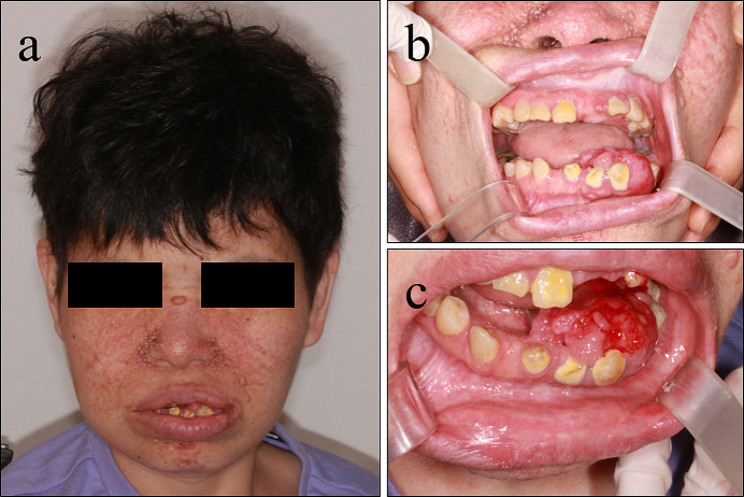
Case presentation: A 41-year-old woman first visited the Department of Oral and Maxillofacial Surgery, Chonnam National University Dental Hospital, complaining of gingival enlargement. Clinical examination revealed several manifestations associated with TSC, including intraoral fibromas, facial angiofibromas, dental enamel pits, ungual fibromas, "confetti" skin lesions, hypomelanotic macules, and a shagreen patch. Intraoral examination revealed a 6.0 × 5.0 cm gingival overgrowth on the left mandible. Surgical excision was performed, and subsequent histopathological examination confirmed the diagnosis of GCA. There was no evidence of recurrence within the 24- months of surgery.
Conclusions: We report the first case of GCA in the gingival tissue of a patient with TSC. This report would contribute to an improved understanding of this rare disease. However, further case reports are necessary to clarify the relationship between GCA and TSC.
期刊介绍:
Diagnostic Pathology is an open access, peer-reviewed, online journal that considers research in surgical and clinical pathology, immunology, and biology, with a special focus on cutting-edge approaches in diagnostic pathology and tissue-based therapy. The journal covers all aspects of surgical pathology, including classic diagnostic pathology, prognosis-related diagnosis (tumor stages, prognosis markers, such as MIB-percentage, hormone receptors, etc.), and therapy-related findings. The journal also focuses on the technological aspects of pathology, including molecular biology techniques, morphometry aspects (stereology, DNA analysis, syntactic structure analysis), communication aspects (telecommunication, virtual microscopy, virtual pathology institutions, etc.), and electronic education and quality assurance (for example interactive publication, on-line references with automated updating, etc.).





 京公网安备 11010802042870号
京ICP备2023020795号-1
京公网安备 11010802042870号
京ICP备2023020795号-1

 分享
分享
 求助内容:
求助内容: 应助结果提醒方式:
 扫码关注我们
