Michael Zitzmann, Jann-Frederik Cremers, Claudia Krallmann, Armin Soave, Sabine Kliesch
{"title":"TRACK_9: Testosterone replacement assessment: Classical vs. functional hypogonadism-knowledge from a 9-year study","authors":"Michael Zitzmann, Jann-Frederik Cremers, Claudia Krallmann, Armin Soave, Sabine Kliesch","doi":"10.1111/andr.13626","DOIUrl":null,"url":null,"abstract":"<div>\n \n \n <section>\n \n <h3> Background and objective</h3>\n \n <p>The longitudinal efficacy and clinical utility of Testosterone Therapy (TTh) in ameliorating functional hypogonadism (FH) remain contentious, with long-term data being scarce. To address this lacuna, a comprehensive long-term registry study, stratifying patients across a spectrum of hypogonadal etiologies, offers a robust investigative paradigm.</p>\n </section>\n \n <section>\n \n <h3> Materials and methods</h3>\n \n <p>This 9-year registry, encompassing 650 patients (equivalent to 4,362 cumulative years of treatment), included 188 patients diagnosed with FH (mean age 42.3 ± 11.3 years) and 462 individuals with classical hypogonadism (CH). The cohort segregated into 266 men with primary hypogonadism (PH, mean age 34.0 ± 11.7 years) and 196 with secondary hypogonadism (SH, mean age 31.9 ± 12.0 years). Uniform treatment across the cohort involved intramuscular administration of testosterone undecanoate (1,000 mg). A comparative analysis was conducted focusing on anthropometric, metabolic, and safety parameters.</p>\n </section>\n \n <section>\n \n <h3> Results</h3>\n \n <p>Serum testosterone levels increased from 6.6 ± 2.4 to 19.3 ± 2.9 nmol/L (<i>p</i> < 0.001). TTh was linked with weight reduction and decreased waist circumference (WC) in both CH and FH cohorts (both <i>p</i> < 0.001). Cox regression and Kaplan–Meier analyses delineated disparities: men with FH demonstrated a higher propensity for losing > 10% body weight and > 5% WC compared to CH (hazard ratio [HR] 1.3 [1.1–1.4], <i>p</i> = 0.008 and HR 1.4 [1.3–1.5], <i>p</i> = 0.001). Increases in hematocrit > 50% were uniform across groups, albeit amelioration of anemia was more pronounced in FH versus CH (<i>p</i> = 0.002). Increments of prostate-specific antigen (PSA) levels were more likely to occur in FH (HR 1.3 [1.1–1.6], <i>p</i> = 0.003). FH patients exhibited pronounced improvements in metabolic parameters and in aging male symptom score (AMS) and IIEF-EF questionnaire scores. These effects were markedly modulated by age and initial weight. Subgroup analysis of age-matched obese patients revealed an accentuated impact of TTh in CH compared to FH.</p>\n </section>\n \n <section>\n \n <h3> Discussion and conclusion</h3>\n \n <p>The therapeutic outcomes of TTh across distinct hypogonadal populations demonstrate heterogeneous responses, significantly influenced by diagnostic categorization, age, and baseline risk factor profiles.</p>\n </section>\n </div>","PeriodicalId":7898,"journal":{"name":"Andrology","volume":"12 8","pages":"1675-1696"},"PeriodicalIF":3.4000,"publicationDate":"2024-03-15","publicationTypes":"Journal Article","fieldsOfStudy":null,"isOpenAccess":false,"openAccessPdf":"https://onlinelibrary.wiley.com/doi/epdf/10.1111/andr.13626","citationCount":"0","resultStr":null,"platform":"Semanticscholar","paperid":null,"PeriodicalName":"Andrology","FirstCategoryId":"3","ListUrlMain":"https://onlinelibrary.wiley.com/doi/10.1111/andr.13626","RegionNum":2,"RegionCategory":"医学","ArticlePicture":[],"TitleCN":null,"AbstractTextCN":null,"PMCID":null,"EPubDate":"","PubModel":"","JCR":"Q1","JCRName":"ANDROLOGY","Score":null,"Total":0}
引用次数: 0
Abstract
Background and objective
The longitudinal efficacy and clinical utility of Testosterone Therapy (TTh) in ameliorating functional hypogonadism (FH) remain contentious, with long-term data being scarce. To address this lacuna, a comprehensive long-term registry study, stratifying patients across a spectrum of hypogonadal etiologies, offers a robust investigative paradigm.
Materials and methods
This 9-year registry, encompassing 650 patients (equivalent to 4,362 cumulative years of treatment), included 188 patients diagnosed with FH (mean age 42.3 ± 11.3 years) and 462 individuals with classical hypogonadism (CH). The cohort segregated into 266 men with primary hypogonadism (PH, mean age 34.0 ± 11.7 years) and 196 with secondary hypogonadism (SH, mean age 31.9 ± 12.0 years). Uniform treatment across the cohort involved intramuscular administration of testosterone undecanoate (1,000 mg). A comparative analysis was conducted focusing on anthropometric, metabolic, and safety parameters.
Results
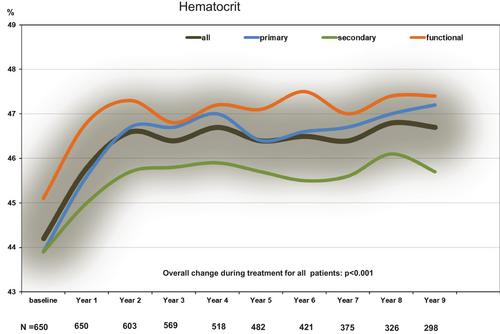
Serum testosterone levels increased from 6.6 ± 2.4 to 19.3 ± 2.9 nmol/L (p < 0.001). TTh was linked with weight reduction and decreased waist circumference (WC) in both CH and FH cohorts (both p < 0.001). Cox regression and Kaplan–Meier analyses delineated disparities: men with FH demonstrated a higher propensity for losing > 10% body weight and > 5% WC compared to CH (hazard ratio [HR] 1.3 [1.1–1.4], p = 0.008 and HR 1.4 [1.3–1.5], p = 0.001). Increases in hematocrit > 50% were uniform across groups, albeit amelioration of anemia was more pronounced in FH versus CH (p = 0.002). Increments of prostate-specific antigen (PSA) levels were more likely to occur in FH (HR 1.3 [1.1–1.6], p = 0.003). FH patients exhibited pronounced improvements in metabolic parameters and in aging male symptom score (AMS) and IIEF-EF questionnaire scores. These effects were markedly modulated by age and initial weight. Subgroup analysis of age-matched obese patients revealed an accentuated impact of TTh in CH compared to FH.
Discussion and conclusion
The therapeutic outcomes of TTh across distinct hypogonadal populations demonstrate heterogeneous responses, significantly influenced by diagnostic categorization, age, and baseline risk factor profiles.
期刊介绍:
Andrology is the study of the male reproductive system and other male gender related health issues. Andrology deals with basic and clinical aspects of the male reproductive system (gonads, endocrine and accessory organs) in all species, including the diagnosis and treatment of medical problems associated with sexual development, infertility, sexual dysfunction, sex hormone action and other urological problems. In medicine, Andrology as a specialty is a recent development, as it had previously been considered a subspecialty of urology or endocrinology





