Agnė Pociūtė, Karolina Kriaučiūnaitė, Aida Kaušylė, Birutė Zablockienė, Tadas Alčauskas, Augustė Jelinskaitė, Akvilė Rudėnaitė, Ligita Jančorienė, Saulius Ročka, Alexei Verkhratsky, Augustas Pivoriūnas
{"title":"Plasma of COVID-19 Patients Does Not Alter Electrical Resistance of Human Endothelial Blood-Brain Barrier In Vitro.","authors":"Agnė Pociūtė, Karolina Kriaučiūnaitė, Aida Kaušylė, Birutė Zablockienė, Tadas Alčauskas, Augustė Jelinskaitė, Akvilė Rudėnaitė, Ligita Jančorienė, Saulius Ročka, Alexei Verkhratsky, Augustas Pivoriūnas","doi":"10.1093/function/zqae002","DOIUrl":null,"url":null,"abstract":"<p><p>The pandemic of coronavirus disease 2019 (COVID-19) caused by severe acute respiratory syndrome coronavirus 2 instigated the most serious global health crisis. Clinical presentation of COVID-19 frequently includes severe neurological and neuropsychiatric symptoms. However, it is presently unknown whether and to which extent pathological impairment of blood-brain barrier (BBB) contributes to the development of neuropathology during COVID-19 progression. In the present study, we used human induced pluripotent stem cells-derived brain endothelial cells (iBECs) to study the effects of blood plasma derived from COVID-19 patients on the BBB integrity in vitro. We also performed a comprehensive analysis of the cytokine and chemokine profiles in the plasma of COVID-19 patients, healthy and recovered individuals. We found significantly increased levels of interferon γ-induced protein 10 kDa, hepatocyte growth factor, and interleukin-18 in the plasma of COVID-19 patients. However, blood plasma from COVID-19 patients did not affect transendothelial electrical resistance in iBEC monolayers. Our results demonstrate that COVID-19-associated blood plasma inflammatory factors do not affect BBB paracellular pathway directly and suggest that pathological remodeling (if any) of BBB during COVID-19 may occur through indirect or yet unknown mechanisms.</p>","PeriodicalId":73119,"journal":{"name":"Function (Oxford, England)","volume":"5 2","pages":"zqae002"},"PeriodicalIF":3.8000,"publicationDate":"2024-01-09","publicationTypes":"Journal Article","fieldsOfStudy":null,"isOpenAccess":false,"openAccessPdf":"https://www.ncbi.nlm.nih.gov/pmc/articles/PMC10935481/pdf/","citationCount":"0","resultStr":null,"platform":"Semanticscholar","paperid":null,"PeriodicalName":"Function (Oxford, England)","FirstCategoryId":"1085","ListUrlMain":"https://doi.org/10.1093/function/zqae002","RegionNum":0,"RegionCategory":null,"ArticlePicture":[],"TitleCN":null,"AbstractTextCN":null,"PMCID":null,"EPubDate":"2024/1/1 0:00:00","PubModel":"eCollection","JCR":"Q2","JCRName":"CELL BIOLOGY","Score":null,"Total":0}
引用次数: 0
Abstract
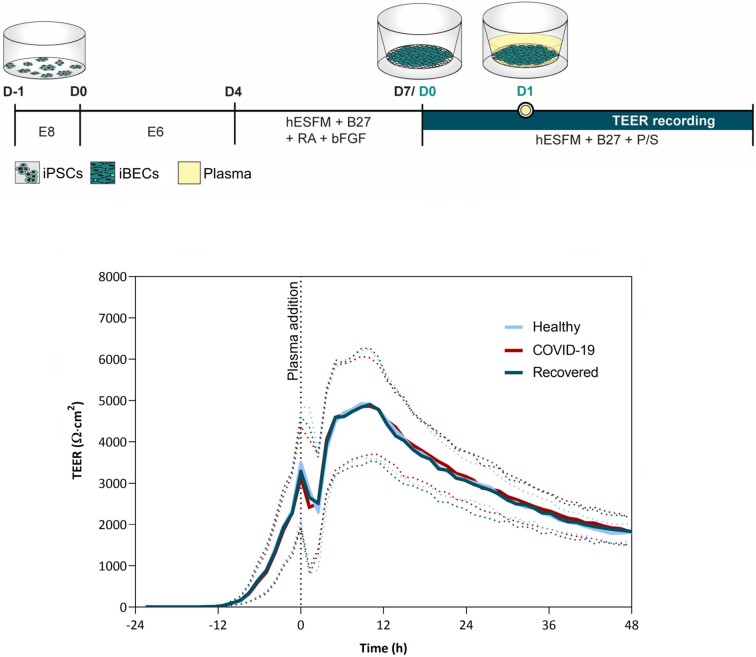
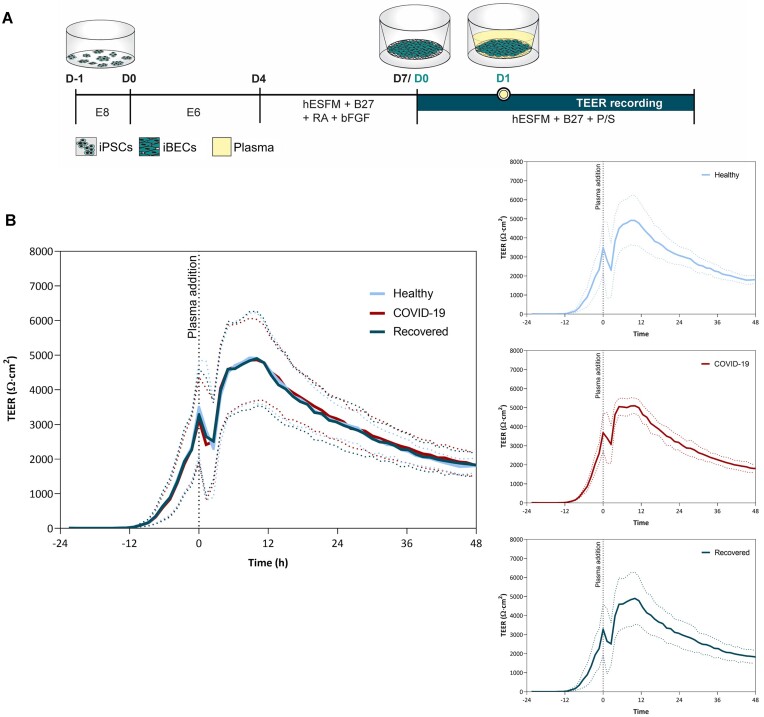
The pandemic of coronavirus disease 2019 (COVID-19) caused by severe acute respiratory syndrome coronavirus 2 instigated the most serious global health crisis. Clinical presentation of COVID-19 frequently includes severe neurological and neuropsychiatric symptoms. However, it is presently unknown whether and to which extent pathological impairment of blood-brain barrier (BBB) contributes to the development of neuropathology during COVID-19 progression. In the present study, we used human induced pluripotent stem cells-derived brain endothelial cells (iBECs) to study the effects of blood plasma derived from COVID-19 patients on the BBB integrity in vitro. We also performed a comprehensive analysis of the cytokine and chemokine profiles in the plasma of COVID-19 patients, healthy and recovered individuals. We found significantly increased levels of interferon γ-induced protein 10 kDa, hepatocyte growth factor, and interleukin-18 in the plasma of COVID-19 patients. However, blood plasma from COVID-19 patients did not affect transendothelial electrical resistance in iBEC monolayers. Our results demonstrate that COVID-19-associated blood plasma inflammatory factors do not affect BBB paracellular pathway directly and suggest that pathological remodeling (if any) of BBB during COVID-19 may occur through indirect or yet unknown mechanisms.



 京公网安备 11010802042870号
京ICP备2023020795号-1
京公网安备 11010802042870号
京ICP备2023020795号-1

 分享
分享

 求助内容:
求助内容: 应助结果提醒方式:
 扫码关注我们
