Víctor José Villanueva-Blasco, Joaquín Mateu-Mollá, Andrea Vázquez-Martínez, Antonio Rial-Boubeta, Fernando Rodríguez de Fonseca, Manuel Isorna Folgar
{"title":"The Role of Sex and Coping Styles on the Relationship Between Depression and Cannabis Use","authors":"Víctor José Villanueva-Blasco, Joaquín Mateu-Mollá, Andrea Vázquez-Martínez, Antonio Rial-Boubeta, Fernando Rodríguez de Fonseca, Manuel Isorna Folgar","doi":"10.1007/s11469-024-01275-3","DOIUrl":null,"url":null,"abstract":"<p>There is evidence for a relationship between problematic cannabis use and depression although the directionality is unclear. The role of coping strategies mediating this relationship is of interest to better understand the mechanisms involved. The aim was to analyze the relationship between cannabis use and depression and its directionality, considering the mediating role of coping styles and their dependence on sex. Correlational and cross-sectional design. There were 261 cannabis users aged 18–57 years (<i>M</i> = 31.04), 36.66% women. Sex, cannabis dependence, coping styles, and depressive symptomatology were analyzed. Women scored higher in depression and men reported higher cannabis use, with a higher prevalence for moderate addiction. Higher severity of depressive symptomatology was found in cannabis users with dependence compared to those with moderate addiction. Active coping strategies were more common in the non-addicted group, while avoidant coping strategies were more common in the dependent group. The role of coping styles was observed to differ according to sex. In men, the relationship between depression and cannabis use was bidirectional, but the predictive capacity of each variable with respect to the others disappeared when considering avoidant coping as a mediator. Passive coping style is key in the relationship between depression and cannabis use. These findings have important implications for prevention and treatment of both problems.</p>","PeriodicalId":14083,"journal":{"name":"International Journal of Mental Health and Addiction","volume":"56 1","pages":""},"PeriodicalIF":2.5000,"publicationDate":"2024-03-15","publicationTypes":"Journal Article","fieldsOfStudy":null,"isOpenAccess":false,"openAccessPdf":"","citationCount":"0","resultStr":null,"platform":"Semanticscholar","paperid":null,"PeriodicalName":"International Journal of Mental Health and Addiction","FirstCategoryId":"3","ListUrlMain":"https://doi.org/10.1007/s11469-024-01275-3","RegionNum":3,"RegionCategory":"医学","ArticlePicture":[],"TitleCN":null,"AbstractTextCN":null,"PMCID":null,"EPubDate":"","PubModel":"","JCR":"Q2","JCRName":"PSYCHIATRY","Score":null,"Total":0}
引用次数: 0
Abstract
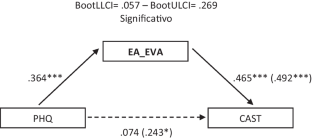
There is evidence for a relationship between problematic cannabis use and depression although the directionality is unclear. The role of coping strategies mediating this relationship is of interest to better understand the mechanisms involved. The aim was to analyze the relationship between cannabis use and depression and its directionality, considering the mediating role of coping styles and their dependence on sex. Correlational and cross-sectional design. There were 261 cannabis users aged 18–57 years (M = 31.04), 36.66% women. Sex, cannabis dependence, coping styles, and depressive symptomatology were analyzed. Women scored higher in depression and men reported higher cannabis use, with a higher prevalence for moderate addiction. Higher severity of depressive symptomatology was found in cannabis users with dependence compared to those with moderate addiction. Active coping strategies were more common in the non-addicted group, while avoidant coping strategies were more common in the dependent group. The role of coping styles was observed to differ according to sex. In men, the relationship between depression and cannabis use was bidirectional, but the predictive capacity of each variable with respect to the others disappeared when considering avoidant coping as a mediator. Passive coping style is key in the relationship between depression and cannabis use. These findings have important implications for prevention and treatment of both problems.
期刊介绍:
The International Journal of Mental Health and Addictions (IJMH) is a publication that specializes in presenting the latest research, policies, causes, literature reviews, prevention, and treatment of mental health and addiction-related topics. It focuses on mental health, substance addictions, behavioral addictions, as well as concurrent mental health and addictive disorders. By publishing peer-reviewed articles of high quality, the journal aims to spark an international discussion on issues related to mental health and addiction and to offer valuable insights into how these conditions impact individuals, families, and societies. The journal covers a wide range of fields, including psychology, sociology, anthropology, criminology, public health, psychiatry, history, and law. It publishes various types of articles, including feature articles, review articles, clinical notes, research notes, letters to the editor, and commentaries. The journal is published six times a year.



 京公网安备 11010802042870号
京ICP备2023020795号-1
京公网安备 11010802042870号
京ICP备2023020795号-1

 分享
分享
 求助内容:
求助内容: 应助结果提醒方式:
 扫码关注我们
