{"title":"PonziFinder: Attention-Based Edge-Enhanced Ponzi Contract Detection","authors":"Yingying Chen;Bixin Li;Yan Xiao;Xiaoning Du","doi":"10.1109/TR.2024.3370734","DOIUrl":null,"url":null,"abstract":"<italic>Ponzi contracts</i> are fraudulent investment scams that promise high returns with little risk to investors. However, existing methods for detecting Ponzi contracts have several limitations. For example, they struggle to deal with the class imbalance problem, and their analysis of function call transactions is inadequate, resulting in redundant features. To tackle the challenges of detecting Ponzi contracts, we present PonziFinder, a novel approach that leverages convolutional-based edge-enhanced graph neural network and attention mechanism for the classification of contract transaction graphs. In contrast to previous methods, we not only consider transaction value and timestamp but also analyze transaction input to standardize and sort transactions. We extract node and edge features that capture the unique characteristics of Ponzi contracts. The edge feature, reflecting interaccount correlation, enhances the propagation and updating of node features for effective Ponzi contract detection. To prevent oversmoothing of node embedding caused by the shallow transaction graph and extract important account node information, we introduce an attention-based global layerwise aggregation mechanism (ALGA) for generating the final contract graph representation for classification. Moreover, we optimize the node feature set and use an effective strategy based on undersampling and ensemble learning to address the issue of class imbalance. Experimental results show that PonziFinder can detect all types of Ponzi contracts (100%) with 97% accuracy when there is sufficient transaction data, outperforming other models. The analysis of input values and the ALGA mechanism are experimentally shown to improve accuracy by 4% and 2%, respectively. In summary, PonziFinder is a novel and effective method for detecting Ponzi contracts. Our approach addresses the limitations of existing methods and demonstrates significant improvements in accuracy and efficiency.","PeriodicalId":56305,"journal":{"name":"IEEE Transactions on Reliability","volume":"74 1","pages":"2305-2319"},"PeriodicalIF":5.7000,"publicationDate":"2024-03-18","publicationTypes":"Journal Article","fieldsOfStudy":null,"isOpenAccess":false,"openAccessPdf":"","citationCount":"0","resultStr":null,"platform":"Semanticscholar","paperid":null,"PeriodicalName":"IEEE Transactions on Reliability","FirstCategoryId":"94","ListUrlMain":"https://ieeexplore.ieee.org/document/10472303/","RegionNum":2,"RegionCategory":"计算机科学","ArticlePicture":[],"TitleCN":null,"AbstractTextCN":null,"PMCID":null,"EPubDate":"","PubModel":"","JCR":"Q1","JCRName":"COMPUTER SCIENCE, HARDWARE & ARCHITECTURE","Score":null,"Total":0}
引用次数: 0
Abstract
Ponzi contracts are fraudulent investment scams that promise high returns with little risk to investors. However, existing methods for detecting Ponzi contracts have several limitations. For example, they struggle to deal with the class imbalance problem, and their analysis of function call transactions is inadequate, resulting in redundant features. To tackle the challenges of detecting Ponzi contracts, we present PonziFinder, a novel approach that leverages convolutional-based edge-enhanced graph neural network and attention mechanism for the classification of contract transaction graphs. In contrast to previous methods, we not only consider transaction value and timestamp but also analyze transaction input to standardize and sort transactions. We extract node and edge features that capture the unique characteristics of Ponzi contracts. The edge feature, reflecting interaccount correlation, enhances the propagation and updating of node features for effective Ponzi contract detection. To prevent oversmoothing of node embedding caused by the shallow transaction graph and extract important account node information, we introduce an attention-based global layerwise aggregation mechanism (ALGA) for generating the final contract graph representation for classification. Moreover, we optimize the node feature set and use an effective strategy based on undersampling and ensemble learning to address the issue of class imbalance. Experimental results show that PonziFinder can detect all types of Ponzi contracts (100%) with 97% accuracy when there is sufficient transaction data, outperforming other models. The analysis of input values and the ALGA mechanism are experimentally shown to improve accuracy by 4% and 2%, respectively. In summary, PonziFinder is a novel and effective method for detecting Ponzi contracts. Our approach addresses the limitations of existing methods and demonstrates significant improvements in accuracy and efficiency.
期刊介绍:
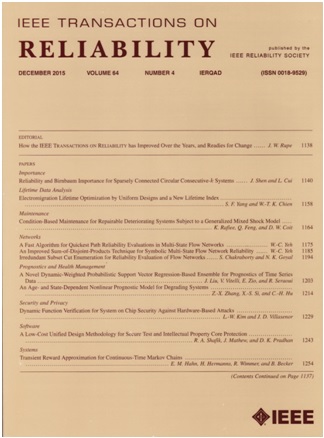
IEEE Transactions on Reliability is a refereed journal for the reliability and allied disciplines including, but not limited to, maintainability, physics of failure, life testing, prognostics, design and manufacture for reliability, reliability for systems of systems, network availability, mission success, warranty, safety, and various measures of effectiveness. Topics eligible for publication range from hardware to software, from materials to systems, from consumer and industrial devices to manufacturing plants, from individual items to networks, from techniques for making things better to ways of predicting and measuring behavior in the field. As an engineering subject that supports new and existing technologies, we constantly expand into new areas of the assurance sciences.



 京公网安备 11010802042870号
京ICP备2023020795号-1
京公网安备 11010802042870号
京ICP备2023020795号-1

 分享
分享
 求助内容:
求助内容: 应助结果提醒方式:
 扫码关注我们
