Yangyang Xu, Liqiang Zhang, Gang Liu, Nana Wang, Jian Mao
{"title":"Tool path optimization with stability constraints for ball-end milling cutters based on frequency domain controlling strategy","authors":"Yangyang Xu, Liqiang Zhang, Gang Liu, Nana Wang, Jian Mao","doi":"10.1007/s00170-024-13069-x","DOIUrl":null,"url":null,"abstract":"<p>Ball-end milling cutters are commonly used for precision processing of complex curved parts in CNC systems. However, the milling process often experiences chatter, leading to final surface damage. To solve the problem, the method of automatically adjusting the tool posture was proposed to avoid chatter problems during the milling process. Frequency response function varies along the processing path. The frequency domain control equation for ball-end milling cutter machining under different operating conditions was established in the feed coordinate system, and the stability of the system at the cutting point can be quickly determined by Nyquist. In order to accurately solve the control equation, a method for solving the Cutter Workpiece Engagement (CWE) boundary under different tool postures was designed. The feasible region for the tool axis was searched based on geometric and stability constraints at each original tool path position. In the feasible domain, the tool axis path was optimized and the tool position file was updated with the constraint of machine tool rotation axis smoothness. Milling experiments were conducted on AL7050-T745 workpiece. From the simulation and experimental results, it can be concluded that milling width and tilt angle have significant impact on the milling process. The method proposed in this article has been experimentally validated in a five-axis ball-end milling experiment.</p>","PeriodicalId":50345,"journal":{"name":"International Journal of Advanced Manufacturing Technology","volume":"2014 1","pages":""},"PeriodicalIF":3.1000,"publicationDate":"2024-03-20","publicationTypes":"Journal Article","fieldsOfStudy":null,"isOpenAccess":false,"openAccessPdf":"","citationCount":"0","resultStr":null,"platform":"Semanticscholar","paperid":null,"PeriodicalName":"International Journal of Advanced Manufacturing Technology","FirstCategoryId":"5","ListUrlMain":"https://doi.org/10.1007/s00170-024-13069-x","RegionNum":3,"RegionCategory":"工程技术","ArticlePicture":[],"TitleCN":null,"AbstractTextCN":null,"PMCID":null,"EPubDate":"","PubModel":"","JCR":"Q2","JCRName":"AUTOMATION & CONTROL SYSTEMS","Score":null,"Total":0}
引用次数: 0
Abstract
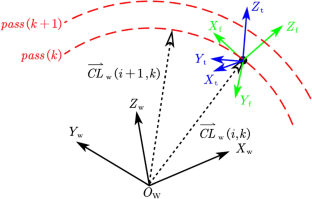
Ball-end milling cutters are commonly used for precision processing of complex curved parts in CNC systems. However, the milling process often experiences chatter, leading to final surface damage. To solve the problem, the method of automatically adjusting the tool posture was proposed to avoid chatter problems during the milling process. Frequency response function varies along the processing path. The frequency domain control equation for ball-end milling cutter machining under different operating conditions was established in the feed coordinate system, and the stability of the system at the cutting point can be quickly determined by Nyquist. In order to accurately solve the control equation, a method for solving the Cutter Workpiece Engagement (CWE) boundary under different tool postures was designed. The feasible region for the tool axis was searched based on geometric and stability constraints at each original tool path position. In the feasible domain, the tool axis path was optimized and the tool position file was updated with the constraint of machine tool rotation axis smoothness. Milling experiments were conducted on AL7050-T745 workpiece. From the simulation and experimental results, it can be concluded that milling width and tilt angle have significant impact on the milling process. The method proposed in this article has been experimentally validated in a five-axis ball-end milling experiment.
期刊介绍:
The International Journal of Advanced Manufacturing Technology bridges the gap between pure research journals and the more practical publications on advanced manufacturing and systems. It therefore provides an outstanding forum for papers covering applications-based research topics relevant to manufacturing processes, machines and process integration.



 京公网安备 11010802042870号
京ICP备2023020795号-1
京公网安备 11010802042870号
京ICP备2023020795号-1

 分享
分享
 求助内容:
求助内容: 应助结果提醒方式:
 扫码关注我们
