Martin Bullock*, Nicole Graulich and Johannes Huwer,
{"title":"Using an Augmented Reality Learning Environment to Teach the Mechanism of an Electrophilic Aromatic Substitution","authors":"Martin Bullock*, Nicole Graulich and Johannes Huwer, ","doi":"10.1021/acs.jchemed.3c00903","DOIUrl":null,"url":null,"abstract":"<p >Last year, IUPAC named augmented reality (AR) as one of the top ten emerging technologies in chemistry for 2022 for chemistry research and teaching chemistry. Despite an increase in the number of studies investigating the use of AR to teach chemistry, there have only been a few studies on the use of AR to teach organic chemistry, especially the mechanism of chemical reactions. We designed an augmented reality learning environment (AR-LE) to teach the mechanism of an electrophilic aromatic substitution (EAS) by illustrating the macroscopic level of the reaction with a video of the experiment, a 2D-AR animation of the mechanism using Lewis structures (symbolic level), and a 3D-AR animation of the mechanism to illustrate the particulate level. The AR-LE was used in five different grade 12 chemistry classes in Germany in 2022. Students took a knowledge test before and after the lesson and answered survey questions regarding their cognitive load, their acceptance of the technology, and their attitude toward the use of the technology to learn chemistry. The findings reveal that students significantly increased their learning gains (<i>Z</i> = 5.348, <i>p</i> < 0.001). The calculated effect size of 0.8062 shows that the treatment had a large effect. Furthermore, their responses to the cognitive load and technology acceptance survey indicated that they did not experience high extraneous cognitive load and showed overall acceptance of the AR-LE.</p>","PeriodicalId":43,"journal":{"name":"Journal of Chemical Education","volume":"101 4","pages":"1534–1543"},"PeriodicalIF":2.9000,"publicationDate":"2024-03-18","publicationTypes":"Journal Article","fieldsOfStudy":null,"isOpenAccess":false,"openAccessPdf":"https://pubs.acs.org/doi/epdf/10.1021/acs.jchemed.3c00903","citationCount":"0","resultStr":null,"platform":"Semanticscholar","paperid":null,"PeriodicalName":"Journal of Chemical Education","FirstCategoryId":"92","ListUrlMain":"https://pubs.acs.org/doi/10.1021/acs.jchemed.3c00903","RegionNum":3,"RegionCategory":"教育学","ArticlePicture":[],"TitleCN":null,"AbstractTextCN":null,"PMCID":null,"EPubDate":"","PubModel":"","JCR":"Q2","JCRName":"CHEMISTRY, MULTIDISCIPLINARY","Score":null,"Total":0}
引用次数: 0
Abstract
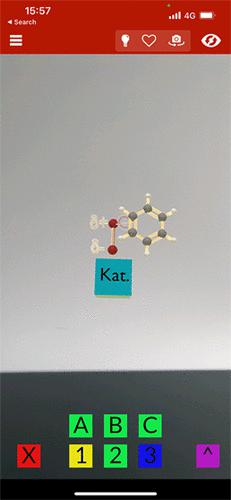
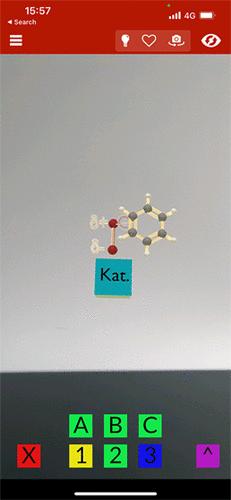
Last year, IUPAC named augmented reality (AR) as one of the top ten emerging technologies in chemistry for 2022 for chemistry research and teaching chemistry. Despite an increase in the number of studies investigating the use of AR to teach chemistry, there have only been a few studies on the use of AR to teach organic chemistry, especially the mechanism of chemical reactions. We designed an augmented reality learning environment (AR-LE) to teach the mechanism of an electrophilic aromatic substitution (EAS) by illustrating the macroscopic level of the reaction with a video of the experiment, a 2D-AR animation of the mechanism using Lewis structures (symbolic level), and a 3D-AR animation of the mechanism to illustrate the particulate level. The AR-LE was used in five different grade 12 chemistry classes in Germany in 2022. Students took a knowledge test before and after the lesson and answered survey questions regarding their cognitive load, their acceptance of the technology, and their attitude toward the use of the technology to learn chemistry. The findings reveal that students significantly increased their learning gains (Z = 5.348, p < 0.001). The calculated effect size of 0.8062 shows that the treatment had a large effect. Furthermore, their responses to the cognitive load and technology acceptance survey indicated that they did not experience high extraneous cognitive load and showed overall acceptance of the AR-LE.
期刊介绍:
The Journal of Chemical Education is the official journal of the Division of Chemical Education of the American Chemical Society, co-published with the American Chemical Society Publications Division. Launched in 1924, the Journal of Chemical Education is the world’s premier chemical education journal. The Journal publishes peer-reviewed articles and related information as a resource to those in the field of chemical education and to those institutions that serve them. JCE typically addresses chemical content, activities, laboratory experiments, instructional methods, and pedagogies. The Journal serves as a means of communication among people across the world who are interested in the teaching and learning of chemistry. This includes instructors of chemistry from middle school through graduate school, professional staff who support these teaching activities, as well as some scientists in commerce, industry, and government.



 京公网安备 11010802042870号
京ICP备2023020795号-1
京公网安备 11010802042870号
京ICP备2023020795号-1

 分享
分享
 求助内容:
求助内容: 应助结果提醒方式:
 扫码关注我们
