UV-filter benzophenones suppress human, pig, rat, and mouse 11β-hydroxysteroid dehydrogenase 1: Structure-activity relationship and in silico docking analysis
Ting Hao , Xin Zhao , Zhongyao Ji , Miaomiao Xia , Han Lu , Jianmin Sang , Shaowei Wang , Linxi Li , Ren-shan Ge , Qiqi Zhu
{"title":"UV-filter benzophenones suppress human, pig, rat, and mouse 11β-hydroxysteroid dehydrogenase 1: Structure-activity relationship and in silico docking analysis","authors":"Ting Hao , Xin Zhao , Zhongyao Ji , Miaomiao Xia , Han Lu , Jianmin Sang , Shaowei Wang , Linxi Li , Ren-shan Ge , Qiqi Zhu","doi":"10.1016/j.cbpc.2024.109900","DOIUrl":null,"url":null,"abstract":"<div><p>Benzophenone chemicals (BPs) have been developed to prevent the adverse effects of UV radiation and they are widely contaminated. 11β-Hydroxysteroid dehydrogenase 1 (11β-HSD1) catalyze the conversion of inactive glucocorticoid to active glucocorticoid, playing critical role in many physiological function. However, the direct effect of BPs on human, pig, rat, and mouse 11β-HSD1 remains unclear. In this study, we screened the inhibitory strength of 12 BPs on 4 species, and performed the structure-activity relationship (SAR) and in silico docking analysis. The inhibitory potency of BPs was: for human 11β-HSD1, BP6 (IC<sub>50</sub> = 18.76 μM) > BP8 (40.84 μM) > BP (88.89 μM) > other BPs; for pig 11β-HSD1, BP8 (45.57 μM) > BP6 (59.44 μM) > BP2 (65.12 μM) > BP (135.56 μM) > other BPs; for rat 11β-HSD1, BP7 (67.17 μM) > BP (68.83 μM) > BP8 (133.04 μM) > other BPs; and for mouse 11β-HSD1, BP8 (41.41 μM) > BP (50.61 μM) > other BPs. These BP chemicals were mixed/competitive inhibitors of these 11β-HSD1 enzymes. The 2,2′-dihydroxy substitutions in two benzene rings play a key role in enhancing the effectiveness of inhibiting 11β-HSD1, possibly via increasing hydrogen bond interactions. Docking analysis shows that these BPs bind to NADPH/glucocorticoid binding sites and forms hydrogen bonds with catalytic residues Ser and/or Tyr. In conclusion, this study demonstrates that BP chemicals can inhibit 11β-HSD1 from 4 species, and there are subtle species-dependent difference in the inhibitory strength and structural variations of BPs.</p></div>","PeriodicalId":10602,"journal":{"name":"Comparative Biochemistry and Physiology C-toxicology & Pharmacology","volume":"281 ","pages":"Article 109900"},"PeriodicalIF":4.3000,"publicationDate":"2024-03-20","publicationTypes":"Journal Article","fieldsOfStudy":null,"isOpenAccess":false,"openAccessPdf":"","citationCount":"0","resultStr":null,"platform":"Semanticscholar","paperid":null,"PeriodicalName":"Comparative Biochemistry and Physiology C-toxicology & Pharmacology","FirstCategoryId":"93","ListUrlMain":"https://www.sciencedirect.com/science/article/pii/S1532045624000681","RegionNum":3,"RegionCategory":"环境科学与生态学","ArticlePicture":[],"TitleCN":null,"AbstractTextCN":null,"PMCID":null,"EPubDate":"","PubModel":"","JCR":"Q2","JCRName":"BIOCHEMISTRY & MOLECULAR BIOLOGY","Score":null,"Total":0}
引用次数: 0
Abstract
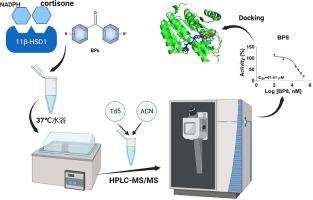
Benzophenone chemicals (BPs) have been developed to prevent the adverse effects of UV radiation and they are widely contaminated. 11β-Hydroxysteroid dehydrogenase 1 (11β-HSD1) catalyze the conversion of inactive glucocorticoid to active glucocorticoid, playing critical role in many physiological function. However, the direct effect of BPs on human, pig, rat, and mouse 11β-HSD1 remains unclear. In this study, we screened the inhibitory strength of 12 BPs on 4 species, and performed the structure-activity relationship (SAR) and in silico docking analysis. The inhibitory potency of BPs was: for human 11β-HSD1, BP6 (IC50 = 18.76 μM) > BP8 (40.84 μM) > BP (88.89 μM) > other BPs; for pig 11β-HSD1, BP8 (45.57 μM) > BP6 (59.44 μM) > BP2 (65.12 μM) > BP (135.56 μM) > other BPs; for rat 11β-HSD1, BP7 (67.17 μM) > BP (68.83 μM) > BP8 (133.04 μM) > other BPs; and for mouse 11β-HSD1, BP8 (41.41 μM) > BP (50.61 μM) > other BPs. These BP chemicals were mixed/competitive inhibitors of these 11β-HSD1 enzymes. The 2,2′-dihydroxy substitutions in two benzene rings play a key role in enhancing the effectiveness of inhibiting 11β-HSD1, possibly via increasing hydrogen bond interactions. Docking analysis shows that these BPs bind to NADPH/glucocorticoid binding sites and forms hydrogen bonds with catalytic residues Ser and/or Tyr. In conclusion, this study demonstrates that BP chemicals can inhibit 11β-HSD1 from 4 species, and there are subtle species-dependent difference in the inhibitory strength and structural variations of BPs.
期刊介绍:
Part C: Toxicology and Pharmacology. This journal is concerned with chemical and drug action at different levels of organization, biotransformation of xenobiotics, mechanisms of toxicity, including reactive oxygen species and carcinogenesis, endocrine disruptors, natural products chemistry, and signal transduction with a molecular approach to these fields.



 京公网安备 11010802042870号
京ICP备2023020795号-1
京公网安备 11010802042870号
京ICP备2023020795号-1

 分享
分享
 求助内容:
求助内容: 应助结果提醒方式:
 扫码关注我们
