{"title":"Protective effects of different lyoprotectants on survival of clinical bacterial isolates in a hospital biobank","authors":"Masoud Alebouyeh , Nasim Almasian Tehrani , Fatemeh Fallah , Leila Azimi , Mehrzad Sadredinamin , Neda Yousefi , Ghazale Ghandchi , Mostafa Haji Molla Hoseini","doi":"10.1016/j.cryobiol.2024.104891","DOIUrl":null,"url":null,"abstract":"<div><p>Nowadays the significant role of biobanks in medical, diagnostic, industrial, and environmental research is well known. Bacterial biobanks could be used as a good resource for designing new treatments, biomedical and industrial researches, and laboratory diagnostics. To have a collection of bacteria from clinical samples and maintain their long-term viability, their preservation needs appropriate protective agents, like cryoprotectants and lyoprotectants. In this study, we collected and characterized Gram-negative and Gram-positive bacteria carrying important antibiotic resistance markers from different clinical samples of hospitalized children. Sucrose (10%), skimmed milk (10%), skimmed milk plus sodium glutamate (10% + 1%), and bovine serum albumin (BSA, 10%) were used as lyoprotectants during the freeze-drying procedure. The survival rate of the lyophilized samples was calculated by dilution plating and measuring the colony forming unit (CFU) after 3 months of storage. The culture analysis results indicated that 25 of the 27 studied bacterial genera (Dilutions 10<sup>−3</sup> to 10<sup>−6</sup>), including <em>Shigella</em>, Methicillin-resistant <em>S. aureus</em>, <em>Acinetobacter</em> spp., <em>Escherichia</em> spp., <em>Pseudomonas</em> spp., <em>Klebsiella</em> spp., <em>Enterococcus</em> spp., were recovered in cultured fractions from all preservation conditions, while 2 genera were only detected in a single preservation condition (2/27, 7.4%). Based on the results, sucrose (10%) and skimmed milk (10%) presented the most protective features. The survival rates varied significantly according to types of the bacteria. Collectively, our results showed a diversity in the recovery of different bacterial genera after lyophilization. While statistically no significant difference was detected among the studied protective agents, sucrose (10%) and skimmed milk (10%) exhibited more effective lyoprotective properties for both Gram-positive and Gram-negative bacteria among the clinical isolates in our study.</p></div>","PeriodicalId":10897,"journal":{"name":"Cryobiology","volume":"115 ","pages":"Article 104891"},"PeriodicalIF":2.1000,"publicationDate":"2024-03-22","publicationTypes":"Journal Article","fieldsOfStudy":null,"isOpenAccess":false,"openAccessPdf":"","citationCount":"0","resultStr":null,"platform":"Semanticscholar","paperid":null,"PeriodicalName":"Cryobiology","FirstCategoryId":"99","ListUrlMain":"https://www.sciencedirect.com/science/article/pii/S0011224024000464","RegionNum":3,"RegionCategory":"生物学","ArticlePicture":[],"TitleCN":null,"AbstractTextCN":null,"PMCID":null,"EPubDate":"","PubModel":"","JCR":"Q2","JCRName":"BIOLOGY","Score":null,"Total":0}
引用次数: 0
Abstract
Nowadays the significant role of biobanks in medical, diagnostic, industrial, and environmental research is well known. Bacterial biobanks could be used as a good resource for designing new treatments, biomedical and industrial researches, and laboratory diagnostics. To have a collection of bacteria from clinical samples and maintain their long-term viability, their preservation needs appropriate protective agents, like cryoprotectants and lyoprotectants. In this study, we collected and characterized Gram-negative and Gram-positive bacteria carrying important antibiotic resistance markers from different clinical samples of hospitalized children. Sucrose (10%), skimmed milk (10%), skimmed milk plus sodium glutamate (10% + 1%), and bovine serum albumin (BSA, 10%) were used as lyoprotectants during the freeze-drying procedure. The survival rate of the lyophilized samples was calculated by dilution plating and measuring the colony forming unit (CFU) after 3 months of storage. The culture analysis results indicated that 25 of the 27 studied bacterial genera (Dilutions 10−3 to 10−6), including Shigella, Methicillin-resistant S. aureus, Acinetobacter spp., Escherichia spp., Pseudomonas spp., Klebsiella spp., Enterococcus spp., were recovered in cultured fractions from all preservation conditions, while 2 genera were only detected in a single preservation condition (2/27, 7.4%). Based on the results, sucrose (10%) and skimmed milk (10%) presented the most protective features. The survival rates varied significantly according to types of the bacteria. Collectively, our results showed a diversity in the recovery of different bacterial genera after lyophilization. While statistically no significant difference was detected among the studied protective agents, sucrose (10%) and skimmed milk (10%) exhibited more effective lyoprotective properties for both Gram-positive and Gram-negative bacteria among the clinical isolates in our study.
期刊介绍:
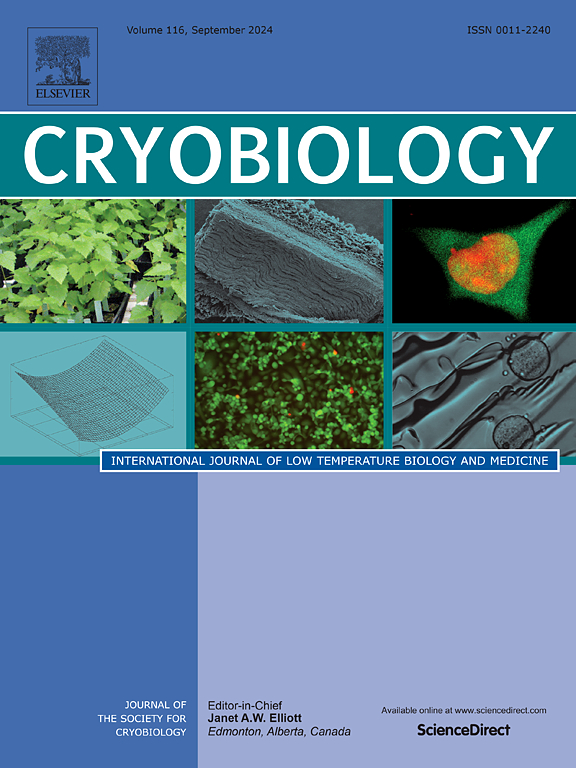
Cryobiology: International Journal of Low Temperature Biology and Medicine publishes research articles on all aspects of low temperature biology and medicine.
Research Areas include:
• Cryoprotective additives and their pharmacological actions
• Cryosurgery
• Freeze-drying
• Freezing
• Frost hardiness in plants
• Hibernation
• Hypothermia
• Medical applications of reduced temperature
• Perfusion of organs
• All pertinent methodologies
Cryobiology is the official journal of the Society for Cryobiology.



 京公网安备 11010802042870号
京ICP备2023020795号-1
京公网安备 11010802042870号
京ICP备2023020795号-1

 分享
分享
 求助内容:
求助内容: 应助结果提醒方式:
 扫码关注我们
