{"title":"Optimization of temperature distribution in building envelopes of Ahmedabad region using nano-encapsulated phase change material","authors":"Dhayanithi J., Tapano Kumar Hotta","doi":"10.1016/j.enbenv.2024.03.004","DOIUrl":null,"url":null,"abstract":"<div><div>The incorporation of Phase Change Materials (PCM) into the building envelopes helps to increase indoor thermal comfort while lowering energy usage. The selection of PCM is directly related to its performance and might be viewed as an optimization challenge. The manuscript highlights the optimization of temperature distribution in building envelopes (walls and roofs) of Ahmedabad by choosing the suitable PCM and Nano-particle. Three different PCMs (RT31, RT 35, and RT42) and Nano-particles (Al<sub>2</sub>O<sub>3,</sub> CuO, and ZnO) with different concentrations (12 %, 16 %, and 20 %) are considered for the optimization. The PCMs are encapsulated into the building layer thickness to examine their characteristics like effective thermal conductivity, concentration, melting point, etc. These parameters are evaluated in a room that measures 5 m x 4 m x 3.5 m (L x W x H). The design-builder software (Version 7.0.2.006) is used to carry out the steady-state numerical simulations for this building envelope. The results suggest that the integration of PCM reduces the building's overall energy consumption by 7.92 kWh/m<sup>2</sup> per year. The optimal design is proposed by establishing a temperature difference (ΔT) in building envelopes and utilizing a hybrid optimization technique (a combination of Artificial neural network (ANN) and Genetic algorithm (GA)). This temperature difference of the building envelope is confirmed to be dependent on their PCM melting point, effective thermal conductivity, concentration (in%), and PCM layer thickness. Hybrid optimization is found to be the most stable strategy for predicting temperature dilation and energy storage in building envelopes. Thus this paper gives a systematic understanding of the selection of PCM and Nano-particles and identifies the suitable PCM layer thickness for encapsulation.</div></div>","PeriodicalId":33659,"journal":{"name":"Energy and Built Environment","volume":"6 5","pages":"Pages 796-808"},"PeriodicalIF":0.0000,"publicationDate":"2025-10-01","publicationTypes":"Journal Article","fieldsOfStudy":null,"isOpenAccess":false,"openAccessPdf":"","citationCount":"0","resultStr":null,"platform":"Semanticscholar","paperid":null,"PeriodicalName":"Energy and Built Environment","FirstCategoryId":"1085","ListUrlMain":"https://www.sciencedirect.com/science/article/pii/S2666123324000382","RegionNum":0,"RegionCategory":null,"ArticlePicture":[],"TitleCN":null,"AbstractTextCN":null,"PMCID":null,"EPubDate":"","PubModel":"","JCR":"Q1","JCRName":"Engineering","Score":null,"Total":0}
引用次数: 0
Abstract
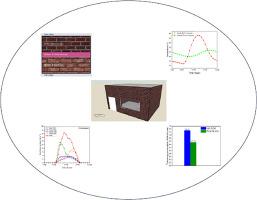
The incorporation of Phase Change Materials (PCM) into the building envelopes helps to increase indoor thermal comfort while lowering energy usage. The selection of PCM is directly related to its performance and might be viewed as an optimization challenge. The manuscript highlights the optimization of temperature distribution in building envelopes (walls and roofs) of Ahmedabad by choosing the suitable PCM and Nano-particle. Three different PCMs (RT31, RT 35, and RT42) and Nano-particles (Al2O3, CuO, and ZnO) with different concentrations (12 %, 16 %, and 20 %) are considered for the optimization. The PCMs are encapsulated into the building layer thickness to examine their characteristics like effective thermal conductivity, concentration, melting point, etc. These parameters are evaluated in a room that measures 5 m x 4 m x 3.5 m (L x W x H). The design-builder software (Version 7.0.2.006) is used to carry out the steady-state numerical simulations for this building envelope. The results suggest that the integration of PCM reduces the building's overall energy consumption by 7.92 kWh/m2 per year. The optimal design is proposed by establishing a temperature difference (ΔT) in building envelopes and utilizing a hybrid optimization technique (a combination of Artificial neural network (ANN) and Genetic algorithm (GA)). This temperature difference of the building envelope is confirmed to be dependent on their PCM melting point, effective thermal conductivity, concentration (in%), and PCM layer thickness. Hybrid optimization is found to be the most stable strategy for predicting temperature dilation and energy storage in building envelopes. Thus this paper gives a systematic understanding of the selection of PCM and Nano-particles and identifies the suitable PCM layer thickness for encapsulation.




 京公网安备 11010802042870号
京ICP备2023020795号-1
京公网安备 11010802042870号
京ICP备2023020795号-1

 分享
分享
 求助内容:
求助内容: 应助结果提醒方式:
 扫码关注我们
