{"title":"Study on the deposition characteristics of fine particles at local components in air conditioning ventilation ducts","authors":"Hongfa Sun , Hao Hu , Jun Gao , Qingzhuo Feng","doi":"10.1016/j.enbenv.2024.07.008","DOIUrl":null,"url":null,"abstract":"<div><div>Air conditioning ventilation ducts are widely used in contemporary buildings. The change of airflow direction in the ducts local components can easily lead to the deposition of particles, which can easily form a secondary source of indoor air pollution and have an adverse effect on human health. Based on this, this paper utilizes the existing experimental data to validate the numerical simulation. The Reynolds stress turbulence model combined with the method of enhanced wall function was used to investigate the deposition characteristics of fine particles in different local components. For the first time, local deposition rates and deposition hotspots were proposed to analyze the simulation results. The results show that the local deposition rate of the particles with a particle size of 1μm do not differ much on each wall surface, and the particles are deposited more uniformly on each wall at the local components, with a difference of less than 10 %, and the maximum local deposition rate is on the outer wall of the local components. When the particle size is larger than 10μm, the local deposition rate on the outer wall of the local component increases significantly, with a maximum increase of 23.3 % (compared to 5μm particles), and the maximum local deposition rate increases slowly with increasing air velocity, with a maximum increase of less than 8 %. The effect of increasing particle size on the maximum local deposition rate is much greater than the increase in air velocity. With the increase of air velocity and particle size, the deposition hotspots of both the 90° bend and the T-type tee duct migrate to the middle of the wall, and the deposition hotspots of the 4-way duct migrate to the inside of the wall.</div></div>","PeriodicalId":33659,"journal":{"name":"Energy and Built Environment","volume":"7 1","pages":"Pages 150-162"},"PeriodicalIF":0.0000,"publicationDate":"2026-02-01","publicationTypes":"Journal Article","fieldsOfStudy":null,"isOpenAccess":false,"openAccessPdf":"","citationCount":"0","resultStr":null,"platform":"Semanticscholar","paperid":null,"PeriodicalName":"Energy and Built Environment","FirstCategoryId":"1085","ListUrlMain":"https://www.sciencedirect.com/science/article/pii/S266612332400076X","RegionNum":0,"RegionCategory":null,"ArticlePicture":[],"TitleCN":null,"AbstractTextCN":null,"PMCID":null,"EPubDate":"2024/7/24 0:00:00","PubModel":"Epub","JCR":"Q1","JCRName":"Engineering","Score":null,"Total":0}
引用次数: 0
Abstract
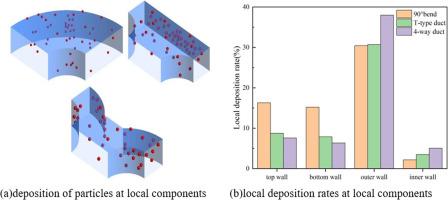
Air conditioning ventilation ducts are widely used in contemporary buildings. The change of airflow direction in the ducts local components can easily lead to the deposition of particles, which can easily form a secondary source of indoor air pollution and have an adverse effect on human health. Based on this, this paper utilizes the existing experimental data to validate the numerical simulation. The Reynolds stress turbulence model combined with the method of enhanced wall function was used to investigate the deposition characteristics of fine particles in different local components. For the first time, local deposition rates and deposition hotspots were proposed to analyze the simulation results. The results show that the local deposition rate of the particles with a particle size of 1μm do not differ much on each wall surface, and the particles are deposited more uniformly on each wall at the local components, with a difference of less than 10 %, and the maximum local deposition rate is on the outer wall of the local components. When the particle size is larger than 10μm, the local deposition rate on the outer wall of the local component increases significantly, with a maximum increase of 23.3 % (compared to 5μm particles), and the maximum local deposition rate increases slowly with increasing air velocity, with a maximum increase of less than 8 %. The effect of increasing particle size on the maximum local deposition rate is much greater than the increase in air velocity. With the increase of air velocity and particle size, the deposition hotspots of both the 90° bend and the T-type tee duct migrate to the middle of the wall, and the deposition hotspots of the 4-way duct migrate to the inside of the wall.




 京公网安备 11010802042870号
京ICP备2023020795号-1
京公网安备 11010802042870号
京ICP备2023020795号-1

 分享
分享
 求助内容:
求助内容: 应助结果提醒方式:
 扫码关注我们
