Xin Hu, Tanika R Sgherza, Jessie B Nothrup, David M Fresco, Kristin Naragon-Gainey, Lauren M Bylsma
{"title":"From lab to life: Evaluating the reliability and validity of psychophysiological data from wearable devices in laboratory and ambulatory settings.","authors":"Xin Hu, Tanika R Sgherza, Jessie B Nothrup, David M Fresco, Kristin Naragon-Gainey, Lauren M Bylsma","doi":"10.3758/s13428-024-02387-3","DOIUrl":null,"url":null,"abstract":"<p><p>Despite the increasing popularity of ambulatory assessment, the reliability and validity of psychophysiological signals from wearable devices is unproven in daily life settings. We evaluated the reliability and validity of physiological signals (electrocardiogram, ECG; photoplethysmography, PPG; electrodermal activity, EDA) collected from two wearable devices (Movisens EcgMove4 and Empatica E4) in the lab (N = 67) and daily life (N = 20) among adults aged 18-64 with Mindware as the laboratory gold standard. Results revealed that both wearable devices' valid data rates in daily life were lower than in the laboratory (Movisens ECG 82.94 vs. 93.10%, Empatica PPG 8.79 vs. 26.14%, and Empatica EDA 41.16 vs. 42.67%, respectively). The poor valid data rates of Empatica PPG signals in the laboratory could be partially attributed to participants' hand movements (r = - .27, p = .03). In laboratory settings, heart rate (HR) derived from both wearable devices exhibited higher concurrent validity than heart rate variability (HRV) metrics (ICCs 0.98-1.00 vs. 0.75-0.97). The number of skin conductance responses (SCRs) derived from Empatica showed higher concurrent validity than skin conductance level (SCL, ICCs 0.38 vs. 0.09). Movisens EcgMove4 provided more reliable and valid HRV measurements than Empatica E4 in both laboratory (split-half reliability: 0.95-0.99 vs. 0.85-0.98; concurrent validity: 0.95-1.00 vs. 0.75-0.98; valid data rate: 93.10 vs. 26.14%) and ambulatory settings (split-half reliability: 0.99-1.00 vs. 0.89-0.98; valid data rate: 82.94 vs. 8.79%). Although the reliability and validity of wearable devices are improving, findings suggest researchers should select devices that yield consistently robust and valid data for their measures of interest.</p>","PeriodicalId":8717,"journal":{"name":"Behavior Research Methods","volume":" ","pages":"1-20"},"PeriodicalIF":3.9000,"publicationDate":"2024-10-01","publicationTypes":"Journal Article","fieldsOfStudy":null,"isOpenAccess":false,"openAccessPdf":"https://www.ncbi.nlm.nih.gov/pmc/articles/PMC12403079/pdf/","citationCount":"0","resultStr":null,"platform":"Semanticscholar","paperid":null,"PeriodicalName":"Behavior Research Methods","FirstCategoryId":"102","ListUrlMain":"https://doi.org/10.3758/s13428-024-02387-3","RegionNum":2,"RegionCategory":"心理学","ArticlePicture":[],"TitleCN":null,"AbstractTextCN":null,"PMCID":null,"EPubDate":"2024/3/25 0:00:00","PubModel":"Epub","JCR":"Q1","JCRName":"PSYCHOLOGY, EXPERIMENTAL","Score":null,"Total":0}
引用次数: 0
Abstract
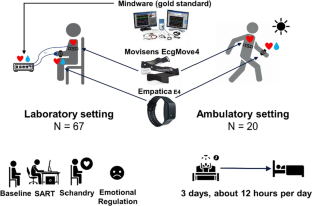
Despite the increasing popularity of ambulatory assessment, the reliability and validity of psychophysiological signals from wearable devices is unproven in daily life settings. We evaluated the reliability and validity of physiological signals (electrocardiogram, ECG; photoplethysmography, PPG; electrodermal activity, EDA) collected from two wearable devices (Movisens EcgMove4 and Empatica E4) in the lab (N = 67) and daily life (N = 20) among adults aged 18-64 with Mindware as the laboratory gold standard. Results revealed that both wearable devices' valid data rates in daily life were lower than in the laboratory (Movisens ECG 82.94 vs. 93.10%, Empatica PPG 8.79 vs. 26.14%, and Empatica EDA 41.16 vs. 42.67%, respectively). The poor valid data rates of Empatica PPG signals in the laboratory could be partially attributed to participants' hand movements (r = - .27, p = .03). In laboratory settings, heart rate (HR) derived from both wearable devices exhibited higher concurrent validity than heart rate variability (HRV) metrics (ICCs 0.98-1.00 vs. 0.75-0.97). The number of skin conductance responses (SCRs) derived from Empatica showed higher concurrent validity than skin conductance level (SCL, ICCs 0.38 vs. 0.09). Movisens EcgMove4 provided more reliable and valid HRV measurements than Empatica E4 in both laboratory (split-half reliability: 0.95-0.99 vs. 0.85-0.98; concurrent validity: 0.95-1.00 vs. 0.75-0.98; valid data rate: 93.10 vs. 26.14%) and ambulatory settings (split-half reliability: 0.99-1.00 vs. 0.89-0.98; valid data rate: 82.94 vs. 8.79%). Although the reliability and validity of wearable devices are improving, findings suggest researchers should select devices that yield consistently robust and valid data for their measures of interest.
尽管流动评估越来越受欢迎,但在日常生活环境中,来自可穿戴设备的心理生理信号的可靠性和有效性尚未得到证实。我们以 Mindware 作为实验室黄金标准,评估了从两款可穿戴设备(Movisens EcgMove4 和 Empatica E4)上采集的生理信号(心电图,ECG;光电血压计,PPG;电皮活动,EDA)在实验室(67 人)和日常生活(20 人)中的可靠性和有效性。结果显示,这两款可穿戴设备在日常生活中的有效数据率均低于实验室(分别为 Movisens ECG 82.94 vs. 93.10%,Empatica PPG 8.79 vs. 26.14%,Empatica EDA 41.16 vs. 42.67%)。Empatica PPG 信号在实验室中的有效数据率较低,部分原因可能是参与者的手部运动(r = - .27,p = .03)。在实验室环境中,两种可穿戴设备得出的心率(HR)比心率变异性(HRV)指标表现出更高的并发有效性(ICCs 0.98-1.00 vs. 0.75-0.97)。由 Empatica 得出的皮肤传导反应次数(SCR)的同期有效性高于皮肤传导水平(SCL,ICCs 0.38 vs. 0.09)。在两个实验室中,Movisens EcgMove4 都比 Empatica E4 提供了更可靠和有效的心率变异测量(半分可靠性:0.95-0.99 vs. 0.85-0.98;并发有效性:0.95-1.00 vs. 0.75-0.98;有效数据率:93.10 vs. 26.14%):93.10 vs. 26.14%)和门诊环境(二分之一可靠性:0.99-1.00 vs. 0.89-0.98;有效数据率:82.94 vs. 8.79%):82.94 vs. 8.79%)。虽然可穿戴设备的可靠性和有效性在不断提高,但研究结果表明,研究人员应选择能为他们感兴趣的测量项目提供持续可靠和有效数据的设备。
期刊介绍:
Behavior Research Methods publishes articles concerned with the methods, techniques, and instrumentation of research in experimental psychology. The journal focuses particularly on the use of computer technology in psychological research. An annual special issue is devoted to this field.



 京公网安备 11010802042870号
京ICP备2023020795号-1
京公网安备 11010802042870号
京ICP备2023020795号-1

 分享
分享
 求助内容:
求助内容: 应助结果提醒方式:
 扫码关注我们
