{"title":"The error patterns of phonemes in children with prelingual hearing loss: A comparison between hearing aid and cochlear implant users","authors":"Yuri Nishiyama , Shujiro Minami , Ryoko Ijuin , Tomoko Kuroki , Ayako Tendo , Yuko Kusui , Satoko Wakabayashi , Kimitaka Kaga","doi":"10.1016/j.anl.2024.01.001","DOIUrl":null,"url":null,"abstract":"<div><h3>Objective</h3><p>To reveal differences in error pattern of phonemes and articulation between children using cochlear implants (CIs) and those using hearing aids (HAs) due to prelingual hearing disorder and help the education of children with prelingual hearing loss.</p></div><div><h3>Method</h3><p>Children with prelingual hearing loss who were receiving auditory-verbal preschool education at an auditory center for hearing-impaired children (Fujimidai Auditory Center, Tokyo, Japan) from 2010 to 2020 were analyzed retrospectively. All participants underwent pure tone audiometry and monosyllabic intelligibility tests. The error answers were categorized into five patterns which was characterized by the substitution, addition, omission, failure, and no response according to consonant errors. In addition, the consonant errors classified into the manner of articulation and the differences of error patterns were analyzed between the HA and the CI group descriptively.</p></div><div><h3>Results</h3><p>A total of 43 children with bilateral HAs and 46 children with bimodal CIs or bilateral CIs were enrolled. No significant between-group differences in median phoneme intelligibility were found. The most common error pattern was substitution in both HA and CI groups. The error number of addition pattern in the HA group was smaller than in the CI group. In both groups, the most common errors of articulation were flap errors, and the most common error patterns were flaps to nasals, nasals to nasals, plosives to plosives. In the HA group, plosives and nasals tended not to be recognized and in the CI group plosives were prone to be added to vowels.</p></div><div><h3>Conclusions</h3><p>There were some different error patterns of articulation and consonant substitution between groups. Clarifying differences of phoneme that are difficult to hear and tend to be misheard would help for creating an effective approach to auditory training for children with hearing loss.</p></div>","PeriodicalId":55627,"journal":{"name":"Auris Nasus Larynx","volume":"51 3","pages":"Pages 537-541"},"PeriodicalIF":1.5000,"publicationDate":"2024-06-01","publicationTypes":"Journal Article","fieldsOfStudy":null,"isOpenAccess":false,"openAccessPdf":"","citationCount":"0","resultStr":null,"platform":"Semanticscholar","paperid":null,"PeriodicalName":"Auris Nasus Larynx","FirstCategoryId":"3","ListUrlMain":"https://www.sciencedirect.com/science/article/pii/S0385814624000075","RegionNum":4,"RegionCategory":"医学","ArticlePicture":[],"TitleCN":null,"AbstractTextCN":null,"PMCID":null,"EPubDate":"2024/3/26 0:00:00","PubModel":"Epub","JCR":"Q2","JCRName":"OTORHINOLARYNGOLOGY","Score":null,"Total":0}
引用次数: 0
Abstract
Objective
To reveal differences in error pattern of phonemes and articulation between children using cochlear implants (CIs) and those using hearing aids (HAs) due to prelingual hearing disorder and help the education of children with prelingual hearing loss.
Method
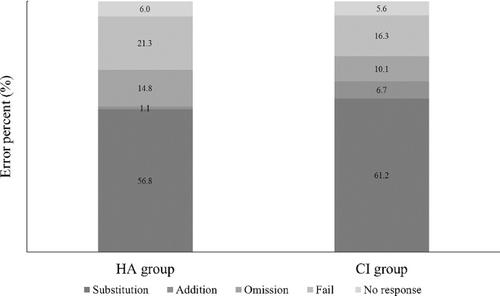
Children with prelingual hearing loss who were receiving auditory-verbal preschool education at an auditory center for hearing-impaired children (Fujimidai Auditory Center, Tokyo, Japan) from 2010 to 2020 were analyzed retrospectively. All participants underwent pure tone audiometry and monosyllabic intelligibility tests. The error answers were categorized into five patterns which was characterized by the substitution, addition, omission, failure, and no response according to consonant errors. In addition, the consonant errors classified into the manner of articulation and the differences of error patterns were analyzed between the HA and the CI group descriptively.
Results
A total of 43 children with bilateral HAs and 46 children with bimodal CIs or bilateral CIs were enrolled. No significant between-group differences in median phoneme intelligibility were found. The most common error pattern was substitution in both HA and CI groups. The error number of addition pattern in the HA group was smaller than in the CI group. In both groups, the most common errors of articulation were flap errors, and the most common error patterns were flaps to nasals, nasals to nasals, plosives to plosives. In the HA group, plosives and nasals tended not to be recognized and in the CI group plosives were prone to be added to vowels.
Conclusions
There were some different error patterns of articulation and consonant substitution between groups. Clarifying differences of phoneme that are difficult to hear and tend to be misheard would help for creating an effective approach to auditory training for children with hearing loss.
方法回顾性分析 2010 年至 2020 年期间在听觉障碍儿童听觉中心(日本东京富士见台听觉中心)接受听觉言语学前教育的听觉障碍儿童。所有参与者都接受了纯音测听和单音节词可理解性测试。根据辅音错误,将错误答案分为五种模式,即替换、添加、遗漏、失败和无反应。此外,还对辅音错误的发音方式进行了分类,并对 HA 组和 CI 组之间错误模式的差异进行了描述性分析。各组之间的音素可懂度中位数无明显差异。HA 组和 CI 组最常见的错误模式都是替换。HA 组的加法错误数量少于 CI 组。在两组中,最常见的发音错误是瓣音错误,最常见的错误模式是瓣音对鼻音、鼻音对鼻音、plosives 对 plosives。在 HA 组中,瓣音和鼻音往往不被识别,而在 CI 组中,瓣音容易与元音相加。厘清难以听到和容易误听的音素之间的差异,将有助于为听力损失儿童制定有效的听觉训练方法。
期刊介绍:
The international journal Auris Nasus Larynx provides the opportunity for rapid, carefully reviewed publications concerning the fundamental and clinical aspects of otorhinolaryngology and related fields. This includes otology, neurotology, bronchoesophagology, laryngology, rhinology, allergology, head and neck medicine and oncologic surgery, maxillofacial and plastic surgery, audiology, speech science.
Original papers, short communications and original case reports can be submitted. Reviews on recent developments are invited regularly and Letters to the Editor commenting on papers or any aspect of Auris Nasus Larynx are welcomed.
Founded in 1973 and previously published by the Society for Promotion of International Otorhinolaryngology, the journal is now the official English-language journal of the Oto-Rhino-Laryngological Society of Japan, Inc. The aim of its new international Editorial Board is to make Auris Nasus Larynx an international forum for high quality research and clinical sciences.



 京公网安备 11010802042870号
京ICP备2023020795号-1
京公网安备 11010802042870号
京ICP备2023020795号-1

 分享
分享
 求助内容:
求助内容: 应助结果提醒方式:
 扫码关注我们
