Role of ehealth literacy, learning styles, and patterns of web-based e-content access for seeking health information among dental university students in Vadodara, India.
{"title":"Role of ehealth literacy, learning styles, and patterns of web-based e-content access for seeking health information among dental university students in Vadodara, India.","authors":"Ramya R Iyer, Rajesh Sethuraman","doi":"10.4103/jehp.jehp_750_23","DOIUrl":null,"url":null,"abstract":"<p><strong>Background: </strong>Individual's learning style, ehealth literacy, and preferred web-based e-content and channel to access information determines how one makes sense of health information on the Internet. Understanding these dynamics will help design suitable e-contents and choose appropriate channels for effective health communication. To assess the relationship between ehealth literacy, learning styles, and web-based e-content accessed for receiving health information among dental college students in Vadodara, India.</p><p><strong>Materials and methods: </strong>A cross-sectional questionnaire study was conducted among all consenting Undergraduate Students (UGs), interns, and Postgraduate Students (PGs) of a dental college in Vadodara, India, from July to August 2022. The questionnaire used to collect data included questions on general information, eHealth literacy scale (eHEALS), Visual Auditory Reading/Writing Kinaesthetic (VARK) Questionnaire, and preferences of web-based e-content for receiving health information. Completely filled questionnaires were subject to statistical analysis: descriptive (means and percentages) and inferential (analysis of variance tests and odds ratio).</p><p><strong>Results: </strong>285 out of 380 students filled out the questionnaires completely (75% response rate). All reported using Internet for receiving health information. Majority preferred textual ehealth message (71%) and access websites (80%). Students were quadmodal (98.%) and trimodal (2%) learners who learned predominantly through kinaesthetic methods (46%). Mean eHEALS score of the group was 30.27 ± 3.41. There was a statistically significant association between preference for sharing channels and being a kinaesthetic learner (OR = 1.6; <i>P</i> = 0.04).</p><p><strong>Conclusions: </strong>Participants were multi-modal, predominantly kinaesthetic learners. The association between the preference for video-sharing channels and being kinaesthetic learner suggests the need and scope for demonstrative and interactive video-based health educational tools, with the endorsement of health authorities based on health policy.</p>","PeriodicalId":15581,"journal":{"name":"Journal of Education and Health Promotion","volume":"13 ","pages":"56"},"PeriodicalIF":1.3000,"publicationDate":"2024-02-26","publicationTypes":"Journal Article","fieldsOfStudy":null,"isOpenAccess":false,"openAccessPdf":"https://www.ncbi.nlm.nih.gov/pmc/articles/PMC10977646/pdf/","citationCount":"0","resultStr":null,"platform":"Semanticscholar","paperid":null,"PeriodicalName":"Journal of Education and Health Promotion","FirstCategoryId":"1085","ListUrlMain":"https://doi.org/10.4103/jehp.jehp_750_23","RegionNum":0,"RegionCategory":null,"ArticlePicture":[],"TitleCN":null,"AbstractTextCN":null,"PMCID":null,"EPubDate":"2024/1/1 0:00:00","PubModel":"eCollection","JCR":"Q3","JCRName":"EDUCATION, SCIENTIFIC DISCIPLINES","Score":null,"Total":0}
引用次数: 0
Abstract
Background: Individual's learning style, ehealth literacy, and preferred web-based e-content and channel to access information determines how one makes sense of health information on the Internet. Understanding these dynamics will help design suitable e-contents and choose appropriate channels for effective health communication. To assess the relationship between ehealth literacy, learning styles, and web-based e-content accessed for receiving health information among dental college students in Vadodara, India.
Materials and methods: A cross-sectional questionnaire study was conducted among all consenting Undergraduate Students (UGs), interns, and Postgraduate Students (PGs) of a dental college in Vadodara, India, from July to August 2022. The questionnaire used to collect data included questions on general information, eHealth literacy scale (eHEALS), Visual Auditory Reading/Writing Kinaesthetic (VARK) Questionnaire, and preferences of web-based e-content for receiving health information. Completely filled questionnaires were subject to statistical analysis: descriptive (means and percentages) and inferential (analysis of variance tests and odds ratio).
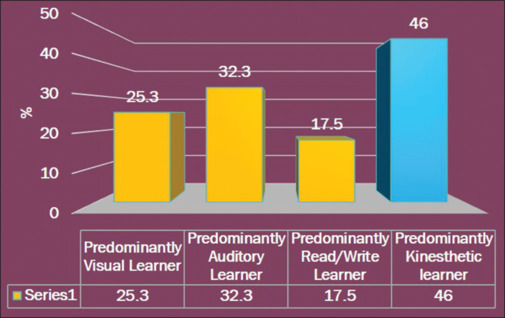
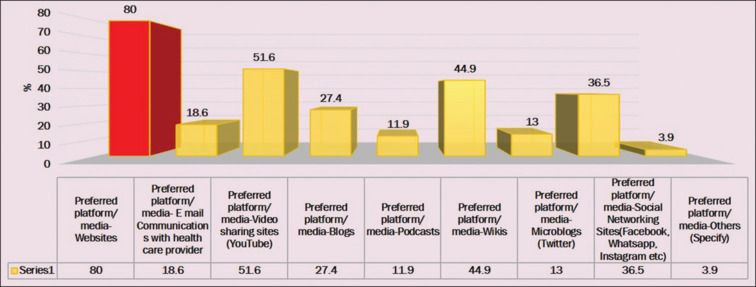
Results: 285 out of 380 students filled out the questionnaires completely (75% response rate). All reported using Internet for receiving health information. Majority preferred textual ehealth message (71%) and access websites (80%). Students were quadmodal (98.%) and trimodal (2%) learners who learned predominantly through kinaesthetic methods (46%). Mean eHEALS score of the group was 30.27 ± 3.41. There was a statistically significant association between preference for sharing channels and being a kinaesthetic learner (OR = 1.6; P = 0.04).
Conclusions: Participants were multi-modal, predominantly kinaesthetic learners. The association between the preference for video-sharing channels and being kinaesthetic learner suggests the need and scope for demonstrative and interactive video-based health educational tools, with the endorsement of health authorities based on health policy.



 京公网安备 11010802042870号
京ICP备2023020795号-1
京公网安备 11010802042870号
京ICP备2023020795号-1

 分享
分享

 求助内容:
求助内容: 应助结果提醒方式:
 扫码关注我们
