{"title":"Diagnosis and Management of Cervical Squamous Intraepithelial Lesions in Pregnancy and Postpartum.","authors":"Alyssa Larish, Margaret E Long","doi":"10.1097/AOG.0000000000005566","DOIUrl":null,"url":null,"abstract":"<p><p>Perinatal care provides important health care opportunities for many individuals at risk for cervical cancer. Pregnancy does not alter cervical cancer screening regimens. ASCCP risk-based management has a colposcopy threshold of a 4% immediate risk of cervical intraepithelial neoplasia (CIN) 3 or cancer, but the actual risk can be considerably higher based on current and past screening results. Improving cervical cancer outcomes with diagnosis during pregnancy rather than postpartum and facilitating further evaluation and treatment postpartum for lesser lesions are the perinatal management goals. Although colposcopy indications are unchanged in pregnancy, some individuals with lower risk of CIN 2-3 and reliable access to postpartum evaluation may defer colposcopy until after delivery. Cervical intraepithelial neoplasia diagnosed in pregnancy tends to be stable, with frequent regression postpartum, though this is not universal. Colposcopic inspection during pregnancy can be challenging. Although biopsies in pregnancy are subjectively associated with increased bleeding, they do not increase complications. Endocervical curettage and expedited treatment are unacceptable. Treatment of CIN 2-3 in pregnancy is not recommended. Excisional biopsies in pregnancy are reserved for suspicion of malignancy that cannot be confirmed by colposcopic biopsy and when excisional biopsy results would alter oncologic or pregnancy care. Surveillance of high-grade lesions in pregnancy uses human papillomavirus-based testing, cytology, and colposcopy, with biopsy of worsening lesions every 12-24 weeks from diagnosis until postpartum evaluation. Mode of delivery does not definitively affect persistence of CIN postpartum. Postpartum care may involve a full colposcopic evaluation or expedited excisional procedure if indicated.</p>","PeriodicalId":19483,"journal":{"name":"Obstetrics and gynecology","volume":" ","pages":"328-338"},"PeriodicalIF":4.7000,"publicationDate":"2024-09-01","publicationTypes":"Journal Article","fieldsOfStudy":null,"isOpenAccess":false,"openAccessPdf":"","citationCount":"0","resultStr":null,"platform":"Semanticscholar","paperid":null,"PeriodicalName":"Obstetrics and gynecology","FirstCategoryId":"3","ListUrlMain":"https://doi.org/10.1097/AOG.0000000000005566","RegionNum":2,"RegionCategory":"医学","ArticlePicture":[],"TitleCN":null,"AbstractTextCN":null,"PMCID":null,"EPubDate":"2024/3/29 0:00:00","PubModel":"Epub","JCR":"Q1","JCRName":"OBSTETRICS & GYNECOLOGY","Score":null,"Total":0}
引用次数: 0
Abstract
Perinatal care provides important health care opportunities for many individuals at risk for cervical cancer. Pregnancy does not alter cervical cancer screening regimens. ASCCP risk-based management has a colposcopy threshold of a 4% immediate risk of cervical intraepithelial neoplasia (CIN) 3 or cancer, but the actual risk can be considerably higher based on current and past screening results. Improving cervical cancer outcomes with diagnosis during pregnancy rather than postpartum and facilitating further evaluation and treatment postpartum for lesser lesions are the perinatal management goals. Although colposcopy indications are unchanged in pregnancy, some individuals with lower risk of CIN 2-3 and reliable access to postpartum evaluation may defer colposcopy until after delivery. Cervical intraepithelial neoplasia diagnosed in pregnancy tends to be stable, with frequent regression postpartum, though this is not universal. Colposcopic inspection during pregnancy can be challenging. Although biopsies in pregnancy are subjectively associated with increased bleeding, they do not increase complications. Endocervical curettage and expedited treatment are unacceptable. Treatment of CIN 2-3 in pregnancy is not recommended. Excisional biopsies in pregnancy are reserved for suspicion of malignancy that cannot be confirmed by colposcopic biopsy and when excisional biopsy results would alter oncologic or pregnancy care. Surveillance of high-grade lesions in pregnancy uses human papillomavirus-based testing, cytology, and colposcopy, with biopsy of worsening lesions every 12-24 weeks from diagnosis until postpartum evaluation. Mode of delivery does not definitively affect persistence of CIN postpartum. Postpartum care may involve a full colposcopic evaluation or expedited excisional procedure if indicated.
期刊介绍:
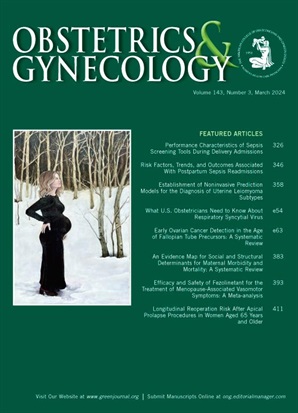
"Obstetrics & Gynecology," affectionately known as "The Green Journal," is the official publication of the American College of Obstetricians and Gynecologists (ACOG). Since its inception in 1953, the journal has been dedicated to advancing the clinical practice of obstetrics and gynecology, as well as related fields. The journal's mission is to promote excellence in these areas by publishing a diverse range of articles that cover translational and clinical topics.
"Obstetrics & Gynecology" provides a platform for the dissemination of evidence-based research, clinical guidelines, and expert opinions that are essential for the continuous improvement of women's health care. The journal's content is designed to inform and educate obstetricians, gynecologists, and other healthcare professionals, ensuring that they stay abreast of the latest developments and best practices in their field.



 京公网安备 11010802042870号
京ICP备2023020795号-1
京公网安备 11010802042870号
京ICP备2023020795号-1

 分享
分享
 求助内容:
求助内容: 应助结果提醒方式:
 扫码关注我们
