Keiana Price, Jasmine M. DeJesus, Shaylene E. Nancekivell
{"title":"She made it with her friend: How social object history influences children's thinking about the value of digital objects","authors":"Keiana Price, Jasmine M. DeJesus, Shaylene E. Nancekivell","doi":"10.1111/cdev.14093","DOIUrl":null,"url":null,"abstract":"<p>Two studies examine how social object histories from collaborative experiences influenced North American children (<i>N</i> = 160, 5–10 years) thinking about the value of digital objects (48% male/51% female; 51% White/24% Black/11% Asian). With forced-choice judgments, Study 1 found (moderate–large effects) that children viewed digital and physical objects with social histories as more special than objects without such histories. On a 10-point scale, Study 2 found (large effects) that children rated digital objects with positive social histories as more special than objects with negative ones. Overall, the studies found that children's tendencies to use object history to understand object value extends into digital contexts. They also reveal how an unexplored kind of history—social history—affects judgments.</p>","PeriodicalId":10109,"journal":{"name":"Child development","volume":"95 5","pages":"1603-1615"},"PeriodicalIF":3.8000,"publicationDate":"2024-04-02","publicationTypes":"Journal Article","fieldsOfStudy":null,"isOpenAccess":false,"openAccessPdf":"https://onlinelibrary.wiley.com/doi/epdf/10.1111/cdev.14093","citationCount":"0","resultStr":null,"platform":"Semanticscholar","paperid":null,"PeriodicalName":"Child development","FirstCategoryId":"102","ListUrlMain":"https://srcd.onlinelibrary.wiley.com/doi/10.1111/cdev.14093","RegionNum":1,"RegionCategory":"心理学","ArticlePicture":[],"TitleCN":null,"AbstractTextCN":null,"PMCID":null,"EPubDate":"","PubModel":"","JCR":"Q1","JCRName":"PSYCHOLOGY, DEVELOPMENTAL","Score":null,"Total":0}
引用次数: 0
Abstract
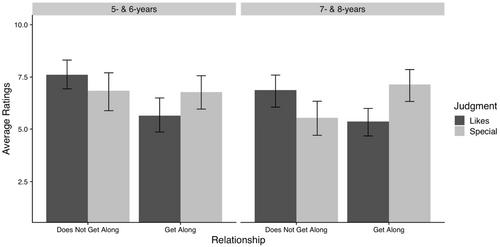
Two studies examine how social object histories from collaborative experiences influenced North American children (N = 160, 5–10 years) thinking about the value of digital objects (48% male/51% female; 51% White/24% Black/11% Asian). With forced-choice judgments, Study 1 found (moderate–large effects) that children viewed digital and physical objects with social histories as more special than objects without such histories. On a 10-point scale, Study 2 found (large effects) that children rated digital objects with positive social histories as more special than objects with negative ones. Overall, the studies found that children's tendencies to use object history to understand object value extends into digital contexts. They also reveal how an unexplored kind of history—social history—affects judgments.
期刊介绍:
As the flagship journal of the Society for Research in Child Development (SRCD), Child Development has published articles, essays, reviews, and tutorials on various topics in the field of child development since 1930. Spanning many disciplines, the journal provides the latest research, not only for researchers and theoreticians, but also for child psychiatrists, clinical psychologists, psychiatric social workers, specialists in early childhood education, educational psychologists, special education teachers, and other researchers. In addition to six issues per year of Child Development, subscribers to the journal also receive a full subscription to Child Development Perspectives and Monographs of the Society for Research in Child Development.





 京公网安备 11010802042870号
京ICP备2023020795号-1
京公网安备 11010802042870号
京ICP备2023020795号-1

 分享
分享
 求助内容:
求助内容: 应助结果提醒方式:
 扫码关注我们
