Analysis of Electrode Tip Angle Variation on Weld Geometry, Distortion, and Hardness in Commercially Pure Titanium Welded Using Pulsed-Gas Tungsten Arc Welding
{"title":"Analysis of Electrode Tip Angle Variation on Weld Geometry, Distortion, and Hardness in Commercially Pure Titanium Welded Using Pulsed-Gas Tungsten Arc Welding","authors":"Adarsh Kumar, Mithlesh Kumar Mahto, Meghanshu Vashista, Mohd Zaheer Khan Yusufzai","doi":"10.1007/s11665-024-09387-6","DOIUrl":null,"url":null,"abstract":"<div><p>Gas tungsten arc welding (GTAW) and its variants are esteemed as economically efficient welding methods for welding titanium alloys in the aerospace and nuclear industries. In the present work, the influence of electrode tip angle on weld geometrical elements, distortion, and hardness was investigated in commercially pure titanium (CP-Ti) sheets welded through pulsed-GTAW. Bead-on-plate (BOP) welding was performed on 2 mm thick CP-Ti sheets using electrode tip angles of 30, 45, 60, 75, and 90°. Defect-free welds were obtained by utilizing an indigenously developed shielding setup assembled with p-GTAW machine. The weld geometrical elements were evaluated using metallographic samples of weldment cross section under the stereomicroscope. The findings revealed that as the electrode tip angle increased from 30 to 60°, weld bead width decreased from 6.84 to 5.32 mm. Additionally, the weld penetration initially increased from 1.59 to 1.75 mm up to 60°, but subsequently decreased to 1.51 mm at 90°. Furthermore, increasing the electrode tip angle led to reduction in weld distortion. Microhardness measurements demonstrated an increase in hardness from the base (141 HV<sub>0.2</sub>) to the weld region (151 HV<sub>0.2</sub>), with a slight decrease observed in the HAZ (134 HV<sub>0.2</sub>). This hardness trend across the weldment remained consistent with each electrode tip angle, and higher hardness was observed using large electrode tip angle.</p></div>","PeriodicalId":644,"journal":{"name":"Journal of Materials Engineering and Performance","volume":"34 5","pages":"3918 - 3928"},"PeriodicalIF":2.0000,"publicationDate":"2024-03-29","publicationTypes":"Journal Article","fieldsOfStudy":null,"isOpenAccess":false,"openAccessPdf":"","citationCount":"0","resultStr":null,"platform":"Semanticscholar","paperid":null,"PeriodicalName":"Journal of Materials Engineering and Performance","FirstCategoryId":"88","ListUrlMain":"https://link.springer.com/article/10.1007/s11665-024-09387-6","RegionNum":4,"RegionCategory":"材料科学","ArticlePicture":[],"TitleCN":null,"AbstractTextCN":null,"PMCID":null,"EPubDate":"","PubModel":"","JCR":"Q3","JCRName":"MATERIALS SCIENCE, MULTIDISCIPLINARY","Score":null,"Total":0}
引用次数: 0
Abstract
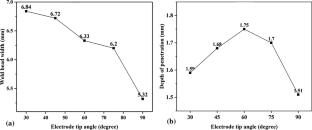
Gas tungsten arc welding (GTAW) and its variants are esteemed as economically efficient welding methods for welding titanium alloys in the aerospace and nuclear industries. In the present work, the influence of electrode tip angle on weld geometrical elements, distortion, and hardness was investigated in commercially pure titanium (CP-Ti) sheets welded through pulsed-GTAW. Bead-on-plate (BOP) welding was performed on 2 mm thick CP-Ti sheets using electrode tip angles of 30, 45, 60, 75, and 90°. Defect-free welds were obtained by utilizing an indigenously developed shielding setup assembled with p-GTAW machine. The weld geometrical elements were evaluated using metallographic samples of weldment cross section under the stereomicroscope. The findings revealed that as the electrode tip angle increased from 30 to 60°, weld bead width decreased from 6.84 to 5.32 mm. Additionally, the weld penetration initially increased from 1.59 to 1.75 mm up to 60°, but subsequently decreased to 1.51 mm at 90°. Furthermore, increasing the electrode tip angle led to reduction in weld distortion. Microhardness measurements demonstrated an increase in hardness from the base (141 HV0.2) to the weld region (151 HV0.2), with a slight decrease observed in the HAZ (134 HV0.2). This hardness trend across the weldment remained consistent with each electrode tip angle, and higher hardness was observed using large electrode tip angle.
期刊介绍:
ASM International''s Journal of Materials Engineering and Performance focuses on solving day-to-day engineering challenges, particularly those involving components for larger systems. The journal presents a clear understanding of relationships between materials selection, processing, applications and performance.
The Journal of Materials Engineering covers all aspects of materials selection, design, processing, characterization and evaluation, including how to improve materials properties through processes and process control of casting, forming, heat treating, surface modification and coating, and fabrication.
Testing and characterization (including mechanical and physical tests, NDE, metallography, failure analysis, corrosion resistance, chemical analysis, surface characterization, and microanalysis of surfaces, features and fractures), and industrial performance measurement are also covered



 京公网安备 11010802042870号
京ICP备2023020795号-1
京公网安备 11010802042870号
京ICP备2023020795号-1

 分享
分享
 求助内容:
求助内容: 应助结果提醒方式:
 扫码关注我们
