Zygosporium palaeogibbum sp. nov. (Xylariales, Ascomycota) associated with Cinnamomum Schaeff. (Lauraceae) leaves from the Siwalik (Middle Miocene) of eastern Himalaya
Sumana Mahato, Maria Virginia Bianchinotti, Sampa Kundu, Mahasin Ali Khan
{"title":"Zygosporium palaeogibbum sp. nov. (Xylariales, Ascomycota) associated with Cinnamomum Schaeff. (Lauraceae) leaves from the Siwalik (Middle Miocene) of eastern Himalaya","authors":"Sumana Mahato, Maria Virginia Bianchinotti, Sampa Kundu, Mahasin Ali Khan","doi":"10.1007/s11557-024-01962-4","DOIUrl":null,"url":null,"abstract":"<p>Well-preserved remains of a mitosporic fungus were found on leaf cuticles of <i>Cinnamomum</i> sp. (<i>Lauraceae</i>) recovered from the lower Siwalik (Chunabati Formation; Middle Miocene) sedimentary stratum of Darjeeling foothills of eastern Himalaya. Based on the characteristic features (solitary vesicular conidiophores arising directly from a superficial mycelium and strongly curved, darkly pigmented, ovoid to pyriform vesicles with 1–3 celled stalk cells), it is here proposed as a new fossil species, <i>Zygosporium palaeogibbum</i> sp. nov. The in situ evidence of <i>Z. palaeogibbum</i> in appreciable numbers on the host leaf cuticles suggests the probable existence of a host-specific saprophytic relationship in the Darjeeling sub-Himalaya’s ancient warm humid tropical climate during the time of deposition. This conclusion on past climate is in agreement with published qualitative, quantitative, and palaeomycological climatic data obtained from the study of megafossil plant remains from the same fossil locality.</p>","PeriodicalId":19111,"journal":{"name":"Mycological Progress","volume":"57 3 1","pages":""},"PeriodicalIF":3.0000,"publicationDate":"2024-04-08","publicationTypes":"Journal Article","fieldsOfStudy":null,"isOpenAccess":false,"openAccessPdf":"","citationCount":"0","resultStr":null,"platform":"Semanticscholar","paperid":null,"PeriodicalName":"Mycological Progress","FirstCategoryId":"99","ListUrlMain":"https://doi.org/10.1007/s11557-024-01962-4","RegionNum":3,"RegionCategory":"生物学","ArticlePicture":[],"TitleCN":null,"AbstractTextCN":null,"PMCID":null,"EPubDate":"","PubModel":"","JCR":"Q3","JCRName":"MYCOLOGY","Score":null,"Total":0}
引用次数: 0
Abstract
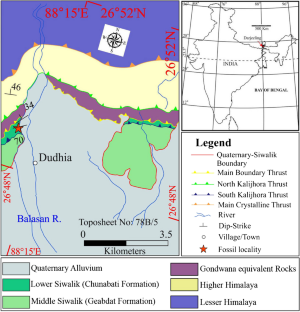
Well-preserved remains of a mitosporic fungus were found on leaf cuticles of Cinnamomum sp. (Lauraceae) recovered from the lower Siwalik (Chunabati Formation; Middle Miocene) sedimentary stratum of Darjeeling foothills of eastern Himalaya. Based on the characteristic features (solitary vesicular conidiophores arising directly from a superficial mycelium and strongly curved, darkly pigmented, ovoid to pyriform vesicles with 1–3 celled stalk cells), it is here proposed as a new fossil species, Zygosporium palaeogibbum sp. nov. The in situ evidence of Z. palaeogibbum in appreciable numbers on the host leaf cuticles suggests the probable existence of a host-specific saprophytic relationship in the Darjeeling sub-Himalaya’s ancient warm humid tropical climate during the time of deposition. This conclusion on past climate is in agreement with published qualitative, quantitative, and palaeomycological climatic data obtained from the study of megafossil plant remains from the same fossil locality.
期刊介绍:
Mycological Progress publishes papers on all aspects of fungi, including lichens. While Review Papers are highly welcome, the main focus is on Research Articles on
Taxonomy and Systematics
Evolution
Cell Biology
Ecology
Biotechnology
Pathology (plants, animals, humans)
Manuscripts on current methods applied in, e.g., morphology, anatomy, ultrastructure (TEM, SEM), genetics, molecular biology, chemistry, and physiology will also be considered.



 京公网安备 11010802042870号
京ICP备2023020795号-1
京公网安备 11010802042870号
京ICP备2023020795号-1

 分享
分享
 求助内容:
求助内容: 应助结果提醒方式:
 扫码关注我们
