Wilmer Carrión-Roca, Annette M. Colón-Mercado, John R. Castro-Suarez, Edwin R. Caballero-Agosto, Francheska M. Colón-González, José A. Centeno-Ortiz, Carlos Ríos-Velázquez, Samuel P. Hernández-Rivera
{"title":"Chemical sensing of common microorganisms found in biopharmaceutical industries using MIR laser spectroscopy and multivariate analysis","authors":"Wilmer Carrión-Roca, Annette M. Colón-Mercado, John R. Castro-Suarez, Edwin R. Caballero-Agosto, Francheska M. Colón-González, José A. Centeno-Ortiz, Carlos Ríos-Velázquez, Samuel P. Hernández-Rivera","doi":"10.1002/jbio.202300391","DOIUrl":null,"url":null,"abstract":"<p>Mid-infrared laser spectroscopy was used to investigate common bacteria encountered in biopharmaceutical industries. The study involved the detection of bacteria using quantum cascade laser spectroscopy coupled to a grazing angle probe (QCL-GAP). Substrates similar to surfaces commonly used in biopharmaceutical industries were used as support media for the samples. Reflectance measurements were assisted by Multivariate Analysis (MVA) to assemble a powerful spectroscopic technique with classification and identification resources. The species analyzed, <i>Staphylococcus aureus</i>, <i>Staphylococcus epidermidis</i>, and <i>Micrococcus luteus</i>, were used to challenge the technique's capability to discriminate from microorganisms of the same family. Principal Components Analysis and Partial Least Squares-Discriminant Analysis differentiated between the bacterial species, using QCL-GAP-MVA as the reference. Spectral differences in the bacterial membrane were used to determine if these microorganisms were present in the samples analyzed. Results herein provided effective discrimination for the bacteria under study with high sensitivity and specificity.</p>","PeriodicalId":184,"journal":{"name":"Journal of Biophotonics","volume":"17 6","pages":""},"PeriodicalIF":2.0000,"publicationDate":"2024-04-06","publicationTypes":"Journal Article","fieldsOfStudy":null,"isOpenAccess":false,"openAccessPdf":"","citationCount":"0","resultStr":null,"platform":"Semanticscholar","paperid":null,"PeriodicalName":"Journal of Biophotonics","FirstCategoryId":"101","ListUrlMain":"https://onlinelibrary.wiley.com/doi/10.1002/jbio.202300391","RegionNum":3,"RegionCategory":"物理与天体物理","ArticlePicture":[],"TitleCN":null,"AbstractTextCN":null,"PMCID":null,"EPubDate":"","PubModel":"","JCR":"Q3","JCRName":"BIOCHEMICAL RESEARCH METHODS","Score":null,"Total":0}
引用次数: 0
Abstract
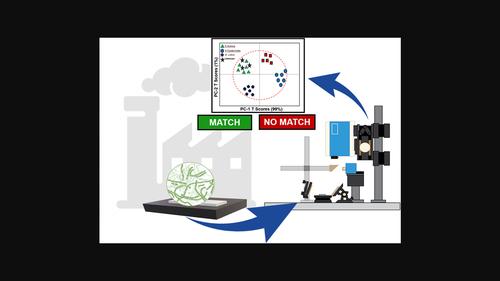
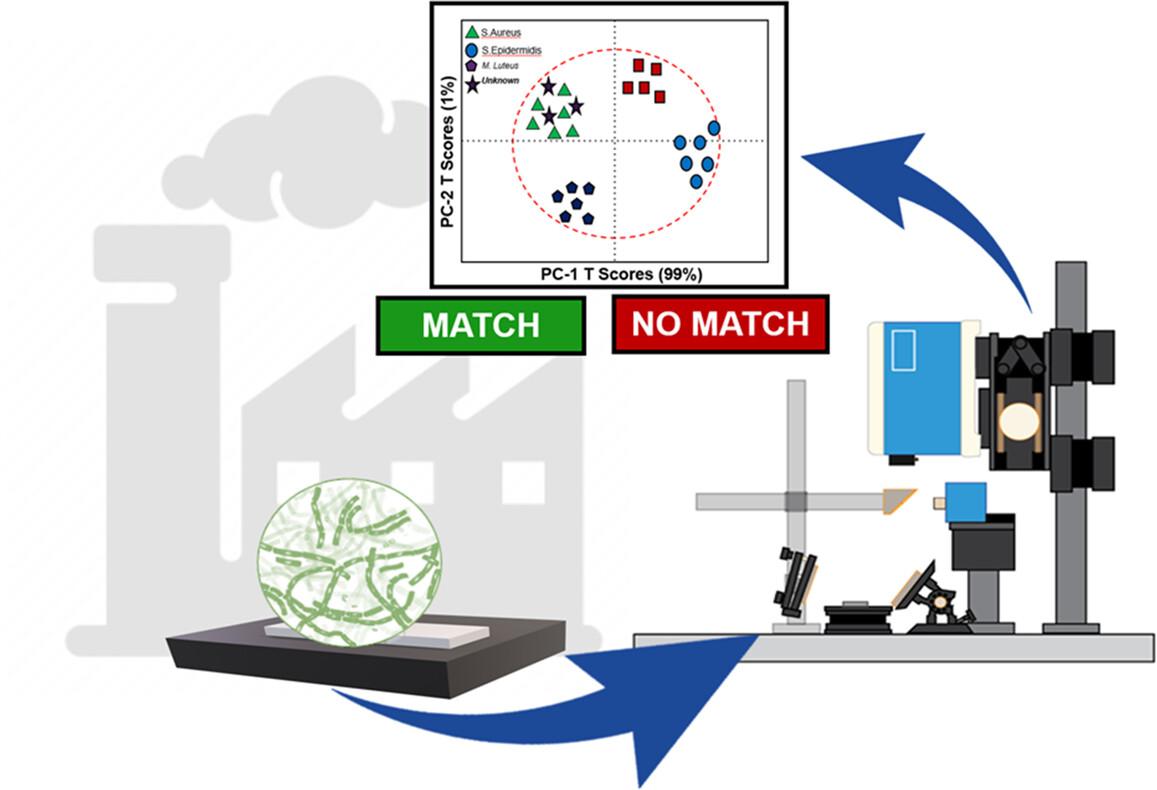
Mid-infrared laser spectroscopy was used to investigate common bacteria encountered in biopharmaceutical industries. The study involved the detection of bacteria using quantum cascade laser spectroscopy coupled to a grazing angle probe (QCL-GAP). Substrates similar to surfaces commonly used in biopharmaceutical industries were used as support media for the samples. Reflectance measurements were assisted by Multivariate Analysis (MVA) to assemble a powerful spectroscopic technique with classification and identification resources. The species analyzed, Staphylococcus aureus, Staphylococcus epidermidis, and Micrococcus luteus, were used to challenge the technique's capability to discriminate from microorganisms of the same family. Principal Components Analysis and Partial Least Squares-Discriminant Analysis differentiated between the bacterial species, using QCL-GAP-MVA as the reference. Spectral differences in the bacterial membrane were used to determine if these microorganisms were present in the samples analyzed. Results herein provided effective discrimination for the bacteria under study with high sensitivity and specificity.
期刊介绍:
The first international journal dedicated to publishing reviews and original articles from this exciting field, the Journal of Biophotonics covers the broad range of research on interactions between light and biological material. The journal offers a platform where the physicist communicates with the biologist and where the clinical practitioner learns about the latest tools for the diagnosis of diseases. As such, the journal is highly interdisciplinary, publishing cutting edge research in the fields of life sciences, medicine, physics, chemistry, and engineering. The coverage extends from fundamental research to specific developments, while also including the latest applications.




 京公网安备 11010802042870号
京ICP备2023020795号-1
京公网安备 11010802042870号
京ICP备2023020795号-1

 分享
分享
 求助内容:
求助内容: 应助结果提醒方式:
 扫码关注我们
