{"title":"Pathophysiological microenvironments in oral candidiasis","authors":"Mette Rose Jørgensen","doi":"10.1111/apm.13412","DOIUrl":null,"url":null,"abstract":"<p>Oral candidiasis (OC), a prevalent opportunistic infection of the oral mucosa, presents a considerable health challenge, particularly in individuals with compromised immune responses, advanced age, and local predisposing conditions. A considerable part of the population carries <i>Candida</i> in the oral cavity, but only few develop OC. Therefore, the pathogenesis of OC may depend on factors other than the attributes of the fungus, such as host factors and other predisposing factors. Mucosal trauma and inflammation compromise epithelial integrity, fostering a conducive environment for fungal invasion. Molecular insights into the immunocompromised state reveal dysregulation in innate and adaptive immunity, creating a permissive environment for <i>Candida</i> proliferation. Detailed examination of <i>Candida</i> species (spp.) and their virulence factors uncovers a nuanced understanding beyond traditional <i>C. albicans</i> focus, which embrace diverse <i>Candida</i> spp. and their strategies, influencing adhesion, invasion, immune evasion, and biofilm formation. Understanding the pathophysiological microenvironments in OC is crucial for the development of targeted therapeutic interventions. This review aims to unravel the diverse pathophysiological microenvironments influencing OC development focusing on microbial, host, and predisposing factors, and considers <i>Candida</i> resistance to antifungal therapy. The comprehensive approach offers a refined perspective on OC, seeking briefly to identify potential therapeutic targets for future effective management.</p>","PeriodicalId":8167,"journal":{"name":"Apmis","volume":"132 12","pages":"956-973"},"PeriodicalIF":2.6000,"publicationDate":"2024-04-04","publicationTypes":"Journal Article","fieldsOfStudy":null,"isOpenAccess":false,"openAccessPdf":"https://onlinelibrary.wiley.com/doi/epdf/10.1111/apm.13412","citationCount":"0","resultStr":null,"platform":"Semanticscholar","paperid":null,"PeriodicalName":"Apmis","FirstCategoryId":"3","ListUrlMain":"https://onlinelibrary.wiley.com/doi/10.1111/apm.13412","RegionNum":4,"RegionCategory":"医学","ArticlePicture":[],"TitleCN":null,"AbstractTextCN":null,"PMCID":null,"EPubDate":"","PubModel":"","JCR":"Q4","JCRName":"IMMUNOLOGY","Score":null,"Total":0}
引用次数: 0
Abstract
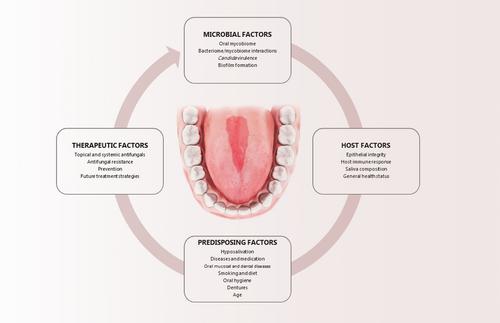
Oral candidiasis (OC), a prevalent opportunistic infection of the oral mucosa, presents a considerable health challenge, particularly in individuals with compromised immune responses, advanced age, and local predisposing conditions. A considerable part of the population carries Candida in the oral cavity, but only few develop OC. Therefore, the pathogenesis of OC may depend on factors other than the attributes of the fungus, such as host factors and other predisposing factors. Mucosal trauma and inflammation compromise epithelial integrity, fostering a conducive environment for fungal invasion. Molecular insights into the immunocompromised state reveal dysregulation in innate and adaptive immunity, creating a permissive environment for Candida proliferation. Detailed examination of Candida species (spp.) and their virulence factors uncovers a nuanced understanding beyond traditional C. albicans focus, which embrace diverse Candida spp. and their strategies, influencing adhesion, invasion, immune evasion, and biofilm formation. Understanding the pathophysiological microenvironments in OC is crucial for the development of targeted therapeutic interventions. This review aims to unravel the diverse pathophysiological microenvironments influencing OC development focusing on microbial, host, and predisposing factors, and considers Candida resistance to antifungal therapy. The comprehensive approach offers a refined perspective on OC, seeking briefly to identify potential therapeutic targets for future effective management.
期刊介绍:
APMIS, formerly Acta Pathologica, Microbiologica et Immunologica Scandinavica, has been published since 1924 by the Scandinavian Societies for Medical Microbiology and Pathology as a non-profit-making scientific journal.



 京公网安备 11010802042870号
京ICP备2023020795号-1
京公网安备 11010802042870号
京ICP备2023020795号-1

 分享
分享
 求助内容:
求助内容: 应助结果提醒方式:
 扫码关注我们
