Tatiana F. Kikhai, Yulia Yu. Agapkina, Tatiana A. Prikazchikova, Maria V. Vdovina, Sofia P. Shekhtman, Sofia V. Fomicheva, Sergey P. Korolev, Marina B. Gottikh
{"title":"Role of I182, R187, and K188 Amino Acid Residues in the Catalytic Domain of HIV-1 Integrase in the Processes of Reverse Transcription and Integration","authors":"Tatiana F. Kikhai, Yulia Yu. Agapkina, Tatiana A. Prikazchikova, Maria V. Vdovina, Sofia P. Shekhtman, Sofia V. Fomicheva, Sergey P. Korolev, Marina B. Gottikh","doi":"10.1134/S0006297924030076","DOIUrl":null,"url":null,"abstract":"<p>Structural organization of HIV-1 integrase is based on a tetramer formed by two protein dimers. Within this tetramer, the catalytic domain of one subunit of the first dimer interacts with the N-terminal domain of the second dimer subunit. It is the tetrameric structure that allows both ends of the viral DNA to be correctly positioned relative to the cellular DNA and to realize catalytic functions of integrase, namely 3′-processing and strand transfer. However, during the HIV-1 replicative cycle, integrase is responsible not only for the integration stage, it is also involved in reverse transcription and is necessary at the stage of capsid formation of the newly formed virions. It has been suggested that HIV-1 integrase is a structurally dynamic protein and its biological functions depend on its structure. Accordingly, studying interactions between the domains of integrase that provide its tetrameric structure is important for understanding its multiple functions. In this work, we investigated the role of three amino acids of the catalytic domain, I182, R187, and K188, located in the contact region of two integrase dimers in the tetramer structure, in reverse transcription and integration. It has been shown that the R187 residue is extremely important for formation of the correct integrase structure, which is necessary at all stages of its functional activity. The I182 residue is necessary for successful integration and is not important for reverse transcription, while the K188 residue, on the contrary, is involved in formation of the integrase structure, which is important for the effective reverse transcription.</p>","PeriodicalId":483,"journal":{"name":"Biochemistry (Moscow)","volume":"89 3","pages":"462 - 473"},"PeriodicalIF":2.2000,"publicationDate":"2024-04-08","publicationTypes":"Journal Article","fieldsOfStudy":null,"isOpenAccess":false,"openAccessPdf":"","citationCount":"0","resultStr":null,"platform":"Semanticscholar","paperid":null,"PeriodicalName":"Biochemistry (Moscow)","FirstCategoryId":"99","ListUrlMain":"https://link.springer.com/article/10.1134/S0006297924030076","RegionNum":4,"RegionCategory":"生物学","ArticlePicture":[],"TitleCN":null,"AbstractTextCN":null,"PMCID":null,"EPubDate":"","PubModel":"","JCR":"Q3","JCRName":"BIOCHEMISTRY & MOLECULAR BIOLOGY","Score":null,"Total":0}
引用次数: 0
Abstract
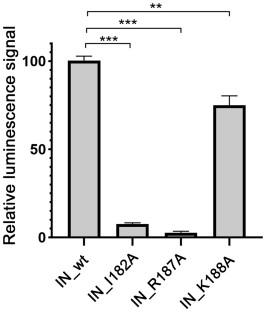
Structural organization of HIV-1 integrase is based on a tetramer formed by two protein dimers. Within this tetramer, the catalytic domain of one subunit of the first dimer interacts with the N-terminal domain of the second dimer subunit. It is the tetrameric structure that allows both ends of the viral DNA to be correctly positioned relative to the cellular DNA and to realize catalytic functions of integrase, namely 3′-processing and strand transfer. However, during the HIV-1 replicative cycle, integrase is responsible not only for the integration stage, it is also involved in reverse transcription and is necessary at the stage of capsid formation of the newly formed virions. It has been suggested that HIV-1 integrase is a structurally dynamic protein and its biological functions depend on its structure. Accordingly, studying interactions between the domains of integrase that provide its tetrameric structure is important for understanding its multiple functions. In this work, we investigated the role of three amino acids of the catalytic domain, I182, R187, and K188, located in the contact region of two integrase dimers in the tetramer structure, in reverse transcription and integration. It has been shown that the R187 residue is extremely important for formation of the correct integrase structure, which is necessary at all stages of its functional activity. The I182 residue is necessary for successful integration and is not important for reverse transcription, while the K188 residue, on the contrary, is involved in formation of the integrase structure, which is important for the effective reverse transcription.
期刊介绍:
Biochemistry (Moscow) is the journal that includes research papers in all fields of biochemistry as well as biochemical aspects of molecular biology, bioorganic chemistry, microbiology, immunology, physiology, and biomedical sciences. Coverage also extends to new experimental methods in biochemistry, theoretical contributions of biochemical importance, reviews of contemporary biochemical topics, and mini-reviews (News in Biochemistry).



 京公网安备 11010802042870号
京ICP备2023020795号-1
京公网安备 11010802042870号
京ICP备2023020795号-1

 分享
分享
 求助内容:
求助内容: 应助结果提醒方式:
 扫码关注我们
