{"title":"Association between quality of life and mortality risk in patients with breast cancer: a systematic review and meta-analysis","authors":"Katsuyoshi Suzuki, Shinichiro Morishita, Jiro Nakano, Taro Okayama, Junichiro Inoue, Takashi Tanaka, Takuya Fukushima","doi":"10.1007/s12282-024-01581-7","DOIUrl":null,"url":null,"abstract":"<h3 data-test=\"abstract-sub-heading\">Background</h3><p>Patients with breast cancer present with various problems that have an adverse effect on the quality of life (QOL). However, the association between the QOL and mortality among patients with breast cancer remains controversial. Therefore, this systematic review and meta-analysis aimed to determine whether QOL impacts prognosis in patients with breast cancer.</p><h3 data-test=\"abstract-sub-heading\">Methods</h3><p>The databases of CINAHL, Scopus, and PubMed databases were searched to retrieve observational studies that assessed the QOL and mortality risk in patients with breast cancer published before December 2022.</p><h3 data-test=\"abstract-sub-heading\">Results</h3><p>Among the 119,061 articles retrieved, six observational studies were included in the meta-analysis. Physical QOL (hazard ratio [HR]: 1.04, 95% confidence interval [CI]: 1.01–1.07, p = 0.003), emotional QOL (HR: 1.01, 95% CI: 1.00–1.03, p = 0.05), and role QOL (HR: 1.01, 95% CI: 1.00–1.01, p = 0.007) showed significant associations with mortality risk. In contrast, global QOL, cognitive QOL, and social QOL showed no associations with mortality risk. Subgroup analysis performed according to treatment time points revealed that the post-treatment physical QOL was associated with mortality risk.</p><h3 data-test=\"abstract-sub-heading\">Conclusions</h3><p>Physical QOL, emotional QOL, and role QOL are associated with mortality risk in patients with breast cancer. Furthermore, post-treatment physical QOL showed a more significant association with prolonged survival than pre-treatment physical QOL.</p>","PeriodicalId":56083,"journal":{"name":"Breast Cancer","volume":"54 1","pages":""},"PeriodicalIF":2.9000,"publicationDate":"2024-04-09","publicationTypes":"Journal Article","fieldsOfStudy":null,"isOpenAccess":false,"openAccessPdf":"","citationCount":"0","resultStr":null,"platform":"Semanticscholar","paperid":null,"PeriodicalName":"Breast Cancer","FirstCategoryId":"3","ListUrlMain":"https://doi.org/10.1007/s12282-024-01581-7","RegionNum":3,"RegionCategory":"医学","ArticlePicture":[],"TitleCN":null,"AbstractTextCN":null,"PMCID":null,"EPubDate":"","PubModel":"","JCR":"Q1","JCRName":"OBSTETRICS & GYNECOLOGY","Score":null,"Total":0}
引用次数: 0
Abstract
Background
Patients with breast cancer present with various problems that have an adverse effect on the quality of life (QOL). However, the association between the QOL and mortality among patients with breast cancer remains controversial. Therefore, this systematic review and meta-analysis aimed to determine whether QOL impacts prognosis in patients with breast cancer.
Methods
The databases of CINAHL, Scopus, and PubMed databases were searched to retrieve observational studies that assessed the QOL and mortality risk in patients with breast cancer published before December 2022.
Results
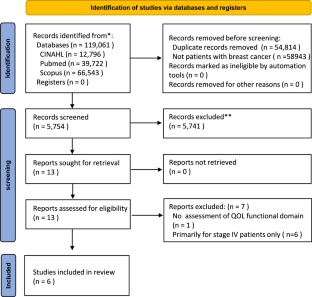
Among the 119,061 articles retrieved, six observational studies were included in the meta-analysis. Physical QOL (hazard ratio [HR]: 1.04, 95% confidence interval [CI]: 1.01–1.07, p = 0.003), emotional QOL (HR: 1.01, 95% CI: 1.00–1.03, p = 0.05), and role QOL (HR: 1.01, 95% CI: 1.00–1.01, p = 0.007) showed significant associations with mortality risk. In contrast, global QOL, cognitive QOL, and social QOL showed no associations with mortality risk. Subgroup analysis performed according to treatment time points revealed that the post-treatment physical QOL was associated with mortality risk.
Conclusions
Physical QOL, emotional QOL, and role QOL are associated with mortality risk in patients with breast cancer. Furthermore, post-treatment physical QOL showed a more significant association with prolonged survival than pre-treatment physical QOL.
期刊介绍:
Breast Cancer, the official journal of the Japanese Breast Cancer Society, publishes articles that contribute to progress in the field, in basic or translational research and also in clinical research, seeking to develop a new focus and new perspectives for all who are concerned with breast cancer. The journal welcomes all original articles describing clinical and epidemiological studies and laboratory investigations regarding breast cancer and related diseases. The journal will consider five types of articles: editorials, review articles, original articles, case reports, and rapid communications. Although editorials and review articles will principally be solicited by the editors, they can also be submitted for peer review, as in the case of original articles. The journal provides the best of up-to-date information on breast cancer, presenting readers with high-impact, original work focusing on pivotal issues.



 京公网安备 11010802042870号
京ICP备2023020795号-1
京公网安备 11010802042870号
京ICP备2023020795号-1

 分享
分享
 求助内容:
求助内容: 应助结果提醒方式:
 扫码关注我们
