Soroosh Hakimian, Abdel-Hakim Bouzid, Lucas A. Hof
{"title":"Effect of gap size on flange face corrosion","authors":"Soroosh Hakimian, Abdel-Hakim Bouzid, Lucas A. Hof","doi":"10.1002/maco.202414367","DOIUrl":null,"url":null,"abstract":"<p>Bolted flanged joints play a critical role in offshore wind turbine tower structures, serving as integral components that connect various sections of the tower. This research study employs electrochemical techniques to investigate the effect of gap dimensions, which determine the crevice gap thickness and crevice depth, on corrosion behavior of 321 stainless steel flange sample plates in a 3.5 wt% NaCl solution at 50°C. Gaskets are used in this study to create gaps between two flange surfaces. A novel fixture is utilized to simulate the applied stress on the gasket, fluid flow within the fixture, and the geometric aspects of the gasket and flange. The findings reveal that increasing the gap thickness from 1.58 to 6.35 mm results in a rise in the general corrosion rate of the flange surface from 0.09 to 1.03 mm y<sup>−1</sup>, and crevice corrosion initiation time increases from 0.23 to 3.12 h. Furthermore, reducing the crevice depth (<i>d</i>) from 7.49 to 0 mm leads to a decrease in the general corrosion rate from 0.09 mm y<sup>−1</sup> to 0.04 µm y<sup>−1</sup>, and cases with <i>d</i> = 3.81 and <i>d</i> = 0 mm show no observable crevice corrosion after potentiostatic tests.</p>","PeriodicalId":18225,"journal":{"name":"Materials and Corrosion-werkstoffe Und Korrosion","volume":"76 6","pages":"833-850"},"PeriodicalIF":2.0000,"publicationDate":"2024-04-04","publicationTypes":"Journal Article","fieldsOfStudy":null,"isOpenAccess":false,"openAccessPdf":"https://onlinelibrary.wiley.com/doi/epdf/10.1002/maco.202414367","citationCount":"0","resultStr":null,"platform":"Semanticscholar","paperid":null,"PeriodicalName":"Materials and Corrosion-werkstoffe Und Korrosion","FirstCategoryId":"88","ListUrlMain":"https://onlinelibrary.wiley.com/doi/10.1002/maco.202414367","RegionNum":4,"RegionCategory":"材料科学","ArticlePicture":[],"TitleCN":null,"AbstractTextCN":null,"PMCID":null,"EPubDate":"","PubModel":"","JCR":"Q4","JCRName":"MATERIALS SCIENCE, MULTIDISCIPLINARY","Score":null,"Total":0}
引用次数: 0
Abstract
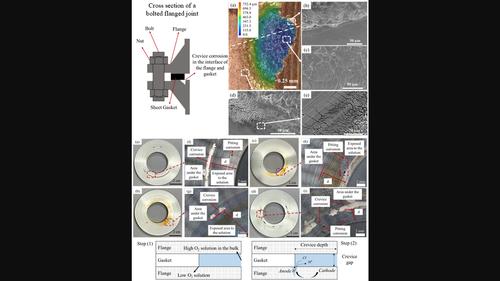
Bolted flanged joints play a critical role in offshore wind turbine tower structures, serving as integral components that connect various sections of the tower. This research study employs electrochemical techniques to investigate the effect of gap dimensions, which determine the crevice gap thickness and crevice depth, on corrosion behavior of 321 stainless steel flange sample plates in a 3.5 wt% NaCl solution at 50°C. Gaskets are used in this study to create gaps between two flange surfaces. A novel fixture is utilized to simulate the applied stress on the gasket, fluid flow within the fixture, and the geometric aspects of the gasket and flange. The findings reveal that increasing the gap thickness from 1.58 to 6.35 mm results in a rise in the general corrosion rate of the flange surface from 0.09 to 1.03 mm y−1, and crevice corrosion initiation time increases from 0.23 to 3.12 h. Furthermore, reducing the crevice depth (d) from 7.49 to 0 mm leads to a decrease in the general corrosion rate from 0.09 mm y−1 to 0.04 µm y−1, and cases with d = 3.81 and d = 0 mm show no observable crevice corrosion after potentiostatic tests.
期刊介绍:
Materials and Corrosion is the leading European journal in its field, providing rapid and comprehensive coverage of the subject and specifically highlighting the increasing importance of corrosion research and prevention.
Several sections exclusive to Materials and Corrosion bring you closer to the current events in the field of corrosion research and add to the impact this journal can make on your work.



 京公网安备 11010802042870号
京ICP备2023020795号-1
京公网安备 11010802042870号
京ICP备2023020795号-1

 分享
分享
 求助内容:
求助内容: 应助结果提醒方式:
 扫码关注我们
