Investigation of recurrence prediction ability of EndoPredict® using microarray data from fresh frozen tissues in ER-positive, HER2-negative breast cancer and indication expansion of EndoPredict® from microarray data from fresh-frozen to FFPE tissues
{"title":"Investigation of recurrence prediction ability of EndoPredict® using microarray data from fresh frozen tissues in ER-positive, HER2-negative breast cancer and indication expansion of EndoPredict® from microarray data from fresh-frozen to FFPE tissues","authors":"Akira Watanabe, Ryo Tsunashima, Chikage Kato, Sae Kitano, Saya Matsumoto, Yoshiaki Sota, Midori Morita, Koichi Sakaguchi, Yasuto Naoi","doi":"10.1007/s12282-024-01573-7","DOIUrl":null,"url":null,"abstract":"<h3 data-test=\"abstract-sub-heading\">Background</h3><p>EndoPredict<sup>®</sup> (EP) is a multigene assay to predict distant recurrence risk in luminal breast cancer. EP measures the expression of 12 genes in primary tumor by qRT-PCR from formalin-fixed paraffin-embedded (FFPE) tissues and calculates EP risk score that indicates the risk of distant recurrence. We evaluated the performance of EP in predicting distant recurrence risk using microarray data from fresh frozen (FF) tissues. We also examined the applicability of EP to microarray data from FFPE tissues.</p><h3 data-test=\"abstract-sub-heading\">Methods</h3><p>We analyzed the publicly available data of 431 node-negative and 270 node-positive patients with luminal breast cancer who received endocrine therapy alone. We evaluated the prognostic value of EP using microarray data from FF tissues. Next, we created an algorithm to calculate EP risk score using microarray data from FFPE tissues. We examined the correlation coefficient of EP risk score and concordance rate of EP risk high/low using microarray data from FFPE/FF tissue pairs in a validation set of 39 patients.</p><h3 data-test=\"abstract-sub-heading\">Results</h3><p>In 431 node-negative patients, the distant recurrence-free survival (DRFS) rate was significantly worse in those with high EP risk scores (<i>P</i> = 3.68 × 10<sup>−6</sup>, log-rank). The 5-year DRFS was 95.2% in those with low EP risk score. In the validation set, the correlation coefficient of EP risk score was 0.93 and the concordance rate of EP risk high/low was 91.7%.</p><h3 data-test=\"abstract-sub-heading\">Conclusions</h3><p>EP using microarray data from FF tissues was useful in predicting distant recurrence risk in luminal breast cancer, and EP might be utilized in microarray data from FFPE tissues.</p>","PeriodicalId":56083,"journal":{"name":"Breast Cancer","volume":"31 1","pages":""},"PeriodicalIF":2.9000,"publicationDate":"2024-04-08","publicationTypes":"Journal Article","fieldsOfStudy":null,"isOpenAccess":false,"openAccessPdf":"","citationCount":"0","resultStr":null,"platform":"Semanticscholar","paperid":null,"PeriodicalName":"Breast Cancer","FirstCategoryId":"3","ListUrlMain":"https://doi.org/10.1007/s12282-024-01573-7","RegionNum":3,"RegionCategory":"医学","ArticlePicture":[],"TitleCN":null,"AbstractTextCN":null,"PMCID":null,"EPubDate":"","PubModel":"","JCR":"Q1","JCRName":"OBSTETRICS & GYNECOLOGY","Score":null,"Total":0}
引用次数: 0
Abstract
Background
EndoPredict® (EP) is a multigene assay to predict distant recurrence risk in luminal breast cancer. EP measures the expression of 12 genes in primary tumor by qRT-PCR from formalin-fixed paraffin-embedded (FFPE) tissues and calculates EP risk score that indicates the risk of distant recurrence. We evaluated the performance of EP in predicting distant recurrence risk using microarray data from fresh frozen (FF) tissues. We also examined the applicability of EP to microarray data from FFPE tissues.
Methods
We analyzed the publicly available data of 431 node-negative and 270 node-positive patients with luminal breast cancer who received endocrine therapy alone. We evaluated the prognostic value of EP using microarray data from FF tissues. Next, we created an algorithm to calculate EP risk score using microarray data from FFPE tissues. We examined the correlation coefficient of EP risk score and concordance rate of EP risk high/low using microarray data from FFPE/FF tissue pairs in a validation set of 39 patients.
Results
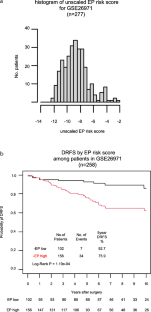
In 431 node-negative patients, the distant recurrence-free survival (DRFS) rate was significantly worse in those with high EP risk scores (P = 3.68 × 10⁻⁶, log-rank). The 5-year DRFS was 95.2% in those with low EP risk score. In the validation set, the correlation coefficient of EP risk score was 0.93 and the concordance rate of EP risk high/low was 91.7%.
Conclusions
EP using microarray data from FF tissues was useful in predicting distant recurrence risk in luminal breast cancer, and EP might be utilized in microarray data from FFPE tissues.
期刊介绍:
Breast Cancer, the official journal of the Japanese Breast Cancer Society, publishes articles that contribute to progress in the field, in basic or translational research and also in clinical research, seeking to develop a new focus and new perspectives for all who are concerned with breast cancer. The journal welcomes all original articles describing clinical and epidemiological studies and laboratory investigations regarding breast cancer and related diseases. The journal will consider five types of articles: editorials, review articles, original articles, case reports, and rapid communications. Although editorials and review articles will principally be solicited by the editors, they can also be submitted for peer review, as in the case of original articles. The journal provides the best of up-to-date information on breast cancer, presenting readers with high-impact, original work focusing on pivotal issues.




 京公网安备 11010802042870号
京ICP备2023020795号-1
京公网安备 11010802042870号
京ICP备2023020795号-1

 分享
分享
 求助内容:
求助内容: 应助结果提醒方式:
 扫码关注我们
