E.S. Cunha , E. Mazepa , M. Batista , F.K. Marchini , G.R. Martinez
{"title":"Redox proteomics in melanoma cells: An optimized protocol","authors":"E.S. Cunha , E. Mazepa , M. Batista , F.K. Marchini , G.R. Martinez","doi":"10.1016/j.ab.2024.115543","DOIUrl":null,"url":null,"abstract":"<div><p>Cancer development and progression are intimately related with post-translational protein modifications, e.g., highly reactive thiol moiety of cysteines enables structural rearrangements resulting in redox biological switches. In this context, redox proteomics techniques, such as 2D redox DIGE, biotin switch assay and OxIcat are fundamental tools to identify and quantify redox-sensitive proteins and to understand redox mechanisms behind thiol modifications. Given the great variability in redox proteomics protocols, problems including decreased resolution of peptides and low protein amounts even after enrichment steps may occur. Considering the biological importance of thiol's oxidation in melanoma, we adapted the biotin-switch assay technique for melanoma cells in order to overcome the limitations and improve coverage of detected proteins.</p></div>","PeriodicalId":7830,"journal":{"name":"Analytical biochemistry","volume":"691 ","pages":"Article 115543"},"PeriodicalIF":2.5000,"publicationDate":"2024-08-01","publicationTypes":"Journal Article","fieldsOfStudy":null,"isOpenAccess":false,"openAccessPdf":"","citationCount":"0","resultStr":null,"platform":"Semanticscholar","paperid":null,"PeriodicalName":"Analytical biochemistry","FirstCategoryId":"99","ListUrlMain":"https://www.sciencedirect.com/science/article/pii/S0003269724000873","RegionNum":4,"RegionCategory":"生物学","ArticlePicture":[],"TitleCN":null,"AbstractTextCN":null,"PMCID":null,"EPubDate":"2024/4/16 0:00:00","PubModel":"Epub","JCR":"Q2","JCRName":"BIOCHEMICAL RESEARCH METHODS","Score":null,"Total":0}
引用次数: 0
Abstract
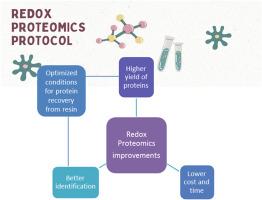
Cancer development and progression are intimately related with post-translational protein modifications, e.g., highly reactive thiol moiety of cysteines enables structural rearrangements resulting in redox biological switches. In this context, redox proteomics techniques, such as 2D redox DIGE, biotin switch assay and OxIcat are fundamental tools to identify and quantify redox-sensitive proteins and to understand redox mechanisms behind thiol modifications. Given the great variability in redox proteomics protocols, problems including decreased resolution of peptides and low protein amounts even after enrichment steps may occur. Considering the biological importance of thiol's oxidation in melanoma, we adapted the biotin-switch assay technique for melanoma cells in order to overcome the limitations and improve coverage of detected proteins.
期刊介绍:
The journal''s title Analytical Biochemistry: Methods in the Biological Sciences declares its broad scope: methods for the basic biological sciences that include biochemistry, molecular genetics, cell biology, proteomics, immunology, bioinformatics and wherever the frontiers of research take the field.
The emphasis is on methods from the strictly analytical to the more preparative that would include novel approaches to protein purification as well as improvements in cell and organ culture. The actual techniques are equally inclusive ranging from aptamers to zymology.
The journal has been particularly active in:
-Analytical techniques for biological molecules-
Aptamer selection and utilization-
Biosensors-
Chromatography-
Cloning, sequencing and mutagenesis-
Electrochemical methods-
Electrophoresis-
Enzyme characterization methods-
Immunological approaches-
Mass spectrometry of proteins and nucleic acids-
Metabolomics-
Nano level techniques-
Optical spectroscopy in all its forms.
The journal is reluctant to include most drug and strictly clinical studies as there are more suitable publication platforms for these types of papers.




 京公网安备 11010802042870号
京ICP备2023020795号-1
京公网安备 11010802042870号
京ICP备2023020795号-1

 分享
分享
 求助内容:
求助内容: 应助结果提醒方式:
 扫码关注我们
