{"title":"EnduroBone: A 3D printed bioreactor for extended bone tissue culture","authors":"Paula Gustin , Anamika Prasad","doi":"10.1016/j.ohx.2024.e00535","DOIUrl":null,"url":null,"abstract":"<div><p>Studies of the effects of external stimuli on bone tissue, disease transmission mechanisms, and potential medication discoveries benefit from long-term tissue viability ex vivo. By simulating the in-vivo environment, bioreactors are essential for studying bone cellular activity throughout biological processes. We present the development of an automated 3D-printed bioreactor EnduroBone designed to sustain the ex-vivo viability of 10 mm diameter cancellous bone cores for an extended period. The device is supplied with two critical parameters for maintaining bone tissue viability: closed-loop continuous flow perfusion of 1 mL/min for nutrient diffusion and waste removal and direct mechanical stimulation with cyclic compression at 13.2 RPM (revolutions per minute) to promote cell viability which can lead to improved tissue stability during ex vivo culturing. The bioreactor addresses several limitations of existing systems and provides a versatile open-source platform for bone cancer research, orthopedic device testing, and other related applications. To validate the bioreactor, fresh swine samples were cultured ex-vivo, and their cell viability was determined to be maintained for up to 28 days. Periodic cell viability assessment through live/dead cell staining and confocal imaging at the start (0 days) and at several time points throughout the culture period (7, 14, 21, and 28 days) was used to demonstrate <em>EnduroBone</em> effectiveness in sustaining bone cell health for the extended period tested.</p></div>","PeriodicalId":37503,"journal":{"name":"HardwareX","volume":"18 ","pages":"Article e00535"},"PeriodicalIF":2.1000,"publicationDate":"2024-04-18","publicationTypes":"Journal Article","fieldsOfStudy":null,"isOpenAccess":false,"openAccessPdf":"https://www.sciencedirect.com/science/article/pii/S2468067224000294/pdfft?md5=9822e41beff57f1ca2489df3f963cb34&pid=1-s2.0-S2468067224000294-main.pdf","citationCount":"0","resultStr":null,"platform":"Semanticscholar","paperid":null,"PeriodicalName":"HardwareX","FirstCategoryId":"1085","ListUrlMain":"https://www.sciencedirect.com/science/article/pii/S2468067224000294","RegionNum":0,"RegionCategory":null,"ArticlePicture":[],"TitleCN":null,"AbstractTextCN":null,"PMCID":null,"EPubDate":"","PubModel":"","JCR":"Q3","JCRName":"ENGINEERING, ELECTRICAL & ELECTRONIC","Score":null,"Total":0}
引用次数: 0
Abstract
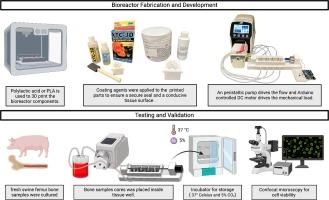
Studies of the effects of external stimuli on bone tissue, disease transmission mechanisms, and potential medication discoveries benefit from long-term tissue viability ex vivo. By simulating the in-vivo environment, bioreactors are essential for studying bone cellular activity throughout biological processes. We present the development of an automated 3D-printed bioreactor EnduroBone designed to sustain the ex-vivo viability of 10 mm diameter cancellous bone cores for an extended period. The device is supplied with two critical parameters for maintaining bone tissue viability: closed-loop continuous flow perfusion of 1 mL/min for nutrient diffusion and waste removal and direct mechanical stimulation with cyclic compression at 13.2 RPM (revolutions per minute) to promote cell viability which can lead to improved tissue stability during ex vivo culturing. The bioreactor addresses several limitations of existing systems and provides a versatile open-source platform for bone cancer research, orthopedic device testing, and other related applications. To validate the bioreactor, fresh swine samples were cultured ex-vivo, and their cell viability was determined to be maintained for up to 28 days. Periodic cell viability assessment through live/dead cell staining and confocal imaging at the start (0 days) and at several time points throughout the culture period (7, 14, 21, and 28 days) was used to demonstrate EnduroBone effectiveness in sustaining bone cell health for the extended period tested.
HardwareXEngineering-Industrial and Manufacturing Engineering
CiteScore
4.10
自引率
18.20%
发文量
124
审稿时长
24 weeks
期刊介绍:
HardwareX is an open access journal established to promote free and open source designing, building and customizing of scientific infrastructure (hardware). HardwareX aims to recognize researchers for the time and effort in developing scientific infrastructure while providing end-users with sufficient information to replicate and validate the advances presented. HardwareX is open to input from all scientific, technological and medical disciplines. Scientific infrastructure will be interpreted in the broadest sense. Including hardware modifications to existing infrastructure, sensors and tools that perform measurements and other functions outside of the traditional lab setting (such as wearables, air/water quality sensors, and low cost alternatives to existing tools), and the creation of wholly new tools for either standard or novel laboratory tasks. Authors are encouraged to submit hardware developments that address all aspects of science, not only the final measurement, for example, enhancements in sample preparation and handling, user safety, and quality control. The use of distributed digital manufacturing strategies (e.g. 3-D printing) is encouraged. All designs must be submitted under an open hardware license.




 京公网安备 11010802042870号
京ICP备2023020795号-1
京公网安备 11010802042870号
京ICP备2023020795号-1

 分享
分享
 求助内容:
求助内容: 应助结果提醒方式:
 扫码关注我们
