Juan A. Hernández-Agüero, Ildefonso Ruiz-Tapiador, Lucas A. Garibaldi, Mikhail V. Kozlov, Elina Mäntylä, Marcos E. Nacif, Norma Salinas, Luis Cayuela
{"title":"The effects of human population density on trophic interactions are contingent upon latitude","authors":"Juan A. Hernández-Agüero, Ildefonso Ruiz-Tapiador, Lucas A. Garibaldi, Mikhail V. Kozlov, Elina Mäntylä, Marcos E. Nacif, Norma Salinas, Luis Cayuela","doi":"10.1111/geb.13849","DOIUrl":null,"url":null,"abstract":"<div>\n \n \n <section>\n \n <h3> Aim</h3>\n \n <p>Global-scale studies are necessary to draw general conclusions on how trophic interactions vary with urbanization and to explore how the effects of urbanization change along latitudinal gradients. We predict that the intensity of trophic interactions decreases in response to urbanization (quantified by human population density). Since trophic interactions are more intense at lower latitudes, we also expect major impacts of urbanization at higher latitudes, where base levels are essentially lower.</p>\n </section>\n \n <section>\n \n <h3> Location</h3>\n \n <p>Global (881 study sites).</p>\n </section>\n \n <section>\n \n <h3> Time period</h3>\n \n <p>2000–2021.</p>\n </section>\n \n <section>\n \n <h3> Major taxa studied</h3>\n \n <p>Birds, arthropods and woody plants.</p>\n </section>\n \n <section>\n \n <h3> Methods</h3>\n \n <p>We compiled global data on insect herbivory and bird predation from studies that employed similar methods and fitted generalized linear mixed models to test how these trophic interactions vary with human population density, latitude and their interactions.</p>\n </section>\n \n <section>\n \n <h3> Results</h3>\n \n <p>The intensity of herbivory and predation decreased with an increase in human population density at lower latitudes. Surprisingly, it remained unaffected at intermediate latitudes and even increased at higher latitudes.</p>\n </section>\n \n <section>\n \n <h3> Main conclusions</h3>\n \n <p>The observed patterns may be attributed to local climate changes in urban areas, such as the Urban Heat Island effect, which disrupts thermal stability in the tropics while increasing niche availability at polar latitudes.</p>\n </section>\n </div>","PeriodicalId":176,"journal":{"name":"Global Ecology and Biogeography","volume":"33 7","pages":""},"PeriodicalIF":6.0000,"publicationDate":"2024-04-23","publicationTypes":"Journal Article","fieldsOfStudy":null,"isOpenAccess":false,"openAccessPdf":"https://onlinelibrary.wiley.com/doi/epdf/10.1111/geb.13849","citationCount":"0","resultStr":null,"platform":"Semanticscholar","paperid":null,"PeriodicalName":"Global Ecology and Biogeography","FirstCategoryId":"93","ListUrlMain":"https://onlinelibrary.wiley.com/doi/10.1111/geb.13849","RegionNum":1,"RegionCategory":"环境科学与生态学","ArticlePicture":[],"TitleCN":null,"AbstractTextCN":null,"PMCID":null,"EPubDate":"","PubModel":"","JCR":"Q1","JCRName":"ECOLOGY","Score":null,"Total":0}
引用次数: 0
Abstract
Aim
Global-scale studies are necessary to draw general conclusions on how trophic interactions vary with urbanization and to explore how the effects of urbanization change along latitudinal gradients. We predict that the intensity of trophic interactions decreases in response to urbanization (quantified by human population density). Since trophic interactions are more intense at lower latitudes, we also expect major impacts of urbanization at higher latitudes, where base levels are essentially lower.
Location
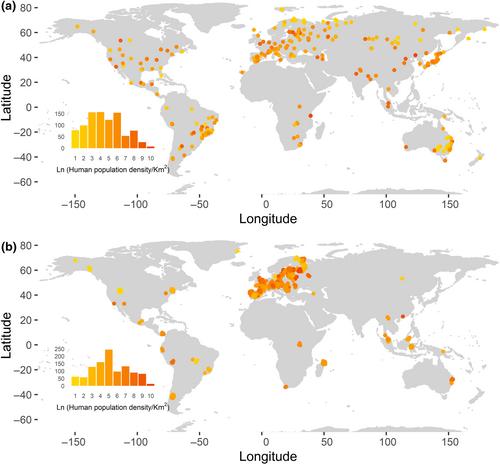
Global (881 study sites).
Time period
2000–2021.
Major taxa studied
Birds, arthropods and woody plants.
Methods
We compiled global data on insect herbivory and bird predation from studies that employed similar methods and fitted generalized linear mixed models to test how these trophic interactions vary with human population density, latitude and their interactions.
Results
The intensity of herbivory and predation decreased with an increase in human population density at lower latitudes. Surprisingly, it remained unaffected at intermediate latitudes and even increased at higher latitudes.
Main conclusions
The observed patterns may be attributed to local climate changes in urban areas, such as the Urban Heat Island effect, which disrupts thermal stability in the tropics while increasing niche availability at polar latitudes.
期刊介绍:
Global Ecology and Biogeography (GEB) welcomes papers that investigate broad-scale (in space, time and/or taxonomy), general patterns in the organization of ecological systems and assemblages, and the processes that underlie them. In particular, GEB welcomes studies that use macroecological methods, comparative analyses, meta-analyses, reviews, spatial analyses and modelling to arrive at general, conceptual conclusions. Studies in GEB need not be global in spatial extent, but the conclusions and implications of the study must be relevant to ecologists and biogeographers globally, rather than being limited to local areas, or specific taxa. Similarly, GEB is not limited to spatial studies; we are equally interested in the general patterns of nature through time, among taxa (e.g., body sizes, dispersal abilities), through the course of evolution, etc. Further, GEB welcomes papers that investigate general impacts of human activities on ecological systems in accordance with the above criteria.




 京公网安备 11010802042870号
京ICP备2023020795号-1
京公网安备 11010802042870号
京ICP备2023020795号-1

 分享
分享
 求助内容:
求助内容: 应助结果提醒方式:
 扫码关注我们
