Investigating the potential of integrated urban greening strategies for reducing outdoor thermal stresses: a case of asymmetrical configuration in the tropical city of Bhopal
{"title":"Investigating the potential of integrated urban greening strategies for reducing outdoor thermal stresses: a case of asymmetrical configuration in the tropical city of Bhopal","authors":"Saurabh Kishore Ojha, Mahua Mukherjee","doi":"10.1007/s00484-024-02680-y","DOIUrl":null,"url":null,"abstract":"<div><p>In Indian cities where streets are the only affordable outdoor public space, pedestrians are always exposed to extreme heat related health risk. However, it’s a challenge to reduce heat stress in existing streets characterized by asymmetrical urban configuration. Integrating vegetation without reconstituting the original orientation and geometry is one of the feasible ways to alleviate stress. Therefore, current study focuses to analyse the heat stress reduction potential of urban greenery strategy in asymmetrical urban configuration from spatiotemporal perspective. It initiates with the selection of commercial streets in extreme hot climate with an on-site measurement of its climatic and morphological attributes. Furthermore, it leads to the classification and prioritizing of street's sections linked to hot-spots determined by varied sky view factor and asymmetrical aspect ratio. Finally, an Envi-Met model with iterated scenarios at the building and street levels is developed, incorporating three strategies (trees, grass, green-walls). The impact of heat related health risk is quantified using a thermal index Universal Thermal Climate Index along with air temperature and mean radiant temperature. The results suggested that due to asymmetricity a fixed strategy would not be applicable across the street. The highest reduction was observed by trees in asymmetrical sections while lowest was recorded by green-wall. However, it would be worthwhile to adopt green-wall along with dense tree’s (leaf area density, 0.3) in order to reduce the heat stress in deeper sections. The evidence-based integration of Urban greenery can assist planners and designers in mitigating extreme heat stress in similar complex urban environment.</p></div>","PeriodicalId":588,"journal":{"name":"International Journal of Biometeorology","volume":"68 7","pages":"1451 - 1474"},"PeriodicalIF":2.6000,"publicationDate":"2024-04-26","publicationTypes":"Journal Article","fieldsOfStudy":null,"isOpenAccess":false,"openAccessPdf":"","citationCount":"0","resultStr":null,"platform":"Semanticscholar","paperid":null,"PeriodicalName":"International Journal of Biometeorology","FirstCategoryId":"89","ListUrlMain":"https://link.springer.com/article/10.1007/s00484-024-02680-y","RegionNum":3,"RegionCategory":"地球科学","ArticlePicture":[],"TitleCN":null,"AbstractTextCN":null,"PMCID":null,"EPubDate":"","PubModel":"","JCR":"Q2","JCRName":"BIOPHYSICS","Score":null,"Total":0}
引用次数: 0
Abstract
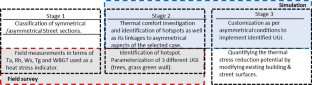
In Indian cities where streets are the only affordable outdoor public space, pedestrians are always exposed to extreme heat related health risk. However, it’s a challenge to reduce heat stress in existing streets characterized by asymmetrical urban configuration. Integrating vegetation without reconstituting the original orientation and geometry is one of the feasible ways to alleviate stress. Therefore, current study focuses to analyse the heat stress reduction potential of urban greenery strategy in asymmetrical urban configuration from spatiotemporal perspective. It initiates with the selection of commercial streets in extreme hot climate with an on-site measurement of its climatic and morphological attributes. Furthermore, it leads to the classification and prioritizing of street's sections linked to hot-spots determined by varied sky view factor and asymmetrical aspect ratio. Finally, an Envi-Met model with iterated scenarios at the building and street levels is developed, incorporating three strategies (trees, grass, green-walls). The impact of heat related health risk is quantified using a thermal index Universal Thermal Climate Index along with air temperature and mean radiant temperature. The results suggested that due to asymmetricity a fixed strategy would not be applicable across the street. The highest reduction was observed by trees in asymmetrical sections while lowest was recorded by green-wall. However, it would be worthwhile to adopt green-wall along with dense tree’s (leaf area density, 0.3) in order to reduce the heat stress in deeper sections. The evidence-based integration of Urban greenery can assist planners and designers in mitigating extreme heat stress in similar complex urban environment.
期刊介绍:
The Journal publishes original research papers, review articles and short communications on studies examining the interactions between living organisms and factors of the natural and artificial atmospheric environment.
Living organisms extend from single cell organisms, to plants and animals, including humans. The atmospheric environment includes climate and weather, electromagnetic radiation, and chemical and biological pollutants. The journal embraces basic and applied research and practical aspects such as living conditions, agriculture, forestry, and health.
The journal is published for the International Society of Biometeorology, and most membership categories include a subscription to the Journal.



 京公网安备 11010802042870号
京ICP备2023020795号-1
京公网安备 11010802042870号
京ICP备2023020795号-1

 分享
分享
 求助内容:
求助内容: 应助结果提醒方式:
 扫码关注我们
