{"title":"Fabricating Co3O4–Co2MnO4 based type-II heterostructure architecture with prominent photoelectrocatalytic performance toward water purification","authors":"Yanan Gong, Shanshan Li, Md Azharul Hossain, Yanan Zhang, Jiarong Zhang, Guowen Wang, Yinghuan Fu, Hongchao Ma","doi":"10.1007/s10008-024-05888-5","DOIUrl":null,"url":null,"abstract":"<div><p>Designing heterogeneous micro-nanostructured photoelectrodes based on ideal semiconductor catalytic materials is an efficient method for realizing the practical application of photoelectrocatalysis (PEC) technology. Herein, we propose a one-pot approach for fabricating semiconductor composite heterostructures (Co<sub>3</sub>O<sub>4</sub>–Co<sub>2</sub>MnO<sub>4</sub> architecture), which is a simpler, faster, and more economical method compared with previous layer-by-layer assembly methods. Interestingly enough, coupled Co<sub>3</sub>O<sub>4</sub> nanowire/Co<sub>2</sub>MnO<sub>4</sub> nanoparticle architecture is fabricated by a one-pot hydrothermal method using cobalt and manganese salts. It can be seen that the micro-nanostructure and PEC performance of Co<sub>3</sub>O<sub>4</sub>–Co<sub>2</sub>MnO<sub>4</sub> architecture can be adjusted by changing the concentration of Mn<sup>2+</sup> (i.e., ratio of Mn/Co) in the precursor solution. Consequently, the as-prepared Ti/Co<sub>3</sub>O<sub>4</sub>–Co<sub>2</sub>MnO<sub>4</sub> showed better PEC performance for degrading reactive brilliant blue KN-R with 60 mg/L concentration compared with that of Ti/Co<sub>3</sub>O<sub>4</sub> and Ti/Co<sub>2</sub>MnO<sub>4</sub>. The optimized Ti/Co<sub>3</sub>O<sub>4</sub>–Co<sub>2</sub>MnO<sub>4</sub>-0.3 exhibited better PEC activity (~ 94.12%) in 2 h for degrading reactive brilliant blue KN-R. The enhancement of PEC performance of Ti/Co<sub>3</sub>O<sub>4</sub>–Co<sub>2</sub>MnO<sub>4</sub> can be proposed to the formation of a type-II heterojunction mechanism between Co<sub>3</sub>O<sub>4</sub> and Co<sub>2</sub>MnO<sub>4</sub>, which promotes the formation of active species (·O<sub>2</sub><sup>−</sup>, and h<sup>+</sup>), leading to good separation of induced carriers. This work provides a feasible strategy for fabrication of coupled semiconductor/semiconductor heterostructure with PEC efficiency using a simplified experimental approach.</p></div>","PeriodicalId":665,"journal":{"name":"Journal of Solid State Electrochemistry","volume":"29 8","pages":"3305 - 3313"},"PeriodicalIF":2.6000,"publicationDate":"2024-04-25","publicationTypes":"Journal Article","fieldsOfStudy":null,"isOpenAccess":false,"openAccessPdf":"","citationCount":"0","resultStr":null,"platform":"Semanticscholar","paperid":null,"PeriodicalName":"Journal of Solid State Electrochemistry","FirstCategoryId":"5","ListUrlMain":"https://link.springer.com/article/10.1007/s10008-024-05888-5","RegionNum":4,"RegionCategory":"化学","ArticlePicture":[],"TitleCN":null,"AbstractTextCN":null,"PMCID":null,"EPubDate":"","PubModel":"","JCR":"Q3","JCRName":"ELECTROCHEMISTRY","Score":null,"Total":0}
引用次数: 0
Abstract
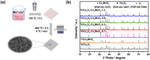
Designing heterogeneous micro-nanostructured photoelectrodes based on ideal semiconductor catalytic materials is an efficient method for realizing the practical application of photoelectrocatalysis (PEC) technology. Herein, we propose a one-pot approach for fabricating semiconductor composite heterostructures (Co3O4–Co2MnO4 architecture), which is a simpler, faster, and more economical method compared with previous layer-by-layer assembly methods. Interestingly enough, coupled Co3O4 nanowire/Co2MnO4 nanoparticle architecture is fabricated by a one-pot hydrothermal method using cobalt and manganese salts. It can be seen that the micro-nanostructure and PEC performance of Co3O4–Co2MnO4 architecture can be adjusted by changing the concentration of Mn2+ (i.e., ratio of Mn/Co) in the precursor solution. Consequently, the as-prepared Ti/Co3O4–Co2MnO4 showed better PEC performance for degrading reactive brilliant blue KN-R with 60 mg/L concentration compared with that of Ti/Co3O4 and Ti/Co2MnO4. The optimized Ti/Co3O4–Co2MnO4-0.3 exhibited better PEC activity (~ 94.12%) in 2 h for degrading reactive brilliant blue KN-R. The enhancement of PEC performance of Ti/Co3O4–Co2MnO4 can be proposed to the formation of a type-II heterojunction mechanism between Co3O4 and Co2MnO4, which promotes the formation of active species (·O2−, and h+), leading to good separation of induced carriers. This work provides a feasible strategy for fabrication of coupled semiconductor/semiconductor heterostructure with PEC efficiency using a simplified experimental approach.
期刊介绍:
The Journal of Solid State Electrochemistry is devoted to all aspects of solid-state chemistry and solid-state physics in electrochemistry.
The Journal of Solid State Electrochemistry publishes papers on all aspects of electrochemistry of solid compounds, including experimental and theoretical, basic and applied work. It equally publishes papers on the thermodynamics and kinetics of electrochemical reactions if at least one actively participating phase is solid. Also of interest are articles on the transport of ions and electrons in solids whenever these processes are relevant to electrochemical reactions and on the use of solid-state electrochemical reactions in the analysis of solids and their surfaces.
The journal covers solid-state electrochemistry and focusses on the following fields: mechanisms of solid-state electrochemical reactions, semiconductor electrochemistry, electrochemical batteries, accumulators and fuel cells, electrochemical mineral leaching, galvanic metal plating, electrochemical potential memory devices, solid-state electrochemical sensors, ion and electron transport in solid materials and polymers, electrocatalysis, photoelectrochemistry, corrosion of solid materials, solid-state electroanalysis, electrochemical machining of materials, electrochromism and electrochromic devices, new electrochemical solid-state synthesis.
The Journal of Solid State Electrochemistry makes the professional in research and industry aware of this swift progress and its importance for future developments and success in the above-mentioned fields.



 京公网安备 11010802042870号
京ICP备2023020795号-1
京公网安备 11010802042870号
京ICP备2023020795号-1

 分享
分享
 求助内容:
求助内容: 应助结果提醒方式:
 扫码关注我们
