Tallal S. Mahdi, Dalia R. Abd Elhafiz, Nesma M. Helal, Somia S. El Akkad
{"title":"Hydrothermal conversion of mango wood wastes and sugarcane bagasse for biofuel production","authors":"Tallal S. Mahdi, Dalia R. Abd Elhafiz, Nesma M. Helal, Somia S. El Akkad","doi":"10.1007/s13399-024-05572-8","DOIUrl":null,"url":null,"abstract":"<div><p>This paper presents the first-ever evaluation of the thermochemical properties and suitability of mango wood (MW) for energy production. The data is compared to that of sugarcane bagasse (SB), a common biomass in waste-to-energy technology (WTE). Proximate, ultimate, and calorific analyses were conducted to assess the energy potential of MW, while thermogravimetric analysis was employed to investigate its decomposition behavior under pyrolysis conditions. Exhibiting low nitrogen content and an absence of sulfur, the two samples emerged as environmentally friendly energy sources. To investigate their potential for biocrude oil production, hydrothermal liquefaction (HTL) was conducted at low temperature (180 °C) in the presence of water/methanol (35/15v/v) co-solvent system. The results revealed a remarkable enhancement in biocrude oil production, attributed to the strong interaction between the co-solvents and biomass intermediates. Mango wood waste exhibited higher conversion rate of 70 wt%, resulting in higher biocrude oil yield and lower hydrochar selectivity. The biocrude oil produced from MW had a higher heating value (HHV) of 29.70 MJ/kg and higher energy recovery (EY% ~ 50.60%) than that from SB. Moreover, it contains high concentration of phenolic compounds, contributing to enhance its stability; however, SB biocrude oil exhibited an aromatic hydrocarbon content (> 25%), making it suitable candidate for blending with diesel fuel. The hydrochar produced from MW exhibited high HHV of ~ 23.61 MJ/kg and lower EY% of ~ 45.02%, outperforming SB hydrochar in both aspects (HHV ~ 22.7 MJ/kg, EY% ~ 65.43%). Additionally, the MW hydrochar has high ignition temperature and lower burnout temperature.</p></div>","PeriodicalId":488,"journal":{"name":"Biomass Conversion and Biorefinery","volume":"15 23","pages":"30203 - 30217"},"PeriodicalIF":4.1000,"publicationDate":"2024-04-24","publicationTypes":"Journal Article","fieldsOfStudy":null,"isOpenAccess":false,"openAccessPdf":"","citationCount":"0","resultStr":null,"platform":"Semanticscholar","paperid":null,"PeriodicalName":"Biomass Conversion and Biorefinery","FirstCategoryId":"5","ListUrlMain":"https://link.springer.com/article/10.1007/s13399-024-05572-8","RegionNum":4,"RegionCategory":"工程技术","ArticlePicture":[],"TitleCN":null,"AbstractTextCN":null,"PMCID":null,"EPubDate":"","PubModel":"","JCR":"Q3","JCRName":"ENERGY & FUELS","Score":null,"Total":0}
引用次数: 0
Abstract
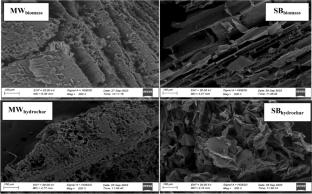
This paper presents the first-ever evaluation of the thermochemical properties and suitability of mango wood (MW) for energy production. The data is compared to that of sugarcane bagasse (SB), a common biomass in waste-to-energy technology (WTE). Proximate, ultimate, and calorific analyses were conducted to assess the energy potential of MW, while thermogravimetric analysis was employed to investigate its decomposition behavior under pyrolysis conditions. Exhibiting low nitrogen content and an absence of sulfur, the two samples emerged as environmentally friendly energy sources. To investigate their potential for biocrude oil production, hydrothermal liquefaction (HTL) was conducted at low temperature (180 °C) in the presence of water/methanol (35/15v/v) co-solvent system. The results revealed a remarkable enhancement in biocrude oil production, attributed to the strong interaction between the co-solvents and biomass intermediates. Mango wood waste exhibited higher conversion rate of 70 wt%, resulting in higher biocrude oil yield and lower hydrochar selectivity. The biocrude oil produced from MW had a higher heating value (HHV) of 29.70 MJ/kg and higher energy recovery (EY% ~ 50.60%) than that from SB. Moreover, it contains high concentration of phenolic compounds, contributing to enhance its stability; however, SB biocrude oil exhibited an aromatic hydrocarbon content (> 25%), making it suitable candidate for blending with diesel fuel. The hydrochar produced from MW exhibited high HHV of ~ 23.61 MJ/kg and lower EY% of ~ 45.02%, outperforming SB hydrochar in both aspects (HHV ~ 22.7 MJ/kg, EY% ~ 65.43%). Additionally, the MW hydrochar has high ignition temperature and lower burnout temperature.
期刊介绍:
Biomass Conversion and Biorefinery presents articles and information on research, development and applications in thermo-chemical conversion; physico-chemical conversion and bio-chemical conversion, including all necessary steps for the provision and preparation of the biomass as well as all possible downstream processing steps for the environmentally sound and economically viable provision of energy and chemical products.



 京公网安备 11010802042870号
京ICP备2023020795号-1
京公网安备 11010802042870号
京ICP备2023020795号-1

 分享
分享
 求助内容:
求助内容: 应助结果提醒方式:
 扫码关注我们
