{"title":"Preparation of PEG-Bi-PbO2 electrode and investigation on its catalytic performance","authors":"Dong Liu, Zhongnan Kang, Guangyu Xu, Wen Chen, Yigang Ding","doi":"10.1007/s10008-024-05878-7","DOIUrl":null,"url":null,"abstract":"<div><p>Co-doped PEG-Bi-PbO<sub>2</sub> composite electrodes, containing Bi<sup>3+</sup> and polyethylene glycol (PEG), were fabricated by a simple electrodeposition method on the Ti substrates. The preparation technological process and the degradation performance of the PEG-Bi-PbO<sub>2</sub> electrode towards P-nitrophenol (PNP) were investigated. The PEG-Bi-PbO<sub>2</sub> electrode was characterized by XRD, SEM, CV, and EIS. The results indicated that compared to the pure PbO<sub>2</sub> and Bi-doped PbO<sub>2</sub> electrodes, the PEG-Bi-PbO<sub>2</sub> electrode exhibited the most uniform distribution of the active surface layer, the smallest particles, and the highest oxygen evolution potential (OEP). And PEG-Bi-modified PbO<sub>2</sub> anode displays superb stability and catalytic activity. Moreover, the electrode exhibited excellent electrochemical oxidation activity on the degradation of PNP with a degradation efficiency of 92.3% achieved at 20 mA/cm<sup>2</sup>, <span>\\({{\\text{C}}}_{{{\\text{Na}}}_{2}{{\\text{SO}}}_{4}}\\)</span> = 0.08 mol/L, pH = 5.0, and 60 °C. The degradation process was consistent with the quasi-primary kinetics.</p></div>","PeriodicalId":665,"journal":{"name":"Journal of Solid State Electrochemistry","volume":"29 8","pages":"3315 - 3326"},"PeriodicalIF":2.6000,"publicationDate":"2024-04-24","publicationTypes":"Journal Article","fieldsOfStudy":null,"isOpenAccess":false,"openAccessPdf":"","citationCount":"0","resultStr":null,"platform":"Semanticscholar","paperid":null,"PeriodicalName":"Journal of Solid State Electrochemistry","FirstCategoryId":"5","ListUrlMain":"https://link.springer.com/article/10.1007/s10008-024-05878-7","RegionNum":4,"RegionCategory":"化学","ArticlePicture":[],"TitleCN":null,"AbstractTextCN":null,"PMCID":null,"EPubDate":"","PubModel":"","JCR":"Q3","JCRName":"ELECTROCHEMISTRY","Score":null,"Total":0}
引用次数: 0
Abstract
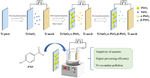
Co-doped PEG-Bi-PbO2 composite electrodes, containing Bi3+ and polyethylene glycol (PEG), were fabricated by a simple electrodeposition method on the Ti substrates. The preparation technological process and the degradation performance of the PEG-Bi-PbO2 electrode towards P-nitrophenol (PNP) were investigated. The PEG-Bi-PbO2 electrode was characterized by XRD, SEM, CV, and EIS. The results indicated that compared to the pure PbO2 and Bi-doped PbO2 electrodes, the PEG-Bi-PbO2 electrode exhibited the most uniform distribution of the active surface layer, the smallest particles, and the highest oxygen evolution potential (OEP). And PEG-Bi-modified PbO2 anode displays superb stability and catalytic activity. Moreover, the electrode exhibited excellent electrochemical oxidation activity on the degradation of PNP with a degradation efficiency of 92.3% achieved at 20 mA/cm2, \({{\text{C}}}_{{{\text{Na}}}_{2}{{\text{SO}}}_{4}}\) = 0.08 mol/L, pH = 5.0, and 60 °C. The degradation process was consistent with the quasi-primary kinetics.
采用简单的电沉积方法在Ti衬底上制备了含有Bi3+和聚乙二醇(PEG)的共掺杂PEG- bi - pbo2复合电极。研究了PEG-Bi-PbO2电极的制备工艺及对硝基苯酚(PNP)的降解性能。采用XRD、SEM、CV、EIS等手段对PEG-Bi-PbO2电极进行了表征。结果表明,与纯PbO2和双掺杂PbO2电极相比,PEG-Bi-PbO2电极的活性表面层分布最均匀,颗粒最小,析氧电位(OEP)最高。并且peg - bi修饰的PbO2阳极表现出良好的稳定性和催化活性。此外,该电极对PNP的降解表现出良好的电化学氧化活性,降解效率为92.3% achieved at 20 mA/cm2, \({{\text{C}}}_{{{\text{Na}}}_{2}{{\text{SO}}}_{4}}\) = 0.08 mol/L, pH = 5.0, and 60 °C. The degradation process was consistent with the quasi-primary kinetics.
期刊介绍:
The Journal of Solid State Electrochemistry is devoted to all aspects of solid-state chemistry and solid-state physics in electrochemistry.
The Journal of Solid State Electrochemistry publishes papers on all aspects of electrochemistry of solid compounds, including experimental and theoretical, basic and applied work. It equally publishes papers on the thermodynamics and kinetics of electrochemical reactions if at least one actively participating phase is solid. Also of interest are articles on the transport of ions and electrons in solids whenever these processes are relevant to electrochemical reactions and on the use of solid-state electrochemical reactions in the analysis of solids and their surfaces.
The journal covers solid-state electrochemistry and focusses on the following fields: mechanisms of solid-state electrochemical reactions, semiconductor electrochemistry, electrochemical batteries, accumulators and fuel cells, electrochemical mineral leaching, galvanic metal plating, electrochemical potential memory devices, solid-state electrochemical sensors, ion and electron transport in solid materials and polymers, electrocatalysis, photoelectrochemistry, corrosion of solid materials, solid-state electroanalysis, electrochemical machining of materials, electrochromism and electrochromic devices, new electrochemical solid-state synthesis.
The Journal of Solid State Electrochemistry makes the professional in research and industry aware of this swift progress and its importance for future developments and success in the above-mentioned fields.



 京公网安备 11010802042870号
京ICP备2023020795号-1
京公网安备 11010802042870号
京ICP备2023020795号-1

 分享
分享
 求助内容:
求助内容: 应助结果提醒方式:
 扫码关注我们
