Wenya Zhang, Yuxin He, Yun Chu, Yuanxin Zhai, Song Qian, Xinhui Wang, Pengju Jiang, Pengfei Cui, Yin Zhang, Jianhao Wang
{"title":"Amorphous curcumin-based hydrogels to reduce the incidence of Post-Surgical intrauterine adhesions","authors":"Wenya Zhang, Yuxin He, Yun Chu, Yuanxin Zhai, Song Qian, Xinhui Wang, Pengju Jiang, Pengfei Cui, Yin Zhang, Jianhao Wang","doi":"10.1093/rb/rbae043","DOIUrl":null,"url":null,"abstract":"\n The incidence of intrauterine adhesions (IUA) was raised accompanied by the increasing utilization of intrauterine surgery. The postoperative physical barrier methods commonly used, such as balloons and other fillers, have limited effectiveness and may even cause further damage to the remaining endometrial tissue. Herein, we developed an injectable thermosensitive hydrogel using Pluronic F127/F68 as pharmaceutical excipients and curcumin as a natural active molecule. The hydrogel effectively addresses solubility and low bioavailability issues associated with curcumin. In vitro, drug release assays revealed that the amorphous curcumin hydrogel promotes dissolution and sustained release of curcumin. In vitro experiments reveal high biocompatibility of the hydrogel and its ability to enhance vascular formation while inhibiting the expression of fibrotic factor TGF-β1. To assess the effectiveness of preventing intrauterine adhesions, in vivo experiments were conducted using IUA rats and compared with a class III medical device, a new-crosslinked hyaluronic acid gel (NCHA). According to the study, curcumin hydrogel is more effective than the NCHA group in improving the regeneration of the endometrium, increasing the blood supply to the endometrium, and reducing the abnormal deposition of fibrin, thus preventing intrauterine adhesion more effectively. This study provides a promising strategy for treating and preventing IUA.","PeriodicalId":5,"journal":{"name":"ACS Applied Materials & Interfaces","volume":"67 23","pages":""},"PeriodicalIF":8.2000,"publicationDate":"2024-04-24","publicationTypes":"Journal Article","fieldsOfStudy":null,"isOpenAccess":false,"openAccessPdf":"","citationCount":"0","resultStr":null,"platform":"Semanticscholar","paperid":null,"PeriodicalName":"ACS Applied Materials & Interfaces","FirstCategoryId":"5","ListUrlMain":"https://doi.org/10.1093/rb/rbae043","RegionNum":2,"RegionCategory":"材料科学","ArticlePicture":[],"TitleCN":null,"AbstractTextCN":null,"PMCID":null,"EPubDate":"","PubModel":"","JCR":"Q1","JCRName":"MATERIALS SCIENCE, MULTIDISCIPLINARY","Score":null,"Total":0}
引用次数: 0
Abstract
The incidence of intrauterine adhesions (IUA) was raised accompanied by the increasing utilization of intrauterine surgery. The postoperative physical barrier methods commonly used, such as balloons and other fillers, have limited effectiveness and may even cause further damage to the remaining endometrial tissue. Herein, we developed an injectable thermosensitive hydrogel using Pluronic F127/F68 as pharmaceutical excipients and curcumin as a natural active molecule. The hydrogel effectively addresses solubility and low bioavailability issues associated with curcumin. In vitro, drug release assays revealed that the amorphous curcumin hydrogel promotes dissolution and sustained release of curcumin. In vitro experiments reveal high biocompatibility of the hydrogel and its ability to enhance vascular formation while inhibiting the expression of fibrotic factor TGF-β1. To assess the effectiveness of preventing intrauterine adhesions, in vivo experiments were conducted using IUA rats and compared with a class III medical device, a new-crosslinked hyaluronic acid gel (NCHA). According to the study, curcumin hydrogel is more effective than the NCHA group in improving the regeneration of the endometrium, increasing the blood supply to the endometrium, and reducing the abnormal deposition of fibrin, thus preventing intrauterine adhesion more effectively. This study provides a promising strategy for treating and preventing IUA.
期刊介绍:
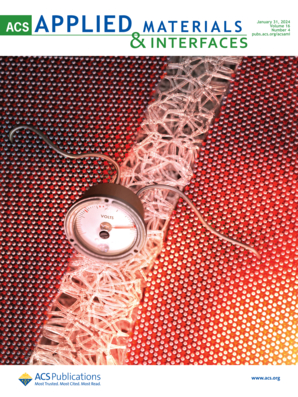
ACS Applied Materials & Interfaces is a leading interdisciplinary journal that brings together chemists, engineers, physicists, and biologists to explore the development and utilization of newly-discovered materials and interfacial processes for specific applications. Our journal has experienced remarkable growth since its establishment in 2009, both in terms of the number of articles published and the impact of the research showcased. We are proud to foster a truly global community, with the majority of published articles originating from outside the United States, reflecting the rapid growth of applied research worldwide.



 京公网安备 11010802042870号
京ICP备2023020795号-1
京公网安备 11010802042870号
京ICP备2023020795号-1

 分享
分享
 求助内容:
求助内容: 应助结果提醒方式:
 扫码关注我们
