Paula Sette, Milagros Gomez Mattson, Carolina Schebor, Daniela Salvatori
{"title":"Strategies for bioactive compound recovery from grape and apple wastes: traditional and emerging technologies to reach zero waste discharge","authors":"Paula Sette, Milagros Gomez Mattson, Carolina Schebor, Daniela Salvatori","doi":"10.1007/s13399-024-05630-1","DOIUrl":null,"url":null,"abstract":"<div><p>The presence of numerous bioactive compounds in fruit wastes indicates the potential to use them as low-cost resource for generating value-added ingredients. The integral use of residual biomass from wine and cider industries was proposed. Phenolic-rich liquid extracts were produced from grape marc (GM), grape stalk (GS), and apple pomace (AP) by applying hydrothermal (T), ultrasound-assisted (US), and enzymatic (EZ) extractions, and the remaining solid fraction (RSF) was then converted into fiber concentrated powders by air-drying. Additionally, the direct conversion of the whole initial wastes into integral powders rich in both fiber and phenolic compounds was proposed. An integral physicochemical study was performed: phenolic compounds, content and techno-functional properties of dietary fiber, and physical and stability properties. The T extraction conducted for 75 min at 75 °C demonstrated superior efficacy in terms of total polyphenol content (TPC) and antioxidant capacity (AC). Under these optimal conditions, the extracts exhibited a TPC content of 251 ± 2 mg GAE/100 g from GM, 1420 ± 5 mg GAE/100 g from GS, and 23 ± 2 mg GAE/100 g from AP. GS extract was mainly composed of procyanidins, catechin, and epicatechin, while in AP, flavonols (mainly rutin) represented the majority group. The GM extract showed a richer polyphenol profile including condensed tannins, flavonols (mainly rutin), flavan-3-ols (catechin), and a greater variety of phenolic acids. Within the fiber-rich powders produced from the RSF (optimal extraction conditions), those from grape wastes registered higher remaining TPC and total dietary fiber content (47–51%), mainly composed of insoluble fiber (IDF). AP powders (integral and from RSF) showed a higher soluble fiber content (SDF), a more balanced IDF/SDF ratio (1.9 and 3.3, respectively), and better hydration properties. Among the integral powders, GM and GS showed high level of TPC (997–1600 mg GAE/100 g), and suitable techno-functional properties. Physical properties are suggestive of free-flowing stable powdered ingredients in all cases. The findings offer a substantial advance in waste valorization, benefiting not only scientists, but also wine and cider producers, as well as the food industry. They pave the way for converting various fruit wastes into diverse food ingredients. This approach enables the economic value recovery while delivering substantial environmental benefits, achieving a zero waste state. Employing these ingredients in creating new functional foods could enhance public health.</p></div>","PeriodicalId":488,"journal":{"name":"Biomass Conversion and Biorefinery","volume":"15 22","pages":"28877 - 28894"},"PeriodicalIF":4.1000,"publicationDate":"2024-04-23","publicationTypes":"Journal Article","fieldsOfStudy":null,"isOpenAccess":false,"openAccessPdf":"","citationCount":"0","resultStr":null,"platform":"Semanticscholar","paperid":null,"PeriodicalName":"Biomass Conversion and Biorefinery","FirstCategoryId":"5","ListUrlMain":"https://link.springer.com/article/10.1007/s13399-024-05630-1","RegionNum":4,"RegionCategory":"工程技术","ArticlePicture":[],"TitleCN":null,"AbstractTextCN":null,"PMCID":null,"EPubDate":"","PubModel":"","JCR":"Q3","JCRName":"ENERGY & FUELS","Score":null,"Total":0}
引用次数: 0
Abstract
The presence of numerous bioactive compounds in fruit wastes indicates the potential to use them as low-cost resource for generating value-added ingredients. The integral use of residual biomass from wine and cider industries was proposed. Phenolic-rich liquid extracts were produced from grape marc (GM), grape stalk (GS), and apple pomace (AP) by applying hydrothermal (T), ultrasound-assisted (US), and enzymatic (EZ) extractions, and the remaining solid fraction (RSF) was then converted into fiber concentrated powders by air-drying. Additionally, the direct conversion of the whole initial wastes into integral powders rich in both fiber and phenolic compounds was proposed. An integral physicochemical study was performed: phenolic compounds, content and techno-functional properties of dietary fiber, and physical and stability properties. The T extraction conducted for 75 min at 75 °C demonstrated superior efficacy in terms of total polyphenol content (TPC) and antioxidant capacity (AC). Under these optimal conditions, the extracts exhibited a TPC content of 251 ± 2 mg GAE/100 g from GM, 1420 ± 5 mg GAE/100 g from GS, and 23 ± 2 mg GAE/100 g from AP. GS extract was mainly composed of procyanidins, catechin, and epicatechin, while in AP, flavonols (mainly rutin) represented the majority group. The GM extract showed a richer polyphenol profile including condensed tannins, flavonols (mainly rutin), flavan-3-ols (catechin), and a greater variety of phenolic acids. Within the fiber-rich powders produced from the RSF (optimal extraction conditions), those from grape wastes registered higher remaining TPC and total dietary fiber content (47–51%), mainly composed of insoluble fiber (IDF). AP powders (integral and from RSF) showed a higher soluble fiber content (SDF), a more balanced IDF/SDF ratio (1.9 and 3.3, respectively), and better hydration properties. Among the integral powders, GM and GS showed high level of TPC (997–1600 mg GAE/100 g), and suitable techno-functional properties. Physical properties are suggestive of free-flowing stable powdered ingredients in all cases. The findings offer a substantial advance in waste valorization, benefiting not only scientists, but also wine and cider producers, as well as the food industry. They pave the way for converting various fruit wastes into diverse food ingredients. This approach enables the economic value recovery while delivering substantial environmental benefits, achieving a zero waste state. Employing these ingredients in creating new functional foods could enhance public health.
期刊介绍:
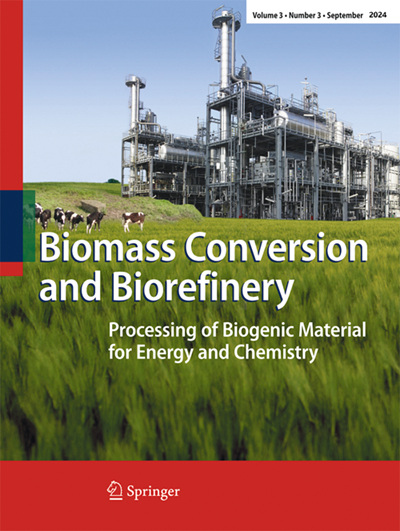
Biomass Conversion and Biorefinery presents articles and information on research, development and applications in thermo-chemical conversion; physico-chemical conversion and bio-chemical conversion, including all necessary steps for the provision and preparation of the biomass as well as all possible downstream processing steps for the environmentally sound and economically viable provision of energy and chemical products.



 京公网安备 11010802042870号
京ICP备2023020795号-1
京公网安备 11010802042870号
京ICP备2023020795号-1

 分享
分享
 求助内容:
求助内容: 应助结果提醒方式:
 扫码关注我们
