{"title":"Numerical simulation and fast method for the 0D-1D multi-scale coupled model and its application in ischemic brain tissue blood flow problems","authors":"Yi Liu, Junqing Jia, Fanhai Zeng, Xiaoyun Jiang","doi":"10.1002/cnm.3828","DOIUrl":null,"url":null,"abstract":"<p>As living standards rise, more and more people are paying attention to their own health, especially issues such as cerebral thrombosis, cerebral infarction, and other cerebral blood flow problems. An accurate simulation of blood flow within cerebral vessels has emerged as a crucial area of research. In this study, we focus on microcirculatory blood flow in ischemic brain tissue and employ a 0D-1D geometric multi-scale coupled model to characterize this process. Given the intricate nature of human cerebral vessels, we apply a numerical method combining the finite element method and the third-order Runge–Kutta method to resolve the coupled model. To enhance computational efficiency, we introduce a fast method based on the reduced-order extrapolation algorithm. Our numerical example underscores the stability of the method and convergence accuracy to <span></span><math>\n <mrow>\n <mi>O</mi>\n <mfenced>\n <mrow>\n <msup>\n <mi>h</mi>\n <mn>3</mn>\n </msup>\n <mo>+</mo>\n <msup>\n <mi>τ</mi>\n <mn>3</mn>\n </msup>\n </mrow>\n </mfenced>\n </mrow></math>, while significantly improving the accuracy and efficiency of blood flow simulation, making the mechanism analysis more accurate. Additionally, we present examples detailing variations and distribution of intracranial pressure and blood flow in ischemic brain tissue throughout a cardiac cycle. Both reduced vascular compliance and vascular stenosis can have adverse effects on intracranial cerebral pressure and blood flow, leading to insufficient local oxygen supply and negative effects on brain function. Meanwhile, there will also be corresponding changes in volume flow and pulsatile blood pressure.</p>","PeriodicalId":50349,"journal":{"name":"International Journal for Numerical Methods in Biomedical Engineering","volume":"40 6","pages":""},"PeriodicalIF":2.4000,"publicationDate":"2024-04-22","publicationTypes":"Journal Article","fieldsOfStudy":null,"isOpenAccess":false,"openAccessPdf":"","citationCount":"0","resultStr":null,"platform":"Semanticscholar","paperid":null,"PeriodicalName":"International Journal for Numerical Methods in Biomedical Engineering","FirstCategoryId":"5","ListUrlMain":"https://onlinelibrary.wiley.com/doi/10.1002/cnm.3828","RegionNum":4,"RegionCategory":"医学","ArticlePicture":[],"TitleCN":null,"AbstractTextCN":null,"PMCID":null,"EPubDate":"","PubModel":"","JCR":"Q3","JCRName":"ENGINEERING, BIOMEDICAL","Score":null,"Total":0}
引用次数: 0
Abstract
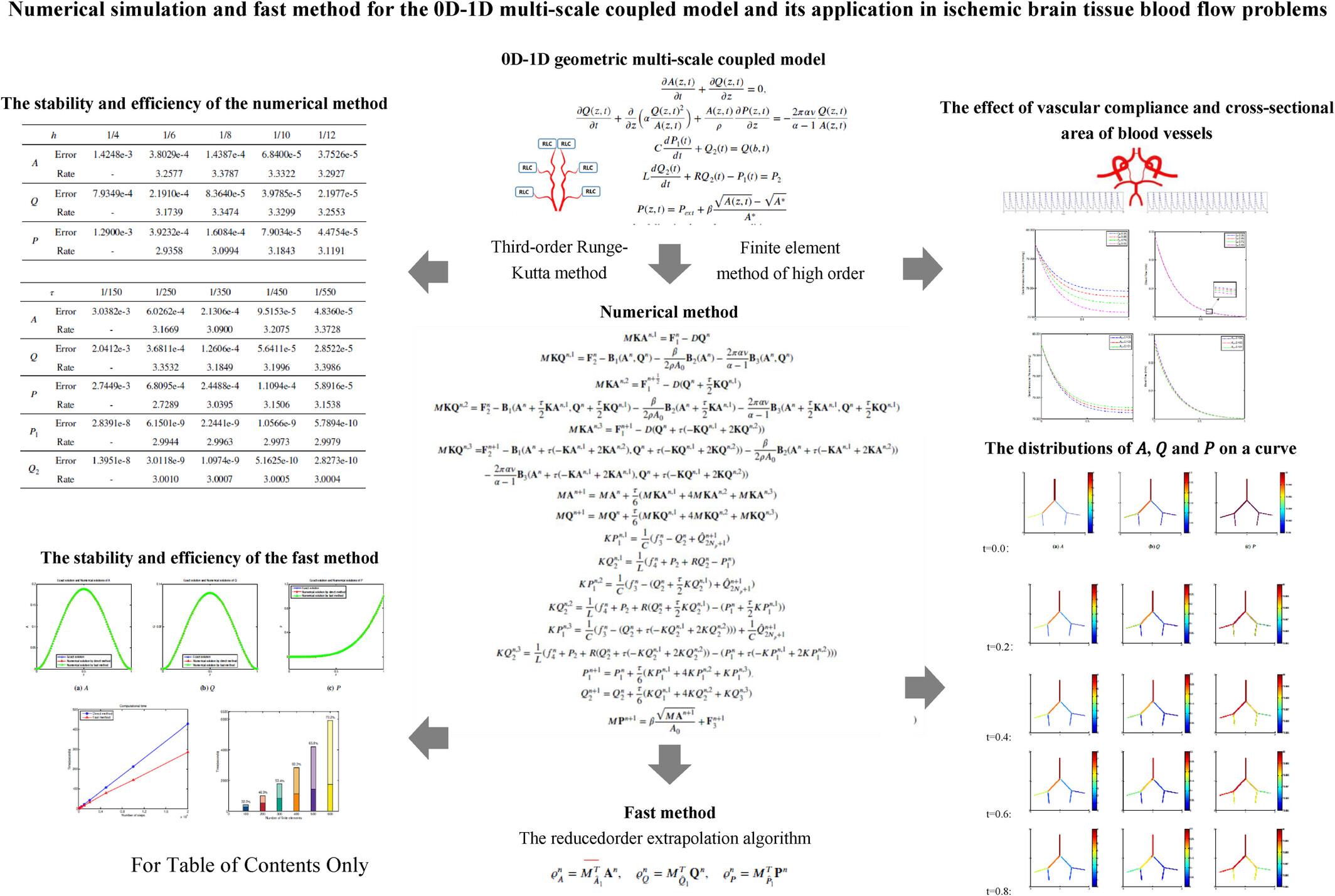
As living standards rise, more and more people are paying attention to their own health, especially issues such as cerebral thrombosis, cerebral infarction, and other cerebral blood flow problems. An accurate simulation of blood flow within cerebral vessels has emerged as a crucial area of research. In this study, we focus on microcirculatory blood flow in ischemic brain tissue and employ a 0D-1D geometric multi-scale coupled model to characterize this process. Given the intricate nature of human cerebral vessels, we apply a numerical method combining the finite element method and the third-order Runge–Kutta method to resolve the coupled model. To enhance computational efficiency, we introduce a fast method based on the reduced-order extrapolation algorithm. Our numerical example underscores the stability of the method and convergence accuracy to , while significantly improving the accuracy and efficiency of blood flow simulation, making the mechanism analysis more accurate. Additionally, we present examples detailing variations and distribution of intracranial pressure and blood flow in ischemic brain tissue throughout a cardiac cycle. Both reduced vascular compliance and vascular stenosis can have adverse effects on intracranial cerebral pressure and blood flow, leading to insufficient local oxygen supply and negative effects on brain function. Meanwhile, there will also be corresponding changes in volume flow and pulsatile blood pressure.
期刊介绍:
All differential equation based models for biomedical applications and their novel solutions (using either established numerical methods such as finite difference, finite element and finite volume methods or new numerical methods) are within the scope of this journal. Manuscripts with experimental and analytical themes are also welcome if a component of the paper deals with numerical methods. Special cases that may not involve differential equations such as image processing, meshing and artificial intelligence are within the scope. Any research that is broadly linked to the wellbeing of the human body, either directly or indirectly, is also within the scope of this journal.




 京公网安备 11010802042870号
京ICP备2023020795号-1
京公网安备 11010802042870号
京ICP备2023020795号-1

 分享
分享
 求助内容:
求助内容: 应助结果提醒方式:
 扫码关注我们
