Lvlin Xiang, Qingqing Shen, Jiajun Zeng, Qiyun Wang
{"title":"Prediction of initiation mechanism of three-dimensional penetrating single crack","authors":"Lvlin Xiang, Qingqing Shen, Jiajun Zeng, Qiyun Wang","doi":"10.1007/s12517-024-11970-z","DOIUrl":null,"url":null,"abstract":"<div><p>In this paper, a novel calculating method for the three-dimensional stress intensity factor (SIF) was put out. By using the finite element approach, it was possible to compute the Mode I, Mode II, and Mode III SIF under the impact of a single factor (height, width, thickness, crack length, and inclination angle) and derive its variation rule. The SIF was computed by using the uniform design method, which also yielded the fitting formula that could determine the fracture at any geometric position on any plate. Then, a new three-dimensional penetrating crack fracture criterion was established to forecast both Mode I, Mode II, and Mode III initiation parameters of three-dimensional penetrating oblique crack. Uniaxial compression tests were done in order to validate the forecasted outcomes, including the crack initiation angle and load. The results demonstrate that the normalized <i>K</i><sub>I</sub> always decreases with <i>z/t</i> (the crack front spacing), while the normalized <i>K</i><sub>II</sub> and <i>K</i><sub>III</sub> increase first and then decrease. <i>K</i><sub>I</sub> and <i>K</i><sub>III</sub> increase with the crack length 2<i>a</i>, while <i>K</i><sub>II</sub> decreases first and then increases with the crack length. <i>K</i><sub>I</sub> and <i>K</i><sub>II</sub> both increase with the plate height. <i>K</i><sub>I</sub> rises with the crack inclination angle, while <i>K</i><sub>II</sub> and <i>K</i><sub>III</sub> initially raise and then lower. Along with the crack inclination angle, the crack initiation angle decreases, and the crack initiation stress rises. All of fracture mechanisms are Mode I.</p></div>","PeriodicalId":476,"journal":{"name":"Arabian Journal of Geosciences","volume":"17 5","pages":""},"PeriodicalIF":1.8270,"publicationDate":"2024-04-22","publicationTypes":"Journal Article","fieldsOfStudy":null,"isOpenAccess":false,"openAccessPdf":"","citationCount":"0","resultStr":null,"platform":"Semanticscholar","paperid":null,"PeriodicalName":"Arabian Journal of Geosciences","FirstCategoryId":"1085","ListUrlMain":"https://link.springer.com/article/10.1007/s12517-024-11970-z","RegionNum":0,"RegionCategory":null,"ArticlePicture":[],"TitleCN":null,"AbstractTextCN":null,"PMCID":null,"EPubDate":"","PubModel":"","JCR":"Q2","JCRName":"Earth and Planetary Sciences","Score":null,"Total":0}
引用次数: 0
Abstract
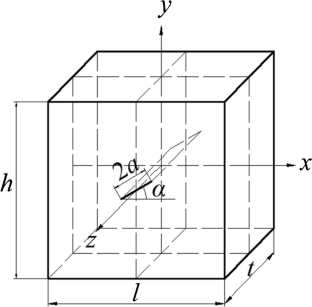
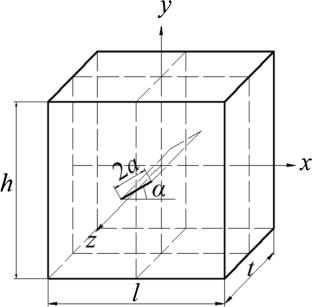
In this paper, a novel calculating method for the three-dimensional stress intensity factor (SIF) was put out. By using the finite element approach, it was possible to compute the Mode I, Mode II, and Mode III SIF under the impact of a single factor (height, width, thickness, crack length, and inclination angle) and derive its variation rule. The SIF was computed by using the uniform design method, which also yielded the fitting formula that could determine the fracture at any geometric position on any plate. Then, a new three-dimensional penetrating crack fracture criterion was established to forecast both Mode I, Mode II, and Mode III initiation parameters of three-dimensional penetrating oblique crack. Uniaxial compression tests were done in order to validate the forecasted outcomes, including the crack initiation angle and load. The results demonstrate that the normalized KI always decreases with z/t (the crack front spacing), while the normalized KII and KIII increase first and then decrease. KI and KIII increase with the crack length 2a, while KII decreases first and then increases with the crack length. KI and KII both increase with the plate height. KI rises with the crack inclination angle, while KII and KIII initially raise and then lower. Along with the crack inclination angle, the crack initiation angle decreases, and the crack initiation stress rises. All of fracture mechanisms are Mode I.
期刊介绍:
The Arabian Journal of Geosciences is the official journal of the Saudi Society for Geosciences and publishes peer-reviewed original and review articles on the entire range of Earth Science themes, focused on, but not limited to, those that have regional significance to the Middle East and the Euro-Mediterranean Zone.
Key topics therefore include; geology, hydrogeology, earth system science, petroleum sciences, geophysics, seismology and crustal structures, tectonics, sedimentology, palaeontology, metamorphic and igneous petrology, natural hazards, environmental sciences and sustainable development, geoarchaeology, geomorphology, paleo-environment studies, oceanography, atmospheric sciences, GIS and remote sensing, geodesy, mineralogy, volcanology, geochemistry and metallogenesis.



 京公网安备 11010802042870号
京ICP备2023020795号-1
京公网安备 11010802042870号
京ICP备2023020795号-1

 分享
分享
 求助内容:
求助内容: 应助结果提醒方式:
 扫码关注我们
