Joseph Aoki, Omar Khalid, Cihan Kaya, Zoltan Nagymanyoki, Jerry Hussong, Mohamed Salama
{"title":"Progression from Prediabetes to Diabetes in a Diverse US Population: a Machine Learning Model.","authors":"Joseph Aoki, Omar Khalid, Cihan Kaya, Zoltan Nagymanyoki, Jerry Hussong, Mohamed Salama","doi":"10.1089/dia.2024.0052","DOIUrl":null,"url":null,"abstract":"Objective To date, there are no widely implemented machine learning (ML) models that predict progression from prediabetes to diabetes. Addressing this knowledge gap would aid in identifying at-risk patients within this heterogeneous population who may benefit from targeted treatment and management in order to preserve glucose metabolism and prevent adverse outcomes. The objective of this study was to utilize readily available laboratory data to train and test the performance of ML-based predictive risk models for progression from prediabetes to diabetes. Methods The study population was composed of laboratory information services data procured from a large US outpatient laboratory network. The retrospective data set was composed of 15,029 adults over a five-year period with initial hemoglobin A1C (A1C) values between 5.0% - 6.4%. ML models were developed using random forest survival methods. The ground truth outcome was progression to A1C values indicative of diabetes (i.e., ≧ 6.5%) within 5 years. Results The prediabetes risk classifier model accurately predicted A1C ≧ 6.5% within 5 years and achieved an area under the curve receiver-operator characteristic of 0.87. The most important predictors of progression from prediabetes to diabetes were initial A1C, initial serum glucose, A1C slope, serum glucose slope, initial HDL, HDL slope, age, and sex. Conclusions Leveraging readily obtainable laboratory data, our ML risk classifier accurately predicts elevation in A1C associated with progression from prediabetes to diabetes. While prospective studies are warranted, the results support the clinical utility of the model to improve timely recognition, risk stratification, and optimal management for patients with prediabetes.","PeriodicalId":5,"journal":{"name":"ACS Applied Materials & Interfaces","volume":"47 21","pages":""},"PeriodicalIF":8.2000,"publicationDate":"2024-04-15","publicationTypes":"Journal Article","fieldsOfStudy":null,"isOpenAccess":false,"openAccessPdf":"","citationCount":"0","resultStr":null,"platform":"Semanticscholar","paperid":null,"PeriodicalName":"ACS Applied Materials & Interfaces","FirstCategoryId":"3","ListUrlMain":"https://doi.org/10.1089/dia.2024.0052","RegionNum":2,"RegionCategory":"材料科学","ArticlePicture":[],"TitleCN":null,"AbstractTextCN":null,"PMCID":null,"EPubDate":"","PubModel":"","JCR":"Q1","JCRName":"MATERIALS SCIENCE, MULTIDISCIPLINARY","Score":null,"Total":0}
引用次数: 0
Abstract
Objective To date, there are no widely implemented machine learning (ML) models that predict progression from prediabetes to diabetes. Addressing this knowledge gap would aid in identifying at-risk patients within this heterogeneous population who may benefit from targeted treatment and management in order to preserve glucose metabolism and prevent adverse outcomes. The objective of this study was to utilize readily available laboratory data to train and test the performance of ML-based predictive risk models for progression from prediabetes to diabetes. Methods The study population was composed of laboratory information services data procured from a large US outpatient laboratory network. The retrospective data set was composed of 15,029 adults over a five-year period with initial hemoglobin A1C (A1C) values between 5.0% - 6.4%. ML models were developed using random forest survival methods. The ground truth outcome was progression to A1C values indicative of diabetes (i.e., ≧ 6.5%) within 5 years. Results The prediabetes risk classifier model accurately predicted A1C ≧ 6.5% within 5 years and achieved an area under the curve receiver-operator characteristic of 0.87. The most important predictors of progression from prediabetes to diabetes were initial A1C, initial serum glucose, A1C slope, serum glucose slope, initial HDL, HDL slope, age, and sex. Conclusions Leveraging readily obtainable laboratory data, our ML risk classifier accurately predicts elevation in A1C associated with progression from prediabetes to diabetes. While prospective studies are warranted, the results support the clinical utility of the model to improve timely recognition, risk stratification, and optimal management for patients with prediabetes.
期刊介绍:
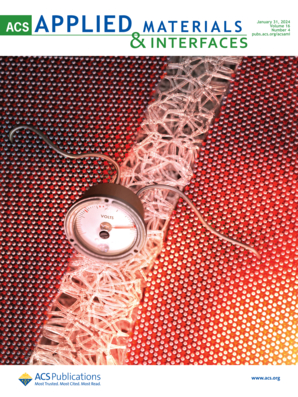
ACS Applied Materials & Interfaces is a leading interdisciplinary journal that brings together chemists, engineers, physicists, and biologists to explore the development and utilization of newly-discovered materials and interfacial processes for specific applications. Our journal has experienced remarkable growth since its establishment in 2009, both in terms of the number of articles published and the impact of the research showcased. We are proud to foster a truly global community, with the majority of published articles originating from outside the United States, reflecting the rapid growth of applied research worldwide.



 京公网安备 11010802042870号
京ICP备2023020795号-1
京公网安备 11010802042870号
京ICP备2023020795号-1

 分享
分享
 求助内容:
求助内容: 应助结果提醒方式:
 扫码关注我们
