T. Breugem, Yu Fan, Andreas K. Gernert, L. V. Van Wassenhove
{"title":"EXPRESS: Equity in Health and Humanitarian Logistics: a People-Centered Perspective","authors":"T. Breugem, Yu Fan, Andreas K. Gernert, L. V. Van Wassenhove","doi":"10.1177/10591478241248751","DOIUrl":null,"url":null,"abstract":"Diversity, equity, and inclusion (DEI) are at the core of present-day health and humanitarian logistics. Aid organizations advocate inclusive people-centered approaches to ensure that affected communities receive appropriate aid in an effective and equitable way. Tensions and even conflicts can arise if affected communities perceive the distribution of aid as inequitable. These perceptions are driven by people’s so-called distributional preferences. These preferences are shaped by culture, social bonds, and experiences, and they describe how an individual’s well-being and behavior are impacted by potential inequalities. Their importance is increasingly recognized by aid organizations, but research on equity in health and humanitarian logistics remains focused on equal access and prioritizing needs. Using current examples from the Syrian and Rohingya refugee crises, we show the importance of recognizing and managing distributional preferences. Based on these examples and in line with DEI principles, we discuss several ways that we, as the operations community, can help conceptualize inclusive and people-centered approaches that account for distributional preferences.","PeriodicalId":4,"journal":{"name":"ACS Applied Energy Materials","volume":"11 18","pages":""},"PeriodicalIF":5.5000,"publicationDate":"2024-04-12","publicationTypes":"Journal Article","fieldsOfStudy":null,"isOpenAccess":false,"openAccessPdf":"","citationCount":"0","resultStr":null,"platform":"Semanticscholar","paperid":null,"PeriodicalName":"ACS Applied Energy Materials","FirstCategoryId":"91","ListUrlMain":"https://doi.org/10.1177/10591478241248751","RegionNum":3,"RegionCategory":"材料科学","ArticlePicture":[],"TitleCN":null,"AbstractTextCN":null,"PMCID":null,"EPubDate":"","PubModel":"","JCR":"Q2","JCRName":"CHEMISTRY, PHYSICAL","Score":null,"Total":0}
引用次数: 0
Abstract
Diversity, equity, and inclusion (DEI) are at the core of present-day health and humanitarian logistics. Aid organizations advocate inclusive people-centered approaches to ensure that affected communities receive appropriate aid in an effective and equitable way. Tensions and even conflicts can arise if affected communities perceive the distribution of aid as inequitable. These perceptions are driven by people’s so-called distributional preferences. These preferences are shaped by culture, social bonds, and experiences, and they describe how an individual’s well-being and behavior are impacted by potential inequalities. Their importance is increasingly recognized by aid organizations, but research on equity in health and humanitarian logistics remains focused on equal access and prioritizing needs. Using current examples from the Syrian and Rohingya refugee crises, we show the importance of recognizing and managing distributional preferences. Based on these examples and in line with DEI principles, we discuss several ways that we, as the operations community, can help conceptualize inclusive and people-centered approaches that account for distributional preferences.
期刊介绍:
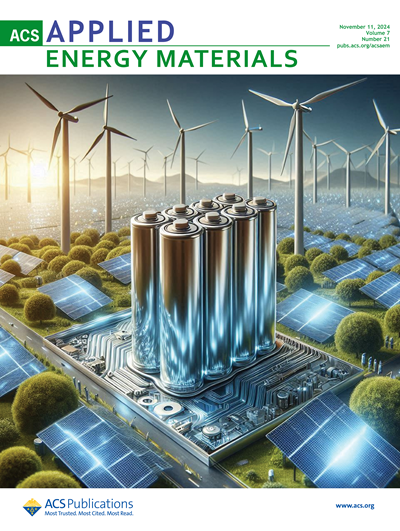
ACS Applied Energy Materials is an interdisciplinary journal publishing original research covering all aspects of materials, engineering, chemistry, physics and biology relevant to energy conversion and storage. The journal is devoted to reports of new and original experimental and theoretical research of an applied nature that integrate knowledge in the areas of materials, engineering, physics, bioscience, and chemistry into important energy applications.




 京公网安备 11010802042870号
京ICP备2023020795号-1
京公网安备 11010802042870号
京ICP备2023020795号-1

 分享
分享
 求助内容:
求助内容: 应助结果提醒方式:
 扫码关注我们
