Corinna C. A. Clark, Pru Holder, F. Boardman, L. Moody, Jacqui Cowlard, Lorna Allen, Claire Walter, James R. Bonham, J. Chudleigh
{"title":"International Perspectives of Extended Genetic Sequencing When Used as Part of Newborn Screening to Identify Cystic Fibrosis","authors":"Corinna C. A. Clark, Pru Holder, F. Boardman, L. Moody, Jacqui Cowlard, Lorna Allen, Claire Walter, James R. Bonham, J. Chudleigh","doi":"10.3390/ijns10020031","DOIUrl":null,"url":null,"abstract":"There is increasing interest in using extended genetic sequencing (EGS) in newborn screening (NBS) for cystic fibrosis (CF). How this is implemented will change the number of children being given an uncertain outcome of CRMS/CFSPID (cystic fibrosis transmembrane conductance regulator (CFTR)-related metabolic syndrome/CF Screen Positive Inconclusive Diagnosis), probable carrier results, and the number of missed CF diagnoses. An international survey of CF health professionals was used to gather views on two approaches to EGS—specific (may reduce detection of CRMS/CFSID but miss some CF cases) versus sensitive (may increase detection of CRMS/CFSPID but avoid missing more CF cases). Health professionals acknowledged the anxiety caused to parents (and health professionals) from the uncertainty surrounding the prognosis and management of CRMS/CFSPID. However, most preferred the sensitive approach, as overall, identifying more cases of CRMS/CFSPID was viewed as less physically and psychologically damaging than a missed case of CF. The importance of early diagnosis and treatment for CF to ensure better health outcomes and reducing diagnostic odysseys for parents were highlighted. A potential benefit to identifying more children with CRMS/CFSPID included increasing knowledge to obtain a better understanding of how these children should best be managed in the future.","PeriodicalId":4,"journal":{"name":"ACS Applied Energy Materials","volume":"3 4","pages":""},"PeriodicalIF":5.5000,"publicationDate":"2024-04-08","publicationTypes":"Journal Article","fieldsOfStudy":null,"isOpenAccess":false,"openAccessPdf":"","citationCount":"0","resultStr":null,"platform":"Semanticscholar","paperid":null,"PeriodicalName":"ACS Applied Energy Materials","FirstCategoryId":"1085","ListUrlMain":"https://doi.org/10.3390/ijns10020031","RegionNum":3,"RegionCategory":"材料科学","ArticlePicture":[],"TitleCN":null,"AbstractTextCN":null,"PMCID":null,"EPubDate":"","PubModel":"","JCR":"Q2","JCRName":"CHEMISTRY, PHYSICAL","Score":null,"Total":0}
引用次数: 0
Abstract
There is increasing interest in using extended genetic sequencing (EGS) in newborn screening (NBS) for cystic fibrosis (CF). How this is implemented will change the number of children being given an uncertain outcome of CRMS/CFSPID (cystic fibrosis transmembrane conductance regulator (CFTR)-related metabolic syndrome/CF Screen Positive Inconclusive Diagnosis), probable carrier results, and the number of missed CF diagnoses. An international survey of CF health professionals was used to gather views on two approaches to EGS—specific (may reduce detection of CRMS/CFSID but miss some CF cases) versus sensitive (may increase detection of CRMS/CFSPID but avoid missing more CF cases). Health professionals acknowledged the anxiety caused to parents (and health professionals) from the uncertainty surrounding the prognosis and management of CRMS/CFSPID. However, most preferred the sensitive approach, as overall, identifying more cases of CRMS/CFSPID was viewed as less physically and psychologically damaging than a missed case of CF. The importance of early diagnosis and treatment for CF to ensure better health outcomes and reducing diagnostic odysseys for parents were highlighted. A potential benefit to identifying more children with CRMS/CFSPID included increasing knowledge to obtain a better understanding of how these children should best be managed in the future.
期刊介绍:
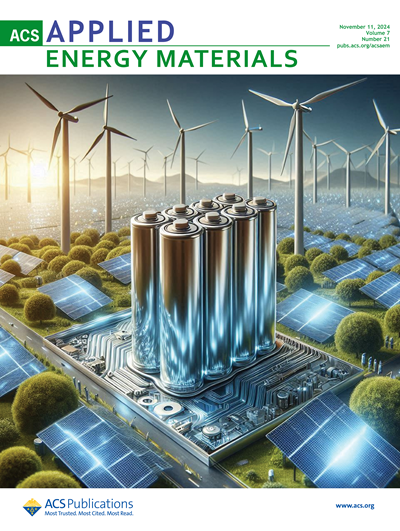
ACS Applied Energy Materials is an interdisciplinary journal publishing original research covering all aspects of materials, engineering, chemistry, physics and biology relevant to energy conversion and storage. The journal is devoted to reports of new and original experimental and theoretical research of an applied nature that integrate knowledge in the areas of materials, engineering, physics, bioscience, and chemistry into important energy applications.



 京公网安备 11010802042870号
京ICP备2023020795号-1
京公网安备 11010802042870号
京ICP备2023020795号-1

 分享
分享
 求助内容:
求助内容: 应助结果提醒方式:
 扫码关注我们
