Bin Zhao , Heping Luo , Jiaqing Liu , Sha Chen , Han Xu , Yu Liao , Xue Feng Lu , Yan Qing , Yiqiang Wu
{"title":"S-doped carbonized wood fiber decorated with sulfide heterojunction-embedded S, N-doped carbon microleaf arrays for efficient high-current-density oxygen evolution","authors":"Bin Zhao , Heping Luo , Jiaqing Liu , Sha Chen , Han Xu , Yu Liao , Xue Feng Lu , Yan Qing , Yiqiang Wu","doi":"10.1016/j.cclet.2024.109919","DOIUrl":null,"url":null,"abstract":"<div><div>Industrial high-current-density oxygen evolution catalyst is the key to accelerating the practical application of hydrogen energy. Herein, Co<sub>9</sub>S<sub>8</sub>/CoS heterojunctions were rationally encapsulated in S, N-codoped carbon ((Co<sub>9</sub>S<sub>8</sub>/CoS)@SNC) microleaf arrays, which are rooted on S-doped carbonized wood fibers (SCWF). Benefiting from the synergistic electronic interactions on heterointerfaces and the accelerated mass transfer by array structure, the obtained self-supporting (Co<sub>9</sub>S<sub>8</sub>/CoS)@SNC/SCWF electrode exhibits superior performance toward alkaline oxygen evolution reaction (OER) with an ultra-low overpotential of 274 mV at 1000 mA/cm<sup>2</sup>, a small Tafel slope of 48.84 mV/dec, and ultralong stability up to 100 h. Theoretical calculations show that interfacing Co<sub>9</sub>S<sub>8</sub> with CoS can upshift the d-band center of the Co atoms and strengthen the interactions with oxygen intermediates, thereby favoring OER performance. Furthermore, the (Co<sub>9</sub>S<sub>8</sub>/CoS)@SNC/SCWF electrode shows outstanding rechargeability and stable cycle life in aqueous Zn-air batteries with a peak power density of 201.3 mW/cm<sup>2</sup>, exceeding the commercial RuO<sub>2</sub> and Pt/C hybrid catalysts. This work presents a promising strategy for the design of high-current-density OER electrocatalysts from sustainable wood fiber resources, thus promoting their practical applications in the field of electrochemical energy storage and conversion.</div></div>","PeriodicalId":10088,"journal":{"name":"Chinese Chemical Letters","volume":"36 5","pages":"Article 109919"},"PeriodicalIF":8.9000,"publicationDate":"2025-05-01","publicationTypes":"Journal Article","fieldsOfStudy":null,"isOpenAccess":false,"openAccessPdf":"","citationCount":"0","resultStr":null,"platform":"Semanticscholar","paperid":null,"PeriodicalName":"Chinese Chemical Letters","FirstCategoryId":"92","ListUrlMain":"https://www.sciencedirect.com/science/article/pii/S1001841724004388","RegionNum":1,"RegionCategory":"化学","ArticlePicture":[],"TitleCN":null,"AbstractTextCN":null,"PMCID":null,"EPubDate":"2024/4/24 0:00:00","PubModel":"Epub","JCR":"Q1","JCRName":"CHEMISTRY, MULTIDISCIPLINARY","Score":null,"Total":0}
引用次数: 0
Abstract
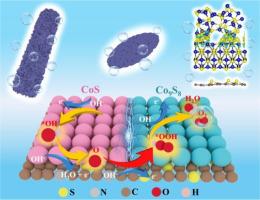
Industrial high-current-density oxygen evolution catalyst is the key to accelerating the practical application of hydrogen energy. Herein, Co9S8/CoS heterojunctions were rationally encapsulated in S, N-codoped carbon ((Co9S8/CoS)@SNC) microleaf arrays, which are rooted on S-doped carbonized wood fibers (SCWF). Benefiting from the synergistic electronic interactions on heterointerfaces and the accelerated mass transfer by array structure, the obtained self-supporting (Co9S8/CoS)@SNC/SCWF electrode exhibits superior performance toward alkaline oxygen evolution reaction (OER) with an ultra-low overpotential of 274 mV at 1000 mA/cm2, a small Tafel slope of 48.84 mV/dec, and ultralong stability up to 100 h. Theoretical calculations show that interfacing Co9S8 with CoS can upshift the d-band center of the Co atoms and strengthen the interactions with oxygen intermediates, thereby favoring OER performance. Furthermore, the (Co9S8/CoS)@SNC/SCWF electrode shows outstanding rechargeability and stable cycle life in aqueous Zn-air batteries with a peak power density of 201.3 mW/cm2, exceeding the commercial RuO2 and Pt/C hybrid catalysts. This work presents a promising strategy for the design of high-current-density OER electrocatalysts from sustainable wood fiber resources, thus promoting their practical applications in the field of electrochemical energy storage and conversion.
期刊介绍:
Chinese Chemical Letters (CCL) (ISSN 1001-8417) was founded in July 1990. The journal publishes preliminary accounts in the whole field of chemistry, including inorganic chemistry, organic chemistry, analytical chemistry, physical chemistry, polymer chemistry, applied chemistry, etc.Chinese Chemical Letters does not accept articles previously published or scheduled to be published. To verify originality, your article may be checked by the originality detection service CrossCheck.



 京公网安备 11010802042870号
京ICP备2023020795号-1
京公网安备 11010802042870号
京ICP备2023020795号-1

 分享
分享
 求助内容:
求助内容: 应助结果提醒方式:
 扫码关注我们
