Fengshun Wang , Huachao Ji , Zefei Wu , Kang Chen , Wenqi Gao , Chen Wang , Longlu Wang , Jianmei Chen , Dafeng Yan
{"title":"The advanced development of one-dimensional transition metal dichalcogenide nanotubes: From preparation to application","authors":"Fengshun Wang , Huachao Ji , Zefei Wu , Kang Chen , Wenqi Gao , Chen Wang , Longlu Wang , Jianmei Chen , Dafeng Yan","doi":"10.1016/j.cclet.2024.109898","DOIUrl":null,"url":null,"abstract":"<div><div>Two-dimensional (2D) transition metal sulfides (TMDs) are emerging and highly well received 2D materials, which are considered as an ideal 2D platform for studying various electronic properties and potential applications due to their chemical diversity. Converting 2D TMDs into one-dimensional (1D) TMDs nanotubes can not only retain some advantages of 2D nanosheets but also providing a unique direction to explore the novel properties of TMDs materials in the 1D limit. However, the controllable preparation of high-quality nanotubes remains a major challenge. It is very necessary to review the advanced development of one-dimensional transition metal dichalcogenide nanotubes from preparation to application. Here, we first summarize a series of bottom-up synthesis methods of 1D TMDs, such as template growth and metal catalyzed method. Then, top-down synthesis methods are summarized, which included self-curing and stacking of TMDs nanosheets. In addition, we discuss some key applications that utilize the properties of 1D-TMDs nanotubes in the areas of catalyst preparation, energy storage, and electronic devices. Last but not least, we prospect the preparation methods of high-quality 1D-TMDs nanotubes, which will lay a foundation for the synthesis of high-performance optoelectronic devices, catalysts, and energy storage components</div></div>","PeriodicalId":10088,"journal":{"name":"Chinese Chemical Letters","volume":"36 5","pages":"Article 109898"},"PeriodicalIF":8.9000,"publicationDate":"2024-04-16","publicationTypes":"Journal Article","fieldsOfStudy":null,"isOpenAccess":false,"openAccessPdf":"","citationCount":"0","resultStr":null,"platform":"Semanticscholar","paperid":null,"PeriodicalName":"Chinese Chemical Letters","FirstCategoryId":"92","ListUrlMain":"https://www.sciencedirect.com/science/article/pii/S1001841724004170","RegionNum":1,"RegionCategory":"化学","ArticlePicture":[],"TitleCN":null,"AbstractTextCN":null,"PMCID":null,"EPubDate":"","PubModel":"","JCR":"Q1","JCRName":"CHEMISTRY, MULTIDISCIPLINARY","Score":null,"Total":0}
引用次数: 0
Abstract
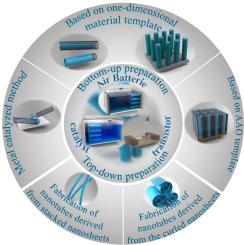
Two-dimensional (2D) transition metal sulfides (TMDs) are emerging and highly well received 2D materials, which are considered as an ideal 2D platform for studying various electronic properties and potential applications due to their chemical diversity. Converting 2D TMDs into one-dimensional (1D) TMDs nanotubes can not only retain some advantages of 2D nanosheets but also providing a unique direction to explore the novel properties of TMDs materials in the 1D limit. However, the controllable preparation of high-quality nanotubes remains a major challenge. It is very necessary to review the advanced development of one-dimensional transition metal dichalcogenide nanotubes from preparation to application. Here, we first summarize a series of bottom-up synthesis methods of 1D TMDs, such as template growth and metal catalyzed method. Then, top-down synthesis methods are summarized, which included self-curing and stacking of TMDs nanosheets. In addition, we discuss some key applications that utilize the properties of 1D-TMDs nanotubes in the areas of catalyst preparation, energy storage, and electronic devices. Last but not least, we prospect the preparation methods of high-quality 1D-TMDs nanotubes, which will lay a foundation for the synthesis of high-performance optoelectronic devices, catalysts, and energy storage components
期刊介绍:
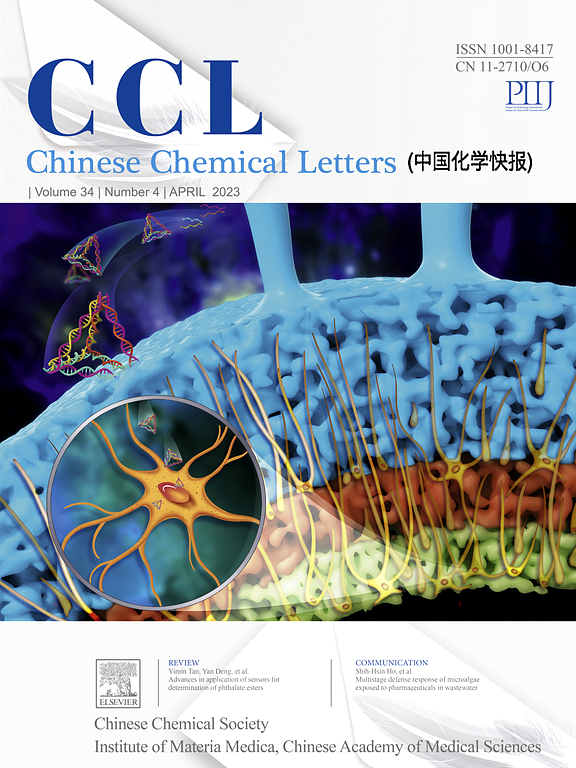
Chinese Chemical Letters (CCL) (ISSN 1001-8417) was founded in July 1990. The journal publishes preliminary accounts in the whole field of chemistry, including inorganic chemistry, organic chemistry, analytical chemistry, physical chemistry, polymer chemistry, applied chemistry, etc.Chinese Chemical Letters does not accept articles previously published or scheduled to be published. To verify originality, your article may be checked by the originality detection service CrossCheck.



 京公网安备 11010802042870号
京ICP备2023020795号-1
京公网安备 11010802042870号
京ICP备2023020795号-1

 分享
分享
 求助内容:
求助内容: 应助结果提醒方式:
 扫码关注我们
