{"title":"Exonuclease-iii -propelled DNAzyme cascade for sensitive and reliable cervical cancer related miRNA analysis","authors":"Hongli Wang , Daoli Wang , Yehong Xu","doi":"10.1016/j.ab.2024.115547","DOIUrl":null,"url":null,"abstract":"<div><p>MicroRNAs (miRNAs) can serve as biomarkers for early-diagnosis, therapy, and postoperative care of cervical cancer. Sensitive and reliable quantification of miRNA remains a huge challenge due to its low expressing levels and background interference. Herein, we propose a novel exonuclease-III (Exo–III)–propelled DNAzyme cascade for sensitive and high-efficient miRNA analysis. This method involves the engineering of compact DNAzyme hairpin probes, including the H1 probe and H2 probe. The H1 probe is designed with exposed analyte recognition subunits that can specifically recognize target miRNA. This recognition triggers two processes: Exo-iii-assisted target regeneration and successive substrate cleavage catalyzed by DNAzyme. The unique character of Exo-III that catalyzes removal of mononucleotides from the blunt or recessed 3′-OH termini of dsDNA confers the approach with a minimal background signal. The multiple signal cycles provided an abundant signal amplification and consequently, the method exhibited a low limit of detection of 3.12 fM, and a better specificity over several homologous miRNAs. In summary, this powerful Exo-III driven DNAzyme cascaded system offers broader and more adaptable methods for comprehending the activities of miRNA in various biological occurrences.</p></div>","PeriodicalId":7830,"journal":{"name":"Analytical biochemistry","volume":"691 ","pages":"Article 115547"},"PeriodicalIF":2.5000,"publicationDate":"2024-04-25","publicationTypes":"Journal Article","fieldsOfStudy":null,"isOpenAccess":false,"openAccessPdf":"","citationCount":"0","resultStr":null,"platform":"Semanticscholar","paperid":null,"PeriodicalName":"Analytical biochemistry","FirstCategoryId":"99","ListUrlMain":"https://www.sciencedirect.com/science/article/pii/S0003269724000915","RegionNum":4,"RegionCategory":"生物学","ArticlePicture":[],"TitleCN":null,"AbstractTextCN":null,"PMCID":null,"EPubDate":"","PubModel":"","JCR":"Q2","JCRName":"BIOCHEMICAL RESEARCH METHODS","Score":null,"Total":0}
引用次数: 0
Abstract
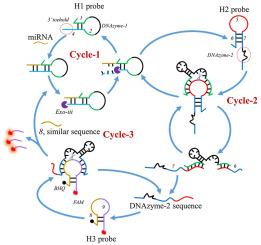
MicroRNAs (miRNAs) can serve as biomarkers for early-diagnosis, therapy, and postoperative care of cervical cancer. Sensitive and reliable quantification of miRNA remains a huge challenge due to its low expressing levels and background interference. Herein, we propose a novel exonuclease-III (Exo–III)–propelled DNAzyme cascade for sensitive and high-efficient miRNA analysis. This method involves the engineering of compact DNAzyme hairpin probes, including the H1 probe and H2 probe. The H1 probe is designed with exposed analyte recognition subunits that can specifically recognize target miRNA. This recognition triggers two processes: Exo-iii-assisted target regeneration and successive substrate cleavage catalyzed by DNAzyme. The unique character of Exo-III that catalyzes removal of mononucleotides from the blunt or recessed 3′-OH termini of dsDNA confers the approach with a minimal background signal. The multiple signal cycles provided an abundant signal amplification and consequently, the method exhibited a low limit of detection of 3.12 fM, and a better specificity over several homologous miRNAs. In summary, this powerful Exo-III driven DNAzyme cascaded system offers broader and more adaptable methods for comprehending the activities of miRNA in various biological occurrences.
期刊介绍:
The journal''s title Analytical Biochemistry: Methods in the Biological Sciences declares its broad scope: methods for the basic biological sciences that include biochemistry, molecular genetics, cell biology, proteomics, immunology, bioinformatics and wherever the frontiers of research take the field.
The emphasis is on methods from the strictly analytical to the more preparative that would include novel approaches to protein purification as well as improvements in cell and organ culture. The actual techniques are equally inclusive ranging from aptamers to zymology.
The journal has been particularly active in:
-Analytical techniques for biological molecules-
Aptamer selection and utilization-
Biosensors-
Chromatography-
Cloning, sequencing and mutagenesis-
Electrochemical methods-
Electrophoresis-
Enzyme characterization methods-
Immunological approaches-
Mass spectrometry of proteins and nucleic acids-
Metabolomics-
Nano level techniques-
Optical spectroscopy in all its forms.
The journal is reluctant to include most drug and strictly clinical studies as there are more suitable publication platforms for these types of papers.



 京公网安备 11010802042870号
京ICP备2023020795号-1
京公网安备 11010802042870号
京ICP备2023020795号-1

 分享
分享
 求助内容:
求助内容: 应助结果提醒方式:
 扫码关注我们
