Xiaolei Song , Xin Li , Xingru Pan , Hongkun Yang , Kun Wang , Tao Yang , Liyao Guo , Xiaoming Xin , Weidong Le , Rongliang Guo , Zhejun Xu
{"title":"The SoxE factor Sox9 is selectively expressed in indirect pathway striatal projection neurons and regulates synaptogenesis","authors":"Xiaolei Song , Xin Li , Xingru Pan , Hongkun Yang , Kun Wang , Tao Yang , Liyao Guo , Xiaoming Xin , Weidong Le , Rongliang Guo , Zhejun Xu","doi":"10.1016/j.fmre.2024.02.019","DOIUrl":null,"url":null,"abstract":"<div><div>Striatum, as the largest structure of the basal ganglia, serves as a center for information transmission and is critical for motor function and reward perception. However, the genetic mechanisms underlying its development require further exploration. Here, we found that <em>Sox9</em>, traditionally recognized as a glial marker, is uniquely expressed in striatal medium spiny neurons (MSNs), especially in <em>Drd2</em>-expressing indirect pathway MSNs (D2-MSNs). Intriguingly, <em>Sox9</em> expression in the striatum, which is conserved in humans, is a dynamic process. It maintains a high level during the perinatal stage, and exhibits low expression levels or vanishes at the embryonic and postnatal stages, respectively. The peak period of <em>Sox9</em> expression coincides with the transition from neurogenesis to synaptogenesis. Importantly, gene regulatory network analysis and gain-of-function experiments confirmed <em>Sox9</em> is strongly correlated with synaptogenesis. Moreover, we identified that <em>Sox9</em> regulates synaptogenesis by repressing <em>Foxp2</em>, a well-known synapse regulator. Furthermore, we demonstrated that the biased expression pattern of <em>Sox9</em> in D2-MSNs is, at least in part, regulated by another SoxE family member <em>Sox8</em>, which is specifically expressed in <em>Drd1</em>-expressing direct pathway MSNs (D1-MSNs). Taken together, our findings reveal a new marker of D2-MSNs and identify its distinctive function in striatal development.</div></div>","PeriodicalId":34602,"journal":{"name":"Fundamental Research","volume":"6 2","pages":"Pages 906-918"},"PeriodicalIF":6.3000,"publicationDate":"2026-03-01","publicationTypes":"Journal Article","fieldsOfStudy":null,"isOpenAccess":false,"openAccessPdf":"","citationCount":"0","resultStr":null,"platform":"Semanticscholar","paperid":null,"PeriodicalName":"Fundamental Research","FirstCategoryId":"1085","ListUrlMain":"https://www.sciencedirect.com/science/article/pii/S2667325824001341","RegionNum":3,"RegionCategory":"综合性期刊","ArticlePicture":[],"TitleCN":null,"AbstractTextCN":null,"PMCID":null,"EPubDate":"2024/4/2 0:00:00","PubModel":"Epub","JCR":"Q1","JCRName":"Multidisciplinary","Score":null,"Total":0}
引用次数: 0
Abstract
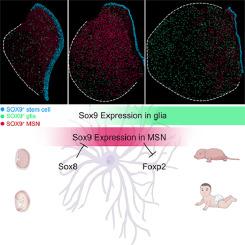
Striatum, as the largest structure of the basal ganglia, serves as a center for information transmission and is critical for motor function and reward perception. However, the genetic mechanisms underlying its development require further exploration. Here, we found that Sox9, traditionally recognized as a glial marker, is uniquely expressed in striatal medium spiny neurons (MSNs), especially in Drd2-expressing indirect pathway MSNs (D2-MSNs). Intriguingly, Sox9 expression in the striatum, which is conserved in humans, is a dynamic process. It maintains a high level during the perinatal stage, and exhibits low expression levels or vanishes at the embryonic and postnatal stages, respectively. The peak period of Sox9 expression coincides with the transition from neurogenesis to synaptogenesis. Importantly, gene regulatory network analysis and gain-of-function experiments confirmed Sox9 is strongly correlated with synaptogenesis. Moreover, we identified that Sox9 regulates synaptogenesis by repressing Foxp2, a well-known synapse regulator. Furthermore, we demonstrated that the biased expression pattern of Sox9 in D2-MSNs is, at least in part, regulated by another SoxE family member Sox8, which is specifically expressed in Drd1-expressing direct pathway MSNs (D1-MSNs). Taken together, our findings reveal a new marker of D2-MSNs and identify its distinctive function in striatal development.





 京公网安备 11010802042870号
京ICP备2023020795号-1
京公网安备 11010802042870号
京ICP备2023020795号-1

 分享
分享
 求助内容:
求助内容: 应助结果提醒方式:
 扫码关注我们
