{"title":"One thought too few: An adaptive rationale for punishing negligence.","authors":"Arun Sarin, F. Cushman","doi":"10.1037/rev0000476","DOIUrl":null,"url":null,"abstract":"Why do we punish negligence? Some current accounts raise the possibility that it can be explained by the kinds of processes that lead us to punish ordinary harmful acts, such as outcome bias, character inference, or antecedent deliberative choices. Although they capture many important cases, these explanations fail to account for others. We argue that, in addition to these phenomena, there is something unique to the punishment of negligence itself: People hold others directly responsible for the basic fact of failing to bring to mind information that would help them to avoid important risks. In other words, we propose that at its heart negligence is a failure of thought. Drawing on the current literature in moral psychology, we suggest that people find it natural to punish such failures, even when they do not arise from conscious, volitional choice. This raises a question: Why punish somebody for a mental event they did not exercise deliberative control over? Drawing on the literature on how thoughts come to mind, we argue that punishing a person for such failures will help prevent their future occurrence, even without the involvement of volitional choice. This provides new insight on the structure and function of our tendency to punish negligent actions. (PsycInfo Database Record (c) 2024 APA, all rights reserved).","PeriodicalId":5,"journal":{"name":"ACS Applied Materials & Interfaces","volume":"509 30","pages":"812-824"},"PeriodicalIF":8.2000,"publicationDate":"2024-04-01","publicationTypes":"Journal Article","fieldsOfStudy":null,"isOpenAccess":false,"openAccessPdf":"","citationCount":"0","resultStr":null,"platform":"Semanticscholar","paperid":null,"PeriodicalName":"ACS Applied Materials & Interfaces","FirstCategoryId":"102","ListUrlMain":"https://doi.org/10.1037/rev0000476","RegionNum":2,"RegionCategory":"材料科学","ArticlePicture":[],"TitleCN":null,"AbstractTextCN":null,"PMCID":null,"EPubDate":"","PubModel":"","JCR":"Q1","JCRName":"MATERIALS SCIENCE, MULTIDISCIPLINARY","Score":null,"Total":0}
引用次数: 0
Abstract
Why do we punish negligence? Some current accounts raise the possibility that it can be explained by the kinds of processes that lead us to punish ordinary harmful acts, such as outcome bias, character inference, or antecedent deliberative choices. Although they capture many important cases, these explanations fail to account for others. We argue that, in addition to these phenomena, there is something unique to the punishment of negligence itself: People hold others directly responsible for the basic fact of failing to bring to mind information that would help them to avoid important risks. In other words, we propose that at its heart negligence is a failure of thought. Drawing on the current literature in moral psychology, we suggest that people find it natural to punish such failures, even when they do not arise from conscious, volitional choice. This raises a question: Why punish somebody for a mental event they did not exercise deliberative control over? Drawing on the literature on how thoughts come to mind, we argue that punishing a person for such failures will help prevent their future occurrence, even without the involvement of volitional choice. This provides new insight on the structure and function of our tendency to punish negligent actions. (PsycInfo Database Record (c) 2024 APA, all rights reserved).
期刊介绍:
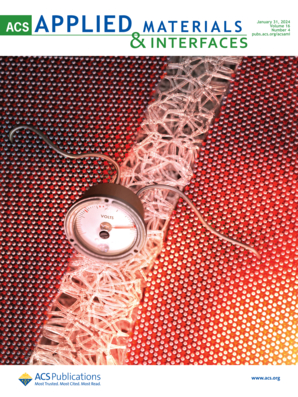
ACS Applied Materials & Interfaces is a leading interdisciplinary journal that brings together chemists, engineers, physicists, and biologists to explore the development and utilization of newly-discovered materials and interfacial processes for specific applications. Our journal has experienced remarkable growth since its establishment in 2009, both in terms of the number of articles published and the impact of the research showcased. We are proud to foster a truly global community, with the majority of published articles originating from outside the United States, reflecting the rapid growth of applied research worldwide.



 京公网安备 11010802042870号
京ICP备2023020795号-1
京公网安备 11010802042870号
京ICP备2023020795号-1

 分享
分享
 求助内容:
求助内容: 应助结果提醒方式:
 扫码关注我们
